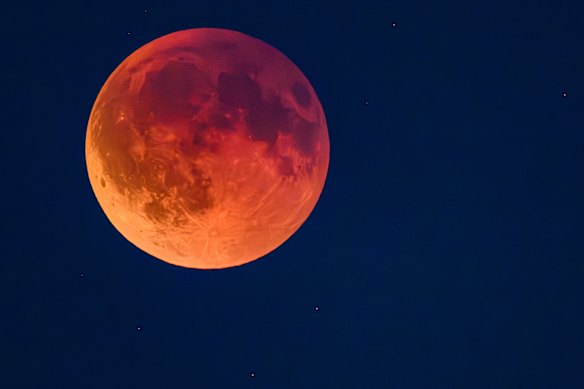

Australians will enjoy a front-row seat to a spectacular lunar eclipse on Tuesday night, marking the last of the phenomenon anywhere on Earth until 2029.
The total lunar eclipse, also known as a blood moon, will cast a shadow that turns the moon to a deep shade of red. It will be visible across Australia, weather permitting.
Here’s what you need to know ahead of the blood moon.
What is a blood moon?
Total lunar eclipses happens every 18 months to three years, when Earth aligns perfectly between the moon and sun, blocking the sun’s light and casting a shadow onto the moon. A blood moon occurs when the moon appears red during an eclipse.
Laura Driessen, an astrophysicist at the University of Sydney, said the moon’s dark reddish and orange appearance could be explained by the filtering of sunlight through Earth’s atmosphere during the eclipse.
“As sunlight filters through Earth’s atmosphere, shorter blue wavelengths scatter while longer red wavelengths bend towards the Moon – giving rise to the dramatic ‘blood moon’ effect,” Driessen said.
When can I see it?
The partial eclipse, where the Earth’s shadow begins to cross the Moon, will start at 8.50pm in Sydney and Melbourne. This will be 7.50pm in Brisbane, and 8.20pm in Adelaide.
The blood moon, or total eclipse, will start a little more than an hour later. It’s estimated to begin at 10.04pm in Sydney and Melbourne, 9.04pm in Brisbane and 9.34pm in Adelaide. Perth will see the total eclipse from 7.04pm.
The Moon is expected to remain fully inside Earth’s shadow for about an hour. It will leave the Earth’s shadow at 11.02pm in Sydney and Melbourne, 10.02pm in Brisbane, and 10.32pm in Adelaide.
The full eclipse will end in Perth at 8.02pm.
What’s the history of the blood moon?
Blood moons have captivated humans for thousands of years, inspiring several myths and legends across the world, and they were often thought to be bad omens.
They’re now viewed as something “even more powerful”, according to Swinburne astrophysicist Rebecca Allen: “A breathtaking reminder that we are living on a moving planet, in a dynamic solar system, just one small, wonderful world, drifting through space.”
Where is best to view it?
The blood moon will be best observed in a dark location, away from bright lights. However, the blood moon should be visible regardless of location, provided the view of the moon isn’t obstructed.
Stargazers are advised to allow up to 15 minutes for their eyes to adjust to the colours from the blood moon, and to prepare their cameras ahead of the total eclipse beginning.
The Moon should be high in the sky when the total eclipse is occurring, making it particularly easy to view. Allen noted that Jupiter will also be high in the sky around the time of totality, making for a “great pairing”.
What exactly are you likely to see?
Whether the blood moon is a deep red, bright copper or something in between will depend on how much smoke or dust is in Earth’s atmosphere at the time of the eclipse, according to Macquarie University astrophysicist Devika Kamath.
“This should be a beautiful and very noticeable total lunar eclipse,” Kamath said.
“The colour comes from sunlight being refracted through the atmosphere and into Earth’s shadow – effectively lighting the Moon with the combined glow of every sunrise and sunset around the planet.”
When is the next eclipse?
Kamath said Tuesday’s blood moon would be the “standout” eclipse on the stargazing calendar, and that the following lunar eclipses were expected to be “less dramatic”.
This includes a partial lunar eclipse in August, and an “almost” lunar eclipse in July 2027. Stargazers will see a subtle dimming in the sky during these events, but won’t be the same as the “true total eclipse” expected on Tuesday.
What other special moons are there?
Other special full moons include:
- Blue moon: not blue in colour or otherwise irregular in appearance, it’s the third full moon in a season with four full moons, or the second full moon in a month. It happens about every 2.5 years.
- Supermoon: occurs when the full moon is at its closest to Earth, appearing 14 per cent larger and 30 per cent brighter at this point than the furthest point of its orbit. It creates a dramatic, glowing moon that, in the right conditions, illuminates the night sky.
- Harvest moon: the name given to the supermoon falling closest to the September equinox, hailing from a time when northern hemisphere farmers used the moon’s increased brightness to gather crops.
- Hunter’s moon: the name given to the supermoon following the harvest moon, traditionally linked to hunting and food storage ahead of the northern hemisphere winter.
Get to the heart of what’s happening with climate change and the environment. Sign up for our fortnightly Environment newsletter.
 Daniel Lo Surdo is a breaking news reporter for The Sydney Morning Herald. He previously helmed the national news live blog for The Sydney Morning Herald and The Age.Connect via email.
From our partners
Disclaimer : This story is auto aggregated by a computer programme and has not been created or edited by DOWNTHENEWS. Publisher: www.smh.com.au