Par
Like “muckraking” and “gag order,” par came to the world via a journalist bending the language. In this case, one Alexander Hamilton (A.H.) Doleman, an amateur golfer and writer from Scotland who competed in the 1870 British Open at Prestwick, asked professional counterparts Davie Straith and James Anderson to predict a winning score. After conferring, the pair said a perfect outing on the 12-hole course would amount to 49.
Par comes from Latin and means “equal” or “equality.” At the time of the championship, Brits used the word to describe a stock’s average performance; one could trade above or below that standard. A few days later, when Young Tom Morris shot a 149 over the three-round competition to win his third straight Championship Belt, Doleman wrote that he’d finished two “over par.” Doleman himself finished 20 shots back, which is why his greatest contribution to the game is linguistic.
Even that success took time, though. The first standardized Course Rating system didn’t emerge until the 1890s, and par itself didn’t gain official recognition until 1911, when the USGA codified a rating standard that called it “perfect play without flukes and under ordinary weather conditions, always allowing two strokes on each putting green.” The R&A followed suit in 1925.
Robert Neubecker
Bogey
Bogey originally meant what par does today in the sense that it represented the target score for any given hole. That definition emerged in 1890, when the secretary of Coventry Golf Club in England, Hugh Rotherman, established a scoring standard at his club. He called the target total a “ground score.”
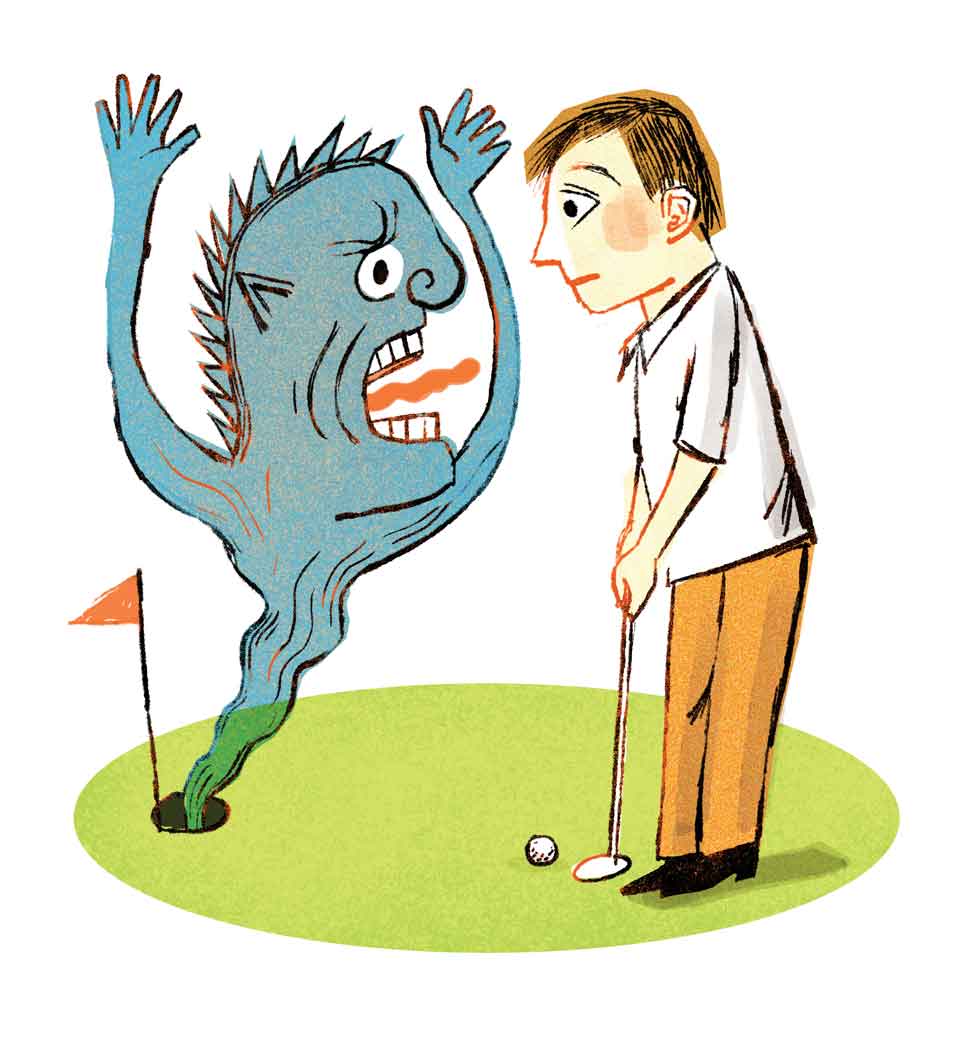
For the Scots, since the 1500s, a “bogey” represented a demon or gremlin, leading to the term “bogey man” and a popular song of the 1880s called “Hush! Hush! Hush! Here Comes the Bogey Man.” By then the term connoted an elusive figure who was difficult to capture, something like the modern Bigfoot.
As the ground score concept spread, golfers replaced that phrase with “bogey score” and adopted the idea that they were chasing or competing against Mr. Bogey. A good player might be called a real “bogey man” and anyone who fell short of the standard “lost to Mr. Bogey.” At the United Services Club, open only to the military, they altered the persona to Colonel Bogey, who stood guard for decades.
As equipment and courses improved, good golfers could easily beat the Colonel and “par” emerged as a target score for pros and proficient amateurs. It was well into the 20th century when U.S. golfers began to use bogey as a term meaning 1 over par, which at the time was just another reason for the game’s founders to dislike Americans.

Robert Neubecker
Birdie
“Bird” was “lit” before it became birdie, if that makes sense. The standard term for shooting 1 under par on a hole is purely American, and it derives from the slang term “bird,” which at the dawn of the 1900s meant anything excellent.
Its specific application to golf, according to legend, traces to Atlantic City (N.J.) Country Club, where A.B. Smith, his brother, William, and George Crump, who designed Pine Valley Golf Club, were playing the second hole. A.B. hit his second shot close on the par 4, and when he tapped in for a 3, called it “a bird of a shot.” After that, the threesome began calling any such feat a “birdie,” and it stuck. The club commemorated the event with a plaque that puts the date at 1903.
The Americans weren’t done with birds. The eagle landed on 2 under par for a hole shortly after the arrival of birdie, with A.B. Smith and friends again claiming credit, although the term wasn’t fully accepted everywhere until the 1930s. The logic was simple enough — if a regular old bird was good, the symbol of the U.S. must be even better.
Smith and his companions used double eagle for 3 under, but that nomenclature was largely undone by a different bird, the albatross, which emerged as the preferred choice in the 1920s. The exact derivation appears to have gone undocumented, although the species brings a logical continuity since it’s a majestic and exceedingly rare bird.

Robert Neubecker
Caddie
This is where the story of the game detours to France. There are written references to “golf” in France dating to the 1400s, and many speculate that caddie comes from the French word “cadet,” which means “boy.” As the story goes, Mary, Queen of Scots, encountered the word on her travels and brought it back to her homeland, where it came to refer to anyone working as a porter or messenger. Eventually, it made the leap to golf.
That sounds tidy enough, but there’s a problem. Other historians say the French didn’t play golf at the time of Mary’s visit, but a different game that used only one club, for which a caddie wouldn’t have been necessary. Whatever the truth, Mary spoke French, as did many nobles, and “cadet” made its way to Scotland (as did “dormie” from the French “dormir,” meaning “to sleep”) and became “caddie” by the 1600s. Dictionaries tagged it as a golf-centric term by the mid-1800s.
Robert Neubecker
Fore
It feels like “fore” should simply be a shortened version of “foreword,” used as a general warning to those ahead of you. It’s not.
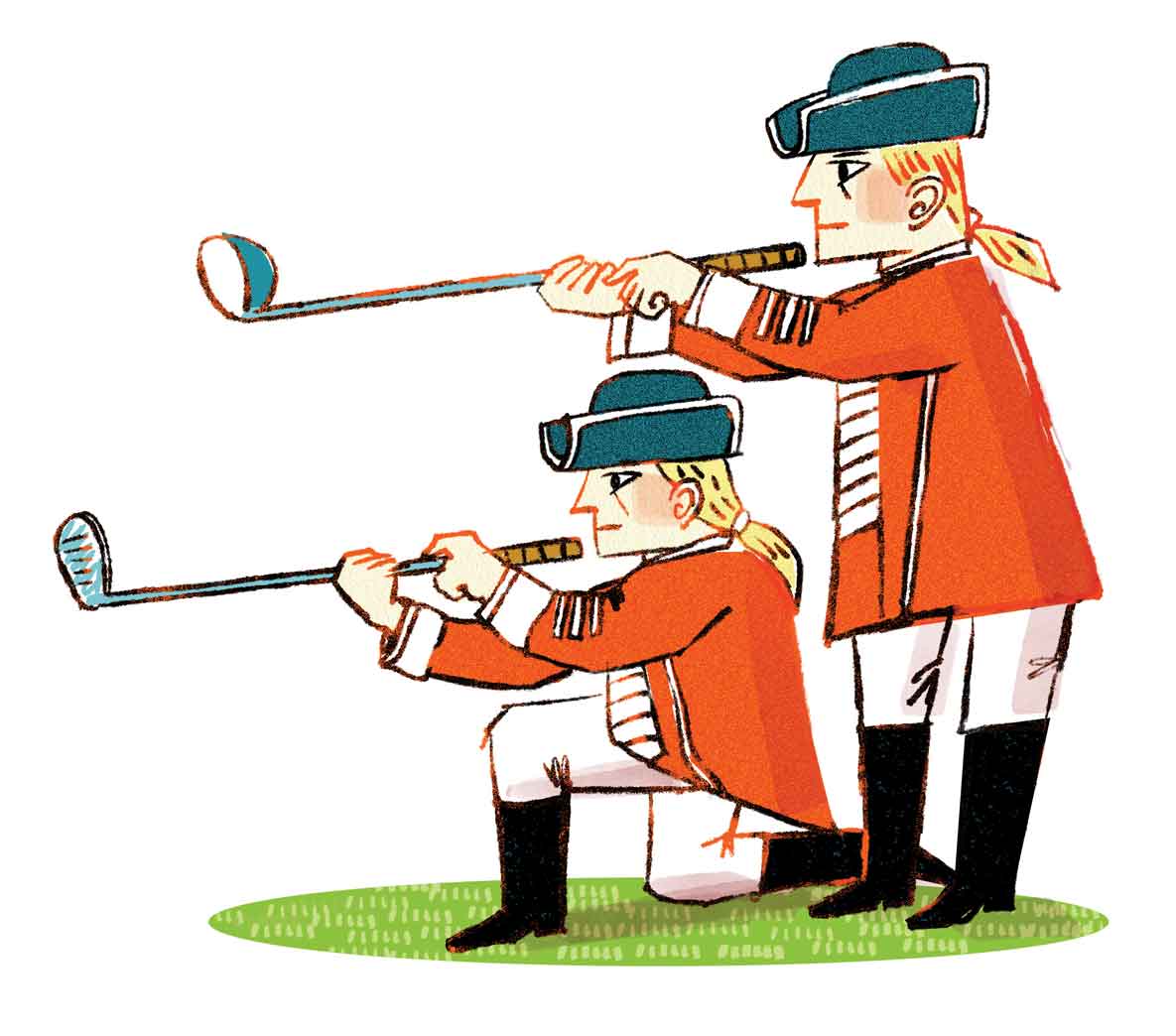
A more fun possibility revolves around military history, particularly the formations of riflemen aligned in rows, with one set kneeling in front of a standing set. “Beware foreword” served as a warning to the soldiers in front when the back row was firing and, according to the theory, that eventually morphed into “fore.” There’s a particular connection to Leith Links in Edinburgh, Scotland, which stood next to a fort, bringing soldiers and golfers into close contact, although the warning there related to a pair of cannons flanking the entry. Either way, it puts the fear of getting plunked by a small white orb into perspective.
A second option concerns forecaddies, which were popular in the age of the feathery ball, because they were expensive and hard to make. To keep track of those leather-wrapped projectiles, forecaddies would stand in the landing area. Before hitting, golfers would yell “forecaddie” to alert his man that the ball was incoming. Eventually, they shortened the warning to “fore.” This, as has been noted, holds a certain logical appeal, since the words “caddie,” “forecaddie” and “fore” all emerged around the same time.

Robert Neubecker
Golf
They say success has 1,000 fathers, which might explain golf’s unresolved paternal roots.
Contenders for the title include colf, kolf, chole, kolbe and kolven, all of which basically mean “club” and are associated with some sort of game that involves hitting an orb with a stick. Some historians trace them back to the ancient Greek word kolaphos or the Latin words colapus or colpus, meaning “to strike” or “to cuff.” The games also seem to have some root in the Roman game paganica, which featured a feather-stuffed ball hit with a curved stick and was spread throughout Europe by the conquering legions.
Other experts propose that the Dutch game kolf — played with a stick and ball on frozen canals or fields – migrated across the North Sea to Scotland. Of course, it doesn’t help that once the game arrived the Scots called it all kinds of names, including goff, goif, golf, goiff, gof, glove, gowf, gouff and gowfe. In Gaelic, the word is goilf.
The truth is elusive, but all that matters is that at some point the Scots began playing a game directly related to the current version of the sport and agreed to call it “golf.” Back then, they may have even “golfed,” but no one does that anymore. At least not if they really know what they’re talking about.
Disclaimer : This story is auto aggregated by a computer programme and has not been created or edited by DOWNTHENEWS. Publisher: golf.com