Updated ,first published
THEATRE
Es & Flo
Old Fitz Theatre
February 15
Reviewed by CASSIE TONGUE
★★★
Mardi Gras season offers us time to reflect on LGBTQIA+ rights – those that are hard-won and those we’re still fighting for – and in theatres across Sydney, companies are spotlighting stories from, by, and for the queer community. The Old Fitz Theatre’s contribution this year is Es & Flo by British playwright Jennifer Lunn, and it arrives with arms outstretched – part embrace, partly prepared to tug at your heartstrings.
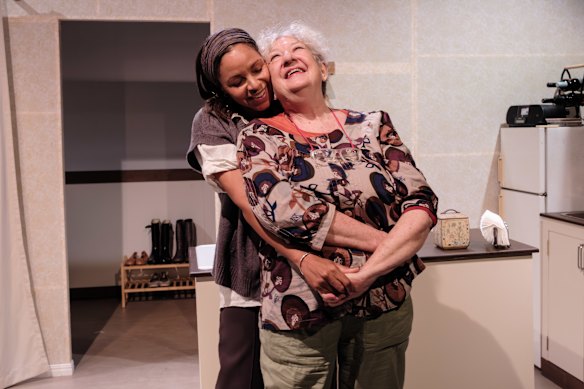
Es (Annie Byron) is celebrating her 71st birthday with her partner Flo (Fay Du Chateau). The couple has been together for decades, so it’s a relatively low-key affair with cake and cups and tea. They have an easy, worn-in affection; there are still plenty of sparks.
But Es has been forgetting things; she might need more than the care Flo is able to give. When Es’s son from a previous marriage raises some alarm bells, the couple’s carefully protected peace (Es has never come out) might just be ruptured forever.
Es & Flo, set in 2023, is a reminder that more rights or acceptance today cannot go back in time and heal generations shaped under more repressive societies. Es and Flo are activists – they met and fell in love at Greenham Common Women’s Peace Camp back in the 1980s, where they protested nuclear weapons – but Es, a schoolteacher by trade, was still boxed in by Margaret Thatcher’s notorious Section 28 legislation that prevented teachers and other authorities from “promoting homosexuality”.
She has carefully cultivated a serene bubble with Flo, known to Es’s son and his wife Catherine (Eloise Snape) as a long-time friend and lodger. She’s even reluctant to share with new home carer Beata (Charlotte Salusinszky), and her daughter Kasia (Erika Ndibe), even though it’s more important than ever that those with Es’s best interests at heart can legally and fully protect her.
Directed by Emma Canalese, this is a warm-hearted production. In her hands, the characters are grounded and the emotional plot points – which compound and escalate with every scene – are noisy without being overwhelming. There’s a pleasing accessibility to the performances, if not quite the depth that makes these people burrow inside your heart, though Snape in particular is remarkable as Catherine slowly finds her voice.
Part of the problem lies in the script; it’s a debut work with strong ideas, but it is occasionally overwrought and favours repetition rather than finding new ways to deepen those ideas. The ending arrives abruptly and a little too smoothly; the story, with all its layers of trauma, despair, and hardship, starts to have a dulling effect instead of burrowing into the heart.
Despite these issues, it’s still refreshing to see a story about women not often granted the spotlight. It’s sobering remember that many couples – more than we think – are still living lives of compromise and old wounds and missed opportunities even if we have landed in a more comfortable future. It’s a reminder of the precarity of all our civil rights; it’s a reminder to take care of each other when systems fail us.
THEATRE
THE NORMAL HEART
Sydney Opera House Drama Theatre, February 12
Until March 14
Reviewed by JOHN SHAND
★★★★
“Whoever thought you’d die from having sex?” asks Felix late in this play. AIDS has killed about seven times more people than COVID, behind which statistic lie value judgments made by governments, pharmaceutical companies, religious organisations, the medical profession and perhaps the public at large.
Larry Kramer’s 1985 play is semi-autobiographical, in that he, like his character Ned Weeks, was a gay writer in New York City, wondering why his friends were dying.
Evan Lever. Neil Bennett
Soon enough, he was desperately trying to spread the word of the first doctor to treat numerous cases, Dr Linda Laubenstein (renamed Emma Brookner in the play): that sex might be one of the ways the virus spread. Weeks’ mission, to convince gay men to stop copulating when they’d only recently begun to feel sexually liberated, met fierce repudiation in his community.
Kramer’s play is well crafted, except that’s its near verbatim nature is also its minor flaw: an inbuilt stasis resulting from Weeks’ ever-mounting anger in the face of the surging deaths of friends, lovers and the lovers of friends.
Mitchell Butel, Sydney Theatre Company’s artistic director, makes a welcome return to our stages as Ned in this STC resurrection of a 2022 State Theatre Company South Australia production, directed by Dean Bryant.
“Weakness terrifies me,” Ned tells Felix, and true to his word, he deals predominantly in outrage, confrontation and belligerence. Butel mostly excels at giving Ned the requisite intensity, without overcooking it to the point where virtually every exchange becomes a shouting match, with no nuance to the scale of the climaxes. He’s even better when restraining Ned’s rage, quivering and almost leaping out of his own skin.
Much of that rage is directed at Bruce, the reserved banker who’s made president of the organisation Ned founds to fight AIDS. Every cause needs warriors and diplomats, and the gifted Tim Draxl shines at remaining almost infuriatingly mild-mannered in the face of the growing horror.
Perhaps outstripping both Butel and Draxl is Nicholas Brown as Felix, the love of Ned’s life. Brown gives Felix such glowing warmth that even his more philosophical statements never sound pontificating, and Bryant creates a glorious moment when Felix first visits Ned’s apartment. They each have a beer, and when Felix deposits his on the glass coffee table, Ned whips a coaster beneath it the with the sudden comedic flourish of a magician. (Bryant also has his actors linger unnecessarily at the end of some scenes with what in film would be reactions shots.)
Amid a cast of nine, Emma Jones, playing the no-nonsense Dr Brookner, is torrential delivering her diatribe when denied research funding, Mark Saturno stands out with his gradual softening of Ned’s straight brother, Ben, and Keiynan Lonsdale brings an elfin lightness to Tommy.
The ending packs the intended emotional punch, by which time Ned is learning, as Felix suggests, to be a little more patient and forgiving.
MUSIC
Australian Chamber Orchestra
City Recital Hall, February 10
Until February 18
Reviewed by HARRIET CUNNINGHAM
★★★★
It’s hard to know where it begins. A low rumble, not quite a note but not quite a noise, barely rising above the patchy pre-concert silence of shuffles and breaths. A distinct phrase or ostinato emerging from the fuzzy palimpsest from time to time, a moment of near clarity to intrigue the ear, before melting back into the whole.
This is Horizon, a new work – in fact, a diptych – by composer and activist John Luther Adams. The two parts have their world premiere on alternate nights, in this, the ACO’s first Australian tour for the year. (They will also give the US premiere later this year, and record both parts for CD release in April).
Visible Horizon (or is it True Horizon? We aren’t told) is mesmerising, its pulse-free, shapeless rise and fall somehow rewiring my attention span to remain engaged for the entire work. I would be fascinated to experience the entire 40-minute span.
Stravinsky’s Concerto in D Basle, by contrast, arrives with pinpoint precision and no time to lose. This is the kind of work that showcases the ACO as a tight-knit band of soloists: staccatos underpinned by pizzicato, or bulging thick chords, played in tight unison, like a musical hive mind.
De Profundis makes an ideal companion piece to the Stravinsky. An early work of Latvian composer Raminta Serksnyte, it channels youthful anxieties and emotions into a compelling tumble that, like the Stravinsky, explores the full range of textures available to a string orchestra. Artistic director Richard Tognetti goads the ensemble into a fiery, take-no-prisoners account.
Pianist Dejan Lazic arrives on stage for the headline work of the concert, Rachmaninoff’s Rhapsody on a Theme of Paganini. Lazic is a delightful partner-in-crime for this not entirely successful arrangement for piano, strings and percussion, making up for the orchestral technicolour of the original with a micro-flamboyant exploration of moods across the 24 variations.
His performance flips the work from grand circus back to a marvel of ingenuity, piecing together glittering fragments into a dramatic whole.
MUSIC
Laneway Festival
Centennial Park, February 8
Reviewed by GEORGE PALATHINGAL
★★★★½
On a day that started more pink poncho club than Pink Pony Club, Laneway – Australia’s premier rock festival pretty much since its 2005 Melbourne debut made the Big Day Out look relatively basic – once again excelled.
A little bit, or even a biggish bit of afternoon rain was never going to stop the thousands of largely Millennial young adults who turned out to see the world’s hottest and coolest acts.
It started especially strongly, with Frankston, Vic’s Belair Lip Bombs serving delicious alt-rock jangle at one end of the park, before we spent much of the afternoon doing laps of Centennial to see what was going on everywhere else.
Happily, to get to the other end you passed the main stages in the middle, so even if you made the trek to encounter a relative dud on the electronic-friendly (but handily covered) stage you’d catch something fantastic in the middle: the moving, acoustic prettiness of a Gigi Perez, say, or Lucy Dacus making her take on maudlin indie somehow work to thousands in a field, too.
Still, past the activations for beauty brands and movies (one opportunity I didn’t take was to get my hair done like Margot Robbie in Wuthering Heights), French enigma Oklou was gently mesmerising in that electronic tent, while solo party-starter The Dare had a solid crack at tearing the roof off it a bit later.
The truly alternative Geese, equal parts mind-blowing and borderline nonsense, appeased the chin-stroking cognoscenti before the big finish on the main stages, starting with superlative Brit indie-rockers Wet Leg and the intoxicating charisma of their frontwoman Rhian Teasdale – the first of two musical icons-in-waiting on that stage.
The other, of course, was headliner Chappell Roan, who has, in just the past couple of years, become the most exciting pop star in recent memory. Her set, all vamp and camp in the best way, was drawn from her only album The Rise and Fall of a Midwest Princess and a handful of singles (with a scorching cover of Heart’s Barracuda thrown in for good measure).
It already sounds like a greatest hits collection and only the hardest-hearted indie snob would say otherwise.
And, at a Laneway powered predominantly by female or female-featuring acts – possibly deliberately, more likely just because they’re currently the best around (late bonus shout-out to Canberra rock bad-arses Teen Jesus and the Jean Teasers and Kiwi charmer Benee) – seeing Roan rule it so magnificently was a delight.
MUSIC
Bach’s Motets
Bach Akademie Australia and The Song Company
Mosman Art Gallery, February 8
Reviewed by PETER McCALLUM
★★★★
Scholars remain unclear about the intended purpose of some of Bach’s motets, but musicologist Christoph Wolff suggests they were used, in part, to train singers in the difficult demands of his music.
To sharpen their minds, musicians were fined one groschen (the price of two quarts of ale) for an accidental mistake, and three groschen for a deliberate slip-up. The Bach Akademie and Song Company’s performance of the seven motets now confidently attributed to Bach would scarcely have refreshed the coffers.
It was concentrated and rewarding – concentrated because of the music’s rich complexity of design and texture, and rewarding because of the Song Company’s superb mastery of interweaving vocal polyphony.
Performed by eight Song Company members arranged in an arc against the high brick wall of the former church that is now Mosman Art Gallery, with four players from the Bach Akademie providing continuo accompaniment, the sound from my vantage point towards the back was vivid, and clear, although it included the acoustic quirks that give such buildings their individuality.
Occasionally, notes or parts were boosted unexpectedly. As a violinist, Bach Akademie musical director Madeleine Easton conducted like an instrumentalist, which was not out of place in the instrumentally inspired figuration of the opening motet Lobet den Herrn, BWV 230 although it set a challenge for the singers, albeit one they met handsomely.
The halting phrases at the start of Komm, Jesu komm had clipped brightness opening out to mellifluous phrases that were slightly missing from the earlier motet. Sandra Milliken’s Herr Jesus Christus began with low hummed sounds from the male singers before translucent yet sombre chorale-like passages from the upper voices established the music’s tread.
At expressive moments, the harmonies modulated vertiginously as though momentarily becoming unanchored. Ich lasse dich nicht BWV 1164 (previously thought to be by Johann Christoph Bach, cousin once removed of Johann Sebastian) and Der Geist hilft unser Schwachheit auf BWV 226 ended the first half, the latter threatening to rattle the fine jar at one tricky moment, although it was small beer.
After an involving reading of Furchte dich nicht BWV 228, cellist Daniel Yeadon gave an unassuming and intimate performance of the Prelude from Bach’s Cello Suite No. 2 in D minor BWV 1008.
A highlight of the concert was Jesu Meine Freude, BWV 227, particularly the beautiful delicacy of the ninth movement in which sopranos Susannah Lawergren and Michelle Ryan coaxed phrases with exquisite delicacy against tenor Christopher Watson, punctuated by warm soft phrases of the chorale from the altos.
O Radiant Dawn by Scottish composer James MacMillan had well-shaped intensity before the glorious eight-part complexity of Singet dem Herrn ein neues Lied , BWV 225 erupted with brilliant agility and exhilarating joy.
THEATRE
Purpose
Wharf 1 Theatre, February 6
Until March 22
Reviewed by JOHN SHAND
★★★★
Faith has been a fickle mistress for Solomon Jasper. She’s steeled his will in the fight for Civil Rights, but failed to assuage his disappointment in his sons, or prevent his leaving an illegitimate brood in his wake. So Solomon, a retired living treasure among African Americans, has turned to beekeeping. Bees, you see, know their purpose in life. So did Solomon. Once.
American playwrights have focused on dysfunctional families with gleeful zeal. Branden Jacobs-Jenkins follows the hallowed tradition of O’Neill, Williams, Miller and Albee, except he elevates the Jaspers’ dysfunctionality to the grotesque.
His theatrical masterstroke is a narrator to steer us through the labyrinth of interlocking hostilities, and tease us with what’s to come. That’s Nazareth, the younger son of Solomon and matriarchal wife Claudine – Naz to all but his father. Naz must be affable, amusing and just a little quirky because he’s neurodivergent to an unspecified degree. Tinashe Mangwana is ideal in director Zindzi Okenyo’s STC production, making credible this asexual creature who delights in solitude while photographing nature.
Naz has just donated sperm to his lesbian friend Aziza, when she drops him off at his parents’ place. All would have been well had she not had to return a forgotten phone charger, by which time the snow’s setting in, and Claudine insists Aziza stay.
If that sounds like the set-up for a melodrama, in part it is, for this play is a many-headed monster: questioning the purpose of life and the viability of marriage; interrogating fame, reputation and accepting one’s children as they are. It even becomes a grim comedy.
The flaws in Okenyo’s production show when the melodrama holds too much sway, and the anger is too relentless. In all other regards, this is an exemplary production of a singular play that would swiftly expose pretenders in the cast. Okenyo’s is strong, with Markus Hamilton as the sternly patriarchal, deeply flawed Solomon. Deni Gordon plays Claudine, and while she has minor lapses, she’s convincing as the only person on earth who can lord it over Solomon.
Sisi Stringer is charismatic as the livewire Aziza, who didn’t know Naz came from this famous family, nor that his real name was Nazareth. Now she’s not so sure about his fathering of her child. Maurice Marvel Meredith excels as the elder son, Solomon Junior, a politician mired in white-collar crime, with the family assemblage celebrating his release from prison as well as Claudine’s birthday.
Junior’s wife, the feisty Morgan (about to do her own time, now that Junior’s out, as they have two young boys), is brilliantly realised by Grace Bentley-Tsibuah. Morgan has wised up, before anyone else, to the Jaspers not exactly being angels of black excellence.
Jeremy Allen’s set is as lavish as the Jaspers are larger than life, and this is an auspicious start to artistic director Mitchell Butel’s STC programming.
MUSIC
OneRepublic
Qudos Bank Arena, February 6
Reviewed by MILLIE MUROI
★★★½
If there’s one thing a performer dreads, it’s coming down with an illness on tour. For OneRepublic frontman Ryan Tedder, the show must go on and, fuelled by sips of tea between songs, he delivers.
Sure, it’s possible to hear a slight huskiness when he reaches for the high notes, and there are points – especially later on in the show – when he seems to be either saving his voice or is just plain fatigued.
But he and his band make it worth the while. The production is well done with simple but effective lighting and imagery, but it’s Tedder’s interpretation that adds spice to the band’s songs.
Switching between high to low registers, and adding vocal twists and runs, Tedder has an instinct for playing with his songs vocally without losing the essence of the number – or doing it just because he can.
Some of OneRepublic’s early hits such as Good Life are crowd pleasers yet benefit from Tedder’s renewal. Lesser known song Life in Colour – which he says the band should have put more in the spotlight on release in 2013 – also gets its time in the sun as its soft instrumentals complement Tedder’s intentional, emphatic and intimate take on the song.
Perfect execution of songs as they’ve been heard before can be pleasant, but in this show the added flair and vocal acrobatics imbue the music with a flavour you won’t hear in OneRepublic’s discography.
There are no jaw-dropping moments or goosebumps, but a solo segment with Zach Filkins on Spanish guitar is a highlight, as is the preview of their song Need Your Love to be released later this year: a catchy and promising medley of rock, hip hop and pop.
Tedder’s keyboard prowess is also impressive. Having written chart-toppers including Halo (ostensibly penned as he gazed at a photo of Jay-Z and imagined what it must be like for Beyoncé to love him), and Bleeding Love sung by Leona Lewis, Tedder adds enchanting detail to these scores when he plays them on piano.
After a mellow middle section, the show is jam-packed as it ends, with best known songs such as Counting Stars, Apologise and I Ain’t Worried bringing it back to life.
Eighteen years after their first Sydney appearance, OneRepublic show why they are still masters of music. They are versatile, polished and adventurous – even with a lead singer nursing his vocal chords on stage in real time.
 John Shand has written about music and theatre since 1981 in more than 30 publications, including for Fairfax Media since 1993. He is also a playwright, author, poet, librettist, drummer and winner of the 2017 Walkley Arts Journalism AwardConnect via X.
 Millie Muroi is the economics writer at The Sydney Morning Herald and The Age. She was formerly an economics correspondent based in Canberra’s Press Gallery and the banking writer based in Sydney.Connect via X or email.
From our partners
Disclaimer : This story is auto aggregated by a computer programme and has not been created or edited by DOWNTHENEWS. Publisher: www.smh.com.au