
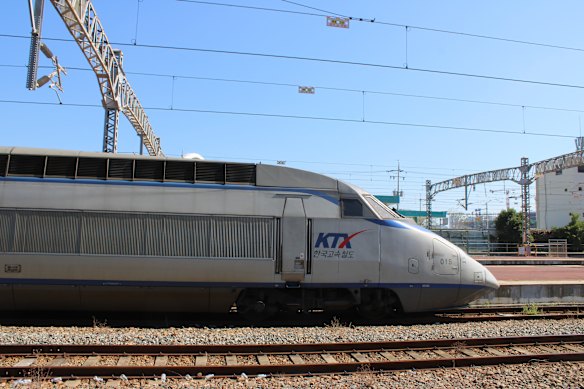
It must be approaching election time again, as this old chestnut – the high-speed rail – has been resurrected (“High-speed rail journey to cost $31”, February 25). Yet again, we are told about the possibility of an unfeasible dream. And guess what, at a mere $90 billion, our premier is securing his votes in the electorates around Newcastle just in time for the elections in 2027. Then, with the federal government pitching in $230 million, promising the project will be “shovel ready” for a final decision on construction in 2028 – just in time for the federal election – Labor is hoping those seats will be secured. Why do the politicians think this figment of their imagination will fool us all again? For a true perspective of this electioneering ploy, I recommend readers view episode three of the first series of Utopia: “Very Fast Turnover”. Meanwhile, the Great Western Highway, a major transport and freight route from the Central West to Western Sydney Airport via the Blue Mountains, has received nothing but unfunded investigations and alternative route studies since 2007, with the latest being the Sydney to Central West Corridors White Paper. Oh, I forgot. That corridor runs through safe Labor seats. Eva Johnstone, Blackheath
It’s hard to see how people rushing back and forth from Brisbane to Melbourne at great speed will do any good for ordinary folk. It is said to “boost the economy”, but the economy is just people buying and selling goods and services to each other or overseas. Faster intercity travel for individuals won’t benefit farmers, graziers or even wholesalers (there are no manufacturers left in the cities to benefit). Office workers are well served already by electronic means. Where’s the rush? Bruce Graham, Waitara
The proposed Sydney-to-Newcastle high-speed rail doesn’t seem to make a lot of sense if, as suggested in the article, the fare would be $31, and the equivalent car trip would be $48 (and even cheaper in an EV). If you had even one passenger, taking a car would be cheaper and take you where you want to be. From here, near Hornsby, I had to do service calls or installations in Newcastle a few times and I could drive it in about 90 minutes. Even when I lived in Rydalmere it was only about two hours, and even with a high-speed train, by the time I got to Central to catch it, any time savings would have been eaten up. Richard Jary, Waitara
If the folks who run this high-speed rail boondoggle are smart, they’ll charge us the bargain price of $31 to travel to Newcastle, but considerably more to return to civilisation, which we will of course willingly pay. Peter Fyfe, Enmore
It is outrageous that the Albanese government is thinking of spending $90 billion on high-speed rail. For that amount, we could ask the US to provide us with two more nuclear subs. Neil Austen, Collaroy Plateau
The best way to unlock land for new homes is to achieve greater frequency, speed and reliability on the existing rail network. Removing freight is the enabler. It is now NSW government freight policy to build the “Sydney Orbital”, which is a rail freight line linking the Port of Newcastle, outer-western Sydney and Port Kembla. The Orbital can be funded by sending all containers by rail through the Port of Newcastle, compared with trucking them through heavily congested Port Botany. The benefits are: Removing freight from the Newcastle-Sydney-Port Kembla rail corridor, and the Sydney metropolitan rail freight network, will enable re-development of surrounding land for new housing based on superior rail services; Imports will reach their Sydney end destination faster and cheaper by taking containers by rail from Newcastle to intermodal terminals located in outer-western Sydney, where light vehicles will complete the trip; Sydney’s empty containers will be sent by rail to all areas of NSW to enable regional economic growth by producing vastly more goods for export as a direct result of having fast, low-cost, rail access to a container terminal at Newcastle; an act of parliament can provide for a monopoly over container transportation by rail that guarantees a return on capital sufficient to justify the private sector funding the Orbital; and the lessee of Port Botany-Port Kembla can merge with the lessee of the Port of Newcastle to achieve a superior return on their respective investments, compared with their current leasing arrangements, which stifle the state’s economy. Greg Cameron, Wamboin
We Coffs Harbour folk would be ecstatic with an adequate-speed train between Sydney
and Brisbane. Andrew Vivian, Sawtell
Will I be able to use my $2.50 seniors daily pass on the Newcastle-Sydney VFT train service? John Swanton, Coogee
Another tunnel under Sydney Harbour for the high-speed train to Newcastle? We already have the Metro tunnel, the existing harbour tunnel for motor vehicles, and the western-harbour tunnel under construction. It must be getting a bit crowded down there. How many tunnels can one harbour harbour? Doug Walker, Baulkham Hills
Given the persistent bureaucratic poor form with accurate financial projections, the $90 billion has to be taken with a large pinch of salt. Steve Ngeow, Chatswood
A sub-optimal outcome
“The restraint [in government spending] extends across all portfolios, from defence to intelligence to infrastructure”: (“PM demands ministers find billions in savings”, February 25). This apparently also includes the “crumbling” aged-care sector, not least due to funding pressures such as the AUKUS program. If ever there was a bigger elephant in the room than our obligations to pay hundreds of millions of dollars annually over the next three decades to prop up the USA’s crumbling submarine-construction program – so that it might supply us with at least one Virginia-class nuclear-powered sub in, say, 30 years – this has to be it. The sheer scale of the dollars flying out the door surely gives the lie to the notion that the national coffers are empty to fund much-needed, but finance-strapped, local programs. How did this happen? Why are we neglecting improvements to our own quality of life, future, and survival in favour of a program that may become obsolete in its objectives even as we continue to fritter away huge sums of money towards a nebulous, and suspect, outcome? Frederick Jansohn, Rose Bay
Tax overhaul needed
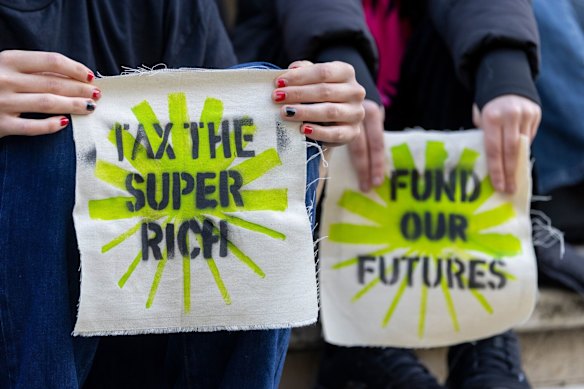
It is obvious that Australia’s taxation system needs to change (“Chalmers gathers troops for tax war”, February 25). The changes that are needed include reducing the capital-gains tax discount, closing down negative gearing on investment properties, increasing the goods-and-services tax across the board and reducing personal income tax. These are sensible and necessary if Australia is to continue to prosper. The biggest threat to these changes, and to the Prime Minister’s desire for the Labor Party to become the preferred party for government, is his default position of being a small target. Preferred parties for government have leaders who inspire and are followed.
This is the challenge for the PM. Leaders who are small targets are difficult to see, let alone follow. The PM needs to stand up and lead these changes. Graham Hansen, Deniston
City plaza concept needs a refresh
I cannot recall just how long this square/plaza has been talked of (“The radical alternative to Sydney’s $150m civic square plan”, smh.com.au, February 25), with various proposals going back decades. It seems like this ongoing dream of the council just belongs in the “talkfest” category. Let’s face it, a city square only works if it allows the area to “breathe”. How could this possibly be realised with the carved out towering hulk of an existing, quite bland, old building still hovering over the space. The area needs to be totally opened up with landscaping, trees with the blue skies able to take prominence. Certainly, incorporate the essential supermarket underground, but the quality of the street level life can only be achieved by clearing the tired old existing structures with a leafy environment allowing the Town Hall finally able to take centre stage. Greg Vale, Kiama
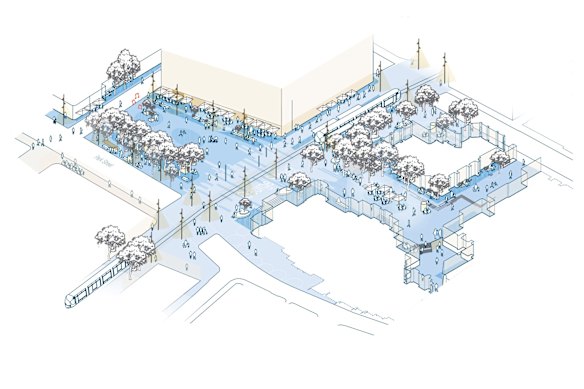
I really have to object to the creation of a square at the Sydney Town Hall area that includes George Street, Park Street, Pitt Street, etc. I also do not see the need to demolish Woolworths and other shops in the area. This area is accessed by many people who live and/or work in the city. I used to shop at Woolworths either on my way to work or on my way home. These amenities will continue to be utilised by people who live and work in the city. You don’t fix what isn’t broken. The city is already a bit of a maze now with the light rail along George Street and the exclusion of cars and other motor vehicles along that street. Pedestrian only spaces are not needed on every corner of the city. Not everyone can walk everywhere. Practicality is needed in all of this. You need to be able to get around the city easily. Susan Dean, Ashfield
May I encourage Sydney City Council to keep going with its open plaza concept fronting the iconic Sydney Town Hall. In the 1990s, post-earthquake Newcastle, we were much criticised for knocking down a misplaced modern bank building to open up a closeted Civic Theatre to the people. While Newcastle is lucky to also have Civic Park fronting its City Hall, the Wheeler Place open plaza is now well utilised and particularly important to urban life in Newcastle. Cities are places of density. So, any open space is valuable to people, especially when it is as well-used as the Sydney Town Hall forecourt. Brian Eastoe, Black Head
Small players need space
The recent discussion on developer uptake (Letters, February 25) should not be used to delay the urgent need for more flexible zoning. We must decouple the viability of high-rise development from the necessity of enabling gentle density in low-density suburbs. Permitting multi-dwelling housing in these areas — supported by a 0.5 car space limit per unit — would prioritise housing delivery over street congestion. With tight controls on height, floor space, and landscaping, such homes can integrate seamlessly into existing neighbourhoods. Crucially, this approach would open the door to small-scale developers who are currently locked out by planning rules designed around large, high-risk projects. Matthew Bartinel, Lemon Tree Passage
Cup of kindness
I know customer service is good business practice (“My cafe is the best, but coffee has nothing to do with it”, February 25), but it means so much these days to be known. When my son started work at a cafe, I reminded him to be patient and kind because he might be the only person some customers speak to all day. The staff at our little local cafe now greet my daughter by name when she shows up first thing in the morning with her baby and toddler. Table ready, coffee and snack ready. The guy in the mobile coffee van who comes to the industrial warehouses where I volunteer has a remarkable ability to remember everyone’s orders. Friendly, superfast hands and great coffee before you know it. Local cafes providing smiles and community. Happening all over the place and worth the price of a coffee. Susanne Lambert, Normanhurst
Leaving Las Vegas
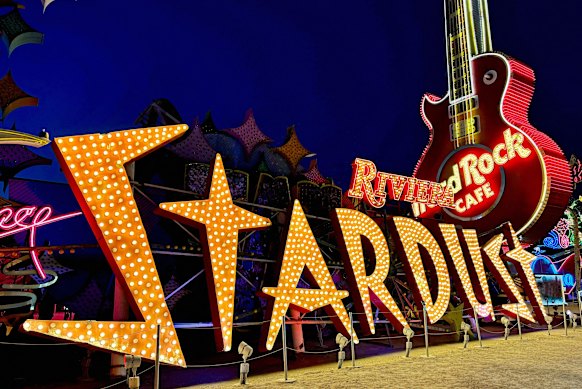
I’m a South’s member and have been following rugby league for around 60 years, since listening to Frank Hyde as I milked cows. But the NRL should not be in Las Vegas, tacitly supporting the appalling Trump regime (“PVL plane jets back to Sydney for air-con fix”, February 25). Of course the NRL is welcome there. Las Vegas is experiencing a huge slump because Canadians no longer come, in protest at Trump’s wanting to make them the 51st state and the tariffs he has imposed. Another issue, of course, is entry to the US, as we read a constant stream of stories about people being appallingly treated by US customs. It will be interesting to see if some of the customs officers haven’t read the memo and don’t wave through people from Australia off to Las Vegas. The third major reason we should not be there is that one of the stated reasons is to get Americans to bet on the NRL. Many gamble responsibly, but for those who don’t it is a scourge, destroying lives and increasing domestic violence. Americans have plenty of ways of losing money. Why add more? Keith Binns, Goulburn
Singapore’s smoke action
Your article including Singapore (‴Kaz’ and Manchester united to make billions on illegal smokes”, February 19), mischaracterises Singapore’s approach to illicit tobacco trans-shipment. Singapore takes the integrity of our ports and free trade zones (FTZ) seriously. Singapore Customs co-operates closely with international counterparts, including the Australian Border Force (ABF), to detect and act against illicit goods and trans-shipment, in accordance with our regulatory framework. Illicit tobacco is a complex, trans-national issue that requires co-ordinated action across multiple jurisdictions. In 2025 alone, intelligence from Singapore Customs led to 15 successful ABF seizures involving 58.9 million cigarettes, Singapore Customs also seized three million cigarettes in an FTZ that were allegedly bound for Australia. These outcomes underscore our commitment to combating illicit trade. Singapore remains committed to sustained international co-operation and will continue to play our part in this collective responsibility. Anil Nayar, Singapore High Commissioner to Australia
- To submit a letter to the Sydney Morning Herald, email letters@smh.com.au. Click here for tips on how to submit letters.
- The Opinion newsletter is a weekly wrap of views that will challenge, champion and inform. Sign up here.
Disclaimer : This story is auto aggregated by a computer programme and has not been created or edited by DOWNTHENEWS. Publisher: www.smh.com.au


