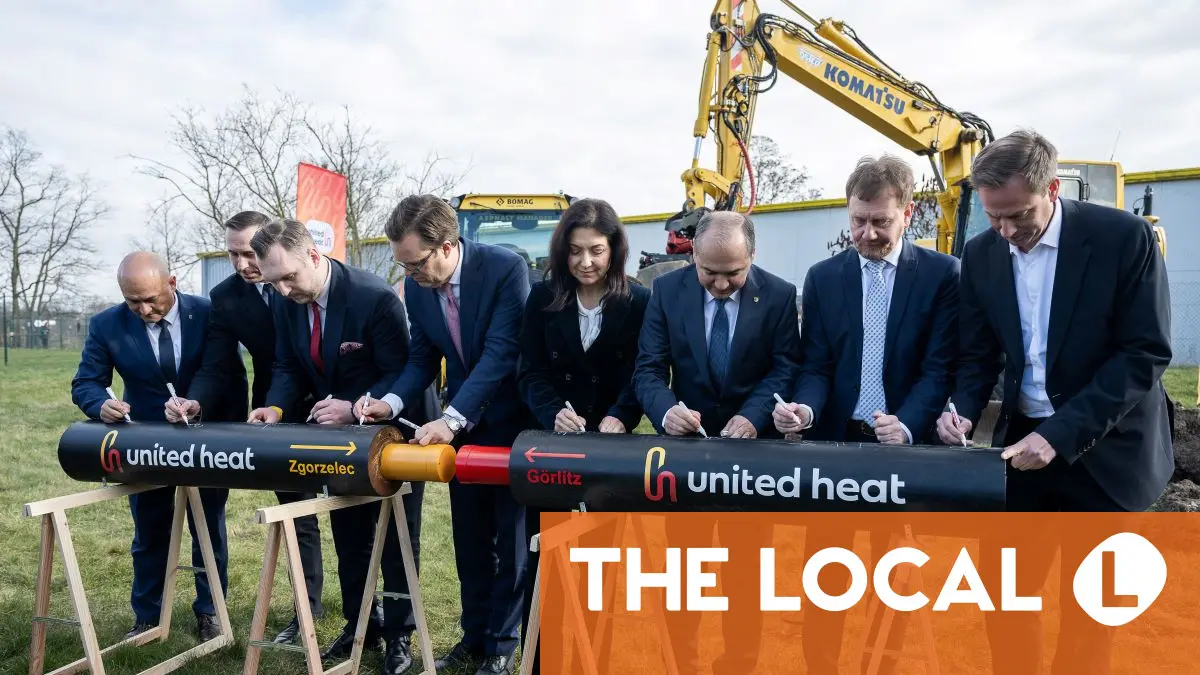
A new heating project linking Görlitz in Germany and Zgorzelec in Poland shows how local leadership and cross-border collaboration could deliver cleaner, more affordable heat – and greater energy security – in uncertain times.
For many residents, the bridge crossing the River Neisse between Görlitz in eastern Germany and Zgorzelec in western Poland feels more like a connection than a border.
Now, that closeness is bringing shared heating infrastructure, which promises lower emissions, greater energy independence and more stable costs for people on both sides of the river.
The two cities have recently begun construction work on ‘United Heat’, a cross‑border district heating system designed to replace fossil fuels with renewable energy and supply climate‑neutral heat to around 85,000 people living in both cities.
Construction officially began in late March with a joint ground-breaking ceremony attended by Polish Energy Minister Miłosz Motyka and Germany’s Federal Minister for Economic Affairs and Energy, Katherina Reiche.
For local households and businesses, the project represents a long‑term shift away from imported fuels and volatile energy markets toward a system anchored in local resources.
A project led from town halls rather than capitals
Although backed by national governments and the European Union, United Heat began as a municipal initiative.
The idea was driven by Görlitz mayor Octavian Ursu and Zgorzelec mayor Rafał Gronicz, who jointly asked how their cities could protect residents from sudden energy price shocks while also meeting climate goals and planning responsibly for the future.
READ ALSO:
The two cities formally launched the project in 2020, signing a letter of intent, commissioning feasibility studies over the following years and submitting funding applications to the European Commission. What followed was a careful, step‑by‑step process aimed at ensuring the system would be technically reliable, financially viable and socially acceptable over the long term.
Why heating is at the heart of the energy transition
Heating accounts for a significant share of household greenhouse gas emissions. Until now, Görlitz’s district heating has relied largely on natural gas, while Zgorzelec has depended mainly on lignite, a particularly carbon‑intensive form of coal.
Together, these systems produce around 50,000 tonnes of CO2 emissions each year.
But replacing these fuels is about more than climate targets. It’s also about giving communities greater control over how they heat their homes and how exposed they are to international crises.
Polish Energy Minister Motyka has described United Heat as “a very important step for energy security” that would help create systems resilient to energy market fluctuations.
Two cities, two sources of renewable energy and one shared system
What will make United Heat especially robust is the way it combines different renewable energy sources on each side of the border.
On the Polish side, a 25‑megawatt biomass heating plant is being built in Zgorzelec, work on which is already underway. Biomass will form the backbone of the shared system, providing a stable and controllable source of heat that can supply both cities, regardless of the weather or season.
On the German side, Görlitz will contribute heat generated by large heat pumps and solar thermal installations, including systems that extract heat directly from Lake Berzdorf.
READ ALSO: Mideast war to brake Germany’s economic recovery
These technologies draw on local natural resources and electricity‑based systems, complementing the biomass supply from Poland and helping to balance the overall energy mix.
The two sides will also be physically linked by a new cross‑border pipeline measuring around 12 kilometres in total, including a 3.8‑kilometre section running beneath the River Neisse.
The connection is designed allow heat to flow flexibly between the two cities, improving reliability and making the whole system more efficient.
The total cost of the United Heat project is estimated at around €190–200 million. A substantial share of the funding is coming from the European Union, with the remaining costs shared between Germany and Poland.
By sharing not just heat, but infrastructure costs and operational risk, the two cities aim to create a system that is both technically resilient and economically predictable over the long term – a key factor in keeping heating costs stable for local residents and businesses.
The project carries particular weight in a region historically shaped by coal mining.
United Heat aims to help complete the shift away from coal and gas entirely by 2030, helping the region become more energy secure even as it shakes up how the two neighbouring cities stay warm.
Disclaimer : This story is auto aggregated by a computer programme and has not been created or edited by DOWNTHENEWS. Publisher: thelocal.de