Idi Amin is often considered Africa’s most notorious postcolonial dictator. Around the time of his government’s fall in 1979, dozens of accounts and biographies emerged, each telling horrific stories of brutality. Henry Kyemba, a former minister in Amin’s government, published State of Blood in 1977, providing an ‘inside story of Idi Amin’s reign of fear’. Thomas Melady, US ambassador to Uganda during Amin’s presidency, titled his diplomatic memoir Hitler in Africa. Fictional accounts have proven just as unsettling. Long before Kevin Macdonald’s The Last King of Scotland (2006), Sharad Patel’s The Rise and Fall of Idi Amin (1981) portrayed the dictator’s victims’ heads in the freezer of State House, ready to be thawed for cannibalistic consumption. In the same year, America’s NBC broadcast a news piece (likely created by the CIA, in whose archive it was deposited) on Amin’s murderous scheming. As crocodiles slither into the Nile, a voiceover states: ‘Idi Amin once claimed that the crocodiles listened to him and did what he said. Animals usually do obey those who feed them.’
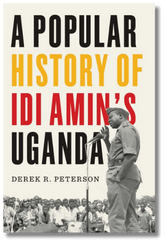
Derek Peterson’s book is a welcome revision to the sensationalism that usually accompanies Amin. With unprecedented access to previously inaccessible sources – many of which Peterson has helped salvage from administrative neglect and environmental ruination – A Popular History of Idi Amin’s Uganda describes a ‘government of action’, where Ugandan clerks, bureaucrats, teachers, and businessmen ‘worked hard to impose order, even in unlikely circumstances’. This is a book on the everyday infrastructures of Amin’s government, focusing on the workers that kept Uganda afloat during its most difficult postcolonial chapter. Peterson complicates the orthodoxy that Amin maintained power solely through brute force. One of the great ironies of Uganda’s violent 1970s is the extent to which ordinary Ugandans regarded Idi Amin, as Peterson puts it, as a ‘hero of cultural and economic liberation’.
While Peterson’s book successfully reorients 1970s Uganda around the infrastructures that shaped public life, at times it can feel moralistic. Peterson makes the claim that he does ‘not make judgments on the people whose lives I study in this book’. Later he concludes that the ‘protagonists in this book were oftentimes chauvinists, misogynists, and busybodies’. More significantly, though, he leaves the reader with unanswered questions. Despite its remarkably rich source base, we rarely get a sense of the motivations driving Peterson’s ‘ordinary’ Ugandans. Yes, thousands worked to build an infrastructure within which Amin could operate – but why? We lose nuance if we analyse 1970s Uganda solely through the prism of the state: despite what the book’s title implies, the country and its people were never fully Amin’s.
A fanfare of stories and recollections circulated across Ugandan media during the 50th independence commemorations in 2012 as the country debated Amin’s legacy. In the Monitor, Uganda’s leading independent newspaper, Timothy Kalyegira lamented: ‘So many Harvard, Oxford, Stanford, Leeds, Cambridge and other elite university Ugandan alumni, despite that world-class education, continue to recycle the same 1970s propaganda views and information on Amin, confirming that they crammed their way through graduate school just to get a Masters and its accompanying prestige.’ But getting the Amin story right is important: ‘The false image of Amin has been used by governments to exaggerate their achievements.’ Peterson’s book is a response to Kalyegira’s call in that it encourages us to consider the links between authoritarian regimes and the often invisible people who make them run.
-
A Popular History of Idi Amin’s Uganda
Derek R. Peterson
Yale University Press, 376pp, £25
Buy from bookshop.org (affiliate link)
Jonathon L. Earle is Associate Professor of African History at Centre College, Kentucky.
Disclaimer : This story is auto aggregated by a computer programme and has not been created or edited by DOWNTHENEWS. Publisher: historytoday.com