Like many Australians, dairy farmer Nick Flanagan finds his WhatsApp group chat is a good barometer of what people are thinking about politics.
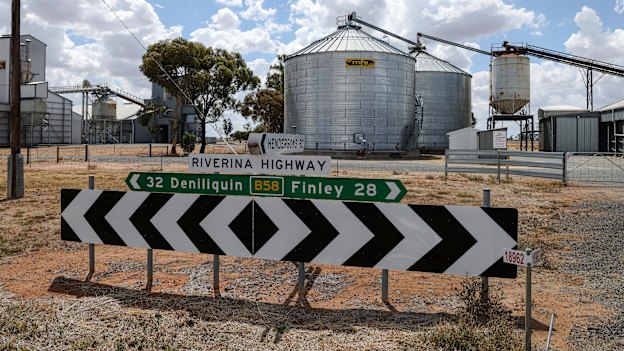
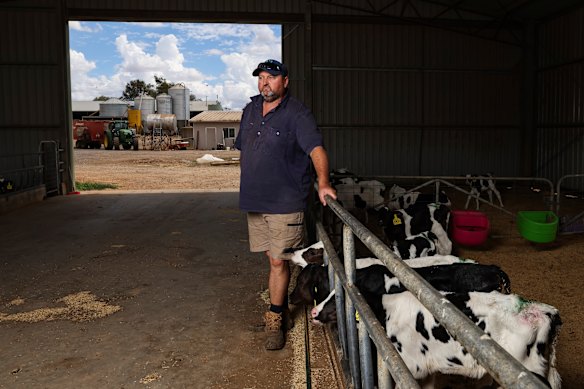
The father-of-three runs a dairy farm outside Finley – a small town in the nation’s food bowl, about 660 kilometres southwest of Sydney and 280 kilometres north of Melbourne. Here, in the federal electorate of Farrer, frustration has been brewing for a long time.
Flanagan mentions one of the men in his WhatsApp chat – a second-generation farmer, like himself. “His father and him were both big Nationals followers. If you wanted an argument in the pub, he’d be the first one to step up,” Flanagan says.
“He defected to One Nation, maybe two or three months ago. He’s a registered member now.”
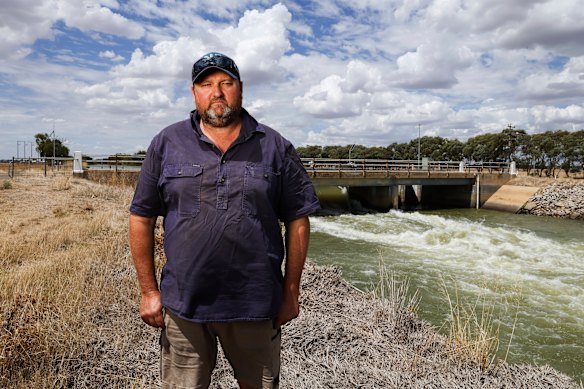
For farmers such as Flanagan, the list of resentments includes labour shortages, penalty rates and unreliable energy. In town, it is a shortage of childcare, health services and housing. And in this irrigation district, north of the Murray River, there’s another flashpoint: water management.
Water is an issue that provokes farmers and the communities that flourish or flail based on their success. Many feel betrayed by long-running government interventions: it started when water became a tradable commodity under John Howard, continued with the Murray Darling Basin plan under leaders of all stripes, and escalated with buybacks under Labor.
Through all this, Sussan Ley has been repeatedly elected as Farrer’s representative for the Liberals in Canberra. Now that her resignation is forcing a byelection, a switch has flicked. It’s not what Nationals leader David Littleproud or new Liberal leader Angus Taylor want to see.
“The majority of guys that I talk to would be like: ‘Yeah, f— the Nationals, they’ve lost us.’ And that’s from being ineffective. Twenty-five years of nothing,” Flanagan says. “This has traditionally always been a Liberal-Nationals seat, and people have just lost any confidence in them.”
This disillusionment runs far deeper than the last nine months, although recent Coalition chaos in Canberra has certainly compounded it. “They’re like: these guys have got no direction. They’ve got no leadership. What the hell are they doing? Let’s try Pauline [Hanson]. That’s pretty as cut and dry, as I see it.”
The seat of Farrer has had four representatives in 77 years: three Liberals and one National, former deputy leader Tim Fischer. Ley won it when Fischer retired in 2001.
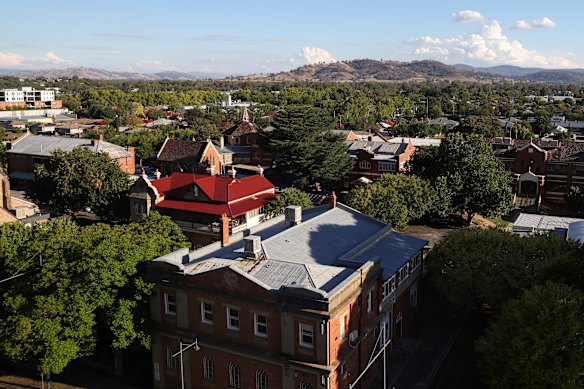
The sprawling electorate, at 126,563 square kilometres, fills out the south-western corner of NSW. Its largest population centre, Albury, is increasingly like inner suburban Sydney and Melbourne. But as you follow the Murray and Murrumbidgee rivers inland, sheep and wheat properties give way to irrigation. The areas around Griffith and Deniliquin produce vast quantities of rice, fruit, wine grapes and almonds that feed the eastern seaboard. Head further west, and small communities give way to desert.
The politics of Farrer change with geography. The Liberals have typically dominated Albury, where about half the electorate lives. The rural and farming lands of the electorate – the other half – have been considered Nationals strongholds, although it’s been seven years since the party has even represented them at a state level.
Yet the second-generation farmer, the young doctor working in Albury, and the migrant business owner in Griffith all say the same thing, as we drive around the electorate to ask about the byelection.
They feel betrayed and neglected; that nobody has listened to them. The way they deliver this message oscillates between exasperation, frustration and fury, but it is broadly consistent: the region has been ignored and it’s time for something different.
How this manifests at the ballot box, however, won’t be so simple. In usual circumstances, the byelection would be a rare showdown between the Coalition partners – with the seat vacant, they can compete against each other.
As incumbents, the Liberals should be frontrunners, although party sources concede it will be challenging. The Nationals also know people are fed up, and will pitch themselves as the strongest alternative to “lone wolves in city centric parties claiming they can do anything for us,” says Gabrielle Coupland, the party’s acting chair in Farrer.
But with the Coalition polling at historic lows, the byelection will be a test of their relevance. The battle is morphing into a four or five-cornered contest that threatens to relegate major parties further down the pile with a messy exchange of preferences.
The question is whether the Liberals will prevail in Albury against Michelle Milthorpe, a Climate 200-backed independent who has already started campaigning – and if the Nationals can pull ahead in the west while One Nation is ascending.
Independent state MP Helen Dalton, who holds an overlapping NSW seat she won from the Nationals, is also toying with running – a wildcard that would make the race even more complex. Who, from all those, comes out on top when preferences are counted?
Campaigns will now spring into action – Ley announced her resignation on Friday – and a date will be set for the byelection. The Liberals, Nationals and One Nation will move quickly to announce their candidates, and Dalton will make her decision.
Australians watching preferences flow in Farrer for the first time will try to decode what they say about this country and the status of conservative and centre-right politics, and Taylor, Littleproud and Hanson will be graded on the results.
For the 124,000 people casting a ballot, however, the contest will be fought over local issues, shaped by local candidates, and a rare chance to send their message to the broader nation.
Volunteers in Milthorpe shirts are already handing out flyers in Albury’s city centre. Cardboard cut-outs of orange emus are appearing around town.
These were common sights just nine months ago, when the teacher and advocate against child sex abuse ran as an independent in last year’s federal election.
Milthorpe came second, helping force Ley to preferences for the first time in 25 years, and cutting her lead to 6.2 per cent. More importantly, she beat Ley in every voting booth in Albury and its suburbs, which have a population of about 60,000.
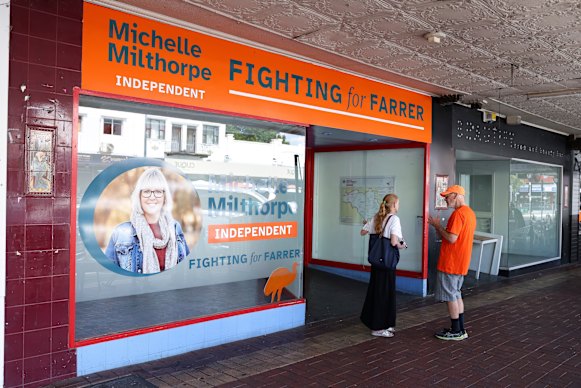
It’s a strong starting point for Milthorpe, who is backed by the Climate 200 fundraising vehicle that has helped send climate-minded independents to Canberra.
She was out the door within hours of Ley saying she would resign two weeks ago, vowing to fight again. Her volunteers stayed in touch, expecting Ley might not last the term. They’ve activated quickly: reopening a shopfront on Albury’s main street, now decorated with the orange bunting they’ve kept since May. So have Climate 200 and the Regional Voices Fund, which donated $60,000 to kickstart the campaign.
The issue that propelled Milthorpe’s success in Albury last time was the cash-strapped local hospital – jointly funded by Victoria and NSW, it reports to Victoria, and the federal government has kept out. It’s supposed to cater to 300,000 people, but bed shortages, surgery waitlists and staff burnout have hampered its capacity. Stories of charity funds spent on artwork, whistleblower complaints and exits of high-profile doctors have fuelled a sense of scandal. The hospital is being redeveloped, but Milthorpe says it’s not enough: she wants a new hospital on a new site.
Dr Lachlan McKeeman, a GP who has protested the redevelopment, has seen two families lose loved ones from cardiac arrest because they couldn’t get help in time; certain services don’t operate outside business hours. “One was lost on the way to Wagga, one was lost on the way to Melbourne,” he says. McKeeman thinks federal leaders are letting the states get away with “absolutely appalling behaviour”.
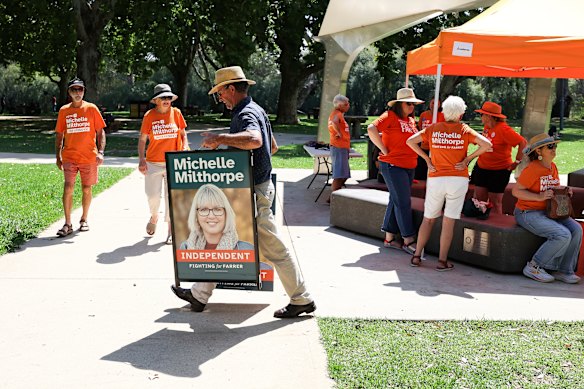
He is preparing to volunteer in his orange Milthorpe shirt, although he won’t vote in the byelection — he lives in Wodonga. The campaign is drawing in plenty of Victorians who are vested in the border town’s shared interests.
On the southern side of the Murray, which becomes the federal seat of Indi, community independents are a mainstay: Cathy McGowan pioneered the movement when she beat the Liberals in 2013. It’s now held by independent Helen Haines, who endorsed Milthorpe with independent ACT Senator David Pocock on Friday.
For the Milthorpe campaign, Indi is a blueprint. “An independent understands the community aspect of it,” McKeeman says. “To steal the Indi phrase, it’s politics done differently.”
But Milthorpe will need to pull votes outside Albury to seize the seat. Her next focus is the town of Deniliquin – a southern irrigation hub, population about 7000 – where she was setting up a new office last week.
As in much of the electorate’s west, these have traditionally been Liberal voters. Ley commanded between 60 and 70 per cent of the two-party vote against Labor in Deniliquin in 2022, although this dipped into the 50s against Milthorpe last year.
That’s because of people like Rob Brown, a family business consultant. Brown loves the town he’s lived in since he was six months old – the gums that line the Edward, taking a dinghy up the river – but says the community is being challenged by the standard mix of regional service shortages: healthcare, childcare and housing.
“All those things double up, or triple up. We have a lot of young people and professionals who want to come back to Deni, but if you can’t get housing or you can’t get childcare, you can’t come back,” Brown says.
“I don’t think many people would be convinced that we’ve had the advocacy we need – that would be across a lot of rural communities. But the water stuff is another layer again.”
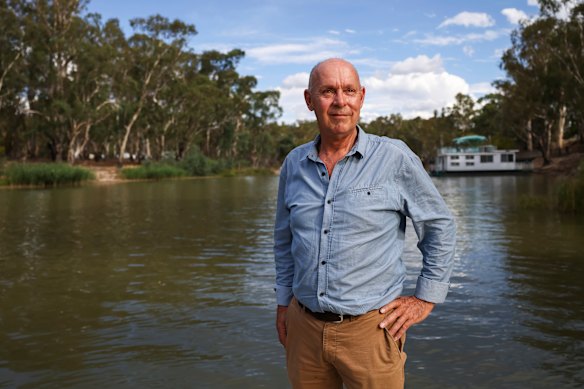
These complex concerns about water management, flooding and food security aren’t just held by farmers – farming benefits flow into local economies and communities, bringing commerce, schools, health services and government funding into the area.
Brown’s frustration, like many others, has been mounting. “Last time I voted for the weirdest people I could. I wanted to send them all a signal to say, ‘Yeah, right. Stuff you. You’re not representing me’,” he says.
He once handed out how-to-votes for Ley, but thinks the Liberals have become a boys’ club and is upset by their swing to the right; he’s also appalled by the rise of One Nation and what that signals to migrants and Indigenous Australians. “Milthorpe’s the only one, at this point,” Brown says.
“Because it’s her second hit, she’s more likely to be heard, [especially] if she can work out how to craft her water policy – to say we just need to breathe, stop these buybacks, and do a rigorous assessment of what works.”
Milthorpe has strengthened her message on water since last year. “We’ve got farming communities that are pretty much on their knees,” she tells this masthead.
“They’re being screwed with water policy, and we’ve got generational farmers who are thinking about selling their farms … I will definitely be calling for a royal commission.”
This message still needs to reach, and convince, the likes of Louise Burge – a well-known farmer around Deniliquin who’s campaigned in the community and Canberra for decades. At one point, she was a senior official with the NSW Farmers Association – an organisation whose members have historically overlapped with the Nationals.
Aged 67, Burge sees the optimism of her parent’s generation dissipating. She thinks the city and country have become more distant as Australia urbanises, resulting in regional health failures and a problematic renewable energy fallout. What makes her tear up, though, is recalling memories of lost crops or 1200 dead sheep because of flooding she links to water mismanagement in Canberra.
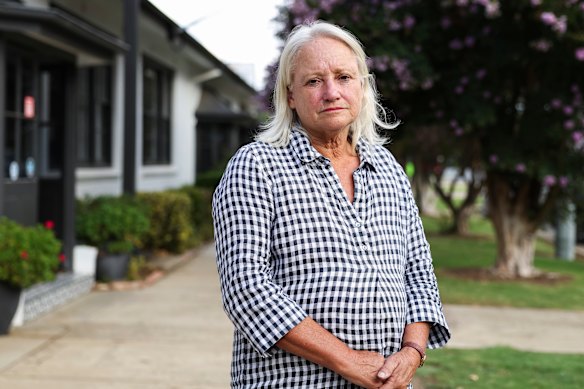
“There’s not a lot of understanding within the political fields, and also the bureaucratic fields, about what policy means when it’s applied to a regional area. That has bred the discontent that is now evident in Farrer,” she says.
Burge thinks the Liberal vote has held for 25 years because there’s been no alternative. “This is a conservative electorate, they are terrified of Labor and the Greens – absolutely terrified,” she says.
But with the byelection bringing new candidates and national attention, Burge anticipates a protest vote. “I will be a swing voter. I was a conservative voter going back years, but what I’ve seen throughout this long period of time is symptomatic of a bigger problem in Australia,” Burge says.
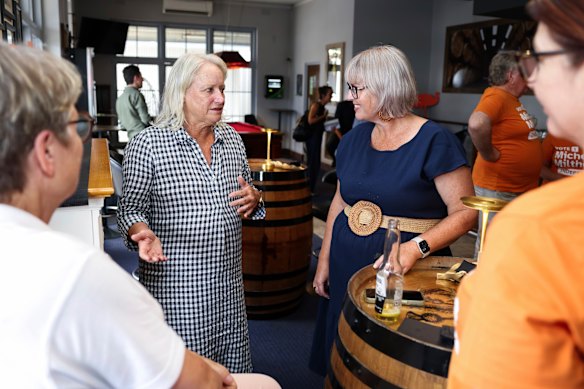
When we interview Burge at a Deniliquin hotel on Tuesday evening, there is, coincidentally, a Milthorpe meet-and-greet happening in the next room. She stays to hear what the candidate has to say.
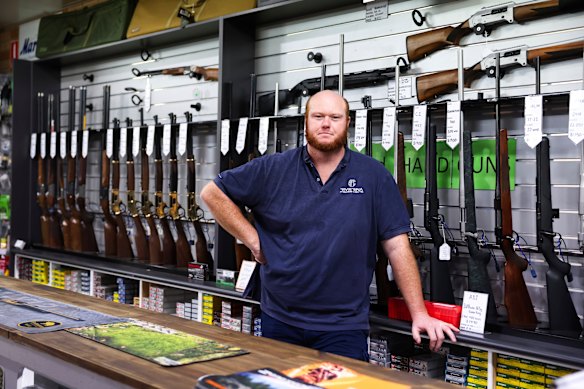
Over in Griffith, a growing city of 27,000 people, Rob Dowton is not giving Milthorpe any thought. “I’m not a fan,” he says, behind the counter of the gun shop where he works. “She’s probably a nice person, but she’s sitting on the wrong side of the fence – she’s a teal. We don’t need any more of them, trying to control the country.”
It’s a label Milthorpe is trying hard to shake. “I’m not a teal and I can’t relate to that, because they can’t relate to our context,” she says of inner-city independents. She likens herself to Tasmanian senator Jacqui Lambie.
But there’s another option for these sceptical voters.
One Nation has been surging in opinion polls since the May election, and is now usurping the Coalition in most surveys. After the South Australian election, Farrer’s byelection will be the first indication of whether this converts at the ballot box. The party has narrowed its candidate list from 81 to four, sources said.
Last year’s One Nation result in Farrer was roughly on par with the national average, at 6.6 per cent of the primary vote, although it ran higher in some western booths. Whether Hanson brings in new voters on election day will determine whether the minor party makes inroads into federal parliament.
Dowton, who lives in nearby Leeton, could be one of them. “I was a Sussan Ley fan, but from what has come out in the last three or four months, we need to find someone that’s going to stand up for the electorate.” New gun laws are one push factor – but it’s not just the firearms issue. “It’s water policies, it’s roads, everything,” he says.
“We need a shake up from what we’ve been dealt for the last 20 years. I think a bit of fresh blood, if it’s One Nation, would be good for the country. We’re stale, and too many people are too comfortable with what’s been happening, election after election … I don’t know if it’s just Labor. I think it’s what came before that, as well.”
He sees the Coalition has been trying to turn things around in the last few weeks, but he’s not buying it. And the defection of Barnaby Joyce to One Nation adds credibility, in Dowton’s mind. “He’s a cocky himself, a cattle farmer up in the New England region, so he gets it,” he says.
“All these politicians in central Sydney, Newcastle, Wollongong area – I don’t think they understand what’s actually happening out here. And I don’t think they care, to an extent. City areas are where they’re going to get majority. We’ve been left behind out in regional NSW.”
Norm Carl, a publican in Gerogery, outside of Albury, heard that sentiment when One Nation had an event at his pub two weeks ago. About 300 people showed up. He describes them as “real country, normal, elderly people who’d had enough”. At least half were over 60, and the same proportion were farmers. “They could have been here to watch a tractor display.”
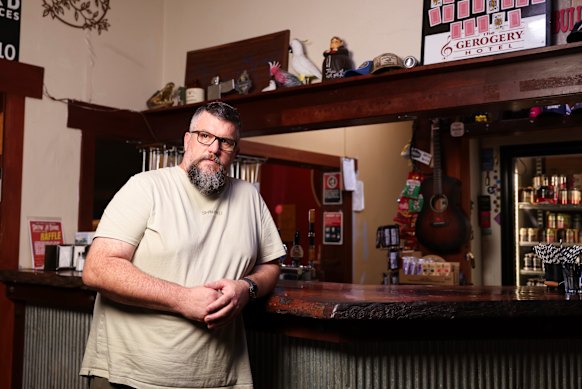
Carl thinks many voters will be scared to pull the trigger on something new because people are weary of change – himself included, particularly when it comes to independents. Although he suspects that could be where things are headed, as independents consolidate their hold on neighbouring seats at a state level.
“Country people like country people. Country people also like no bullshit. I think it’s extremely important to people in the country that they know and trust the candidate,” he says.
Helen Dalton, the independent state MP, comes up often in conversations about good candidates. One Nation has been sounding her out.
The farmer from Yenda, just outside Griffith, has represented the NSW seat of Murray since 2019 – an electorate whose 110,000 square kilometres largely overlap the 126,000 square kilometres of Farrer; almost the entire electorate outside of Albury.
“The rise of One Nation is culminating because people are incredibly unhappy with the direction in which our country is going,” Dalton tells this masthead.
“People are discontented with both Labor and the Coalition, they’re looking for someone who’s going to speak their mind, and [Hanson’s] unscripted. That’s what they say: ‘Well, at least Pauline’s having a go’.”
Dalton will shake up the race if she runs, but she’s keeping her cards close to her chest until after Ley resigns. She hasn’t ruled anything in or out – including whether she will stand for One Nation, or on her own.
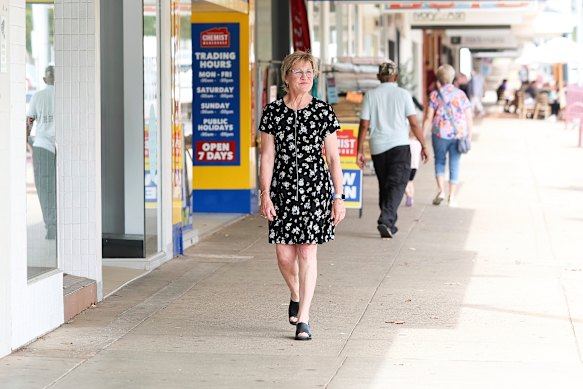
However, she knows the chaos of minor parties. Dalton was a Nationals member, until they knocked her back for preselection. Then she ran for Murray under the Shooters, Fishers and Farmers banner, and snatched the seat from the Nationals in 2019.
“That ended in tears,” she says, referring to her becoming an independent in 2022. “Obviously, I’m not a great party person, because I can’t follow a stupid policy and that’s it.”
Dalton boosted her result as an independent at the 2023 state election, winning 50.2 per cent of first preferences. In a two-candidate race with the Nationals, it came to 66-34. If this held up in a federal contest, it would put Dalton in strong contention.
Her profile is smaller around Albury, which is held safely at a state level by Liberal MP Justin Clancy. She can, however, campaign with runs on the board from her time in NSW parliament.
After successfully pushing for a NSW royal commission into water, and greater transparency laws around water ownership, Dalton wants both these things at federal level. She also mentions the need for new dams, better water treatment plants, fully staffed hospitals, and reliable digital connectivity.
“People are coming into my office begging me to run for One Nation,” she says.
“Mind you, I get quite the opposite view from others as well … I think there’s a lot of hype [for One Nation], but I think if there’s another good candidate somewhere, people will be voting for them.”
One of Hanson’s messages that won’t gel everywhere in Farrer is her hardline stance on zero immigration. It’s particularly jarring in Griffith, one of the most culturally diverse cities in regional Australia.
Both Griffith and nearby Leeton were purpose-built horticultural and agricultural towns that brought in Italian settlers. These days, they’re home to many Indian and Pacific migrants, as well as refugees.
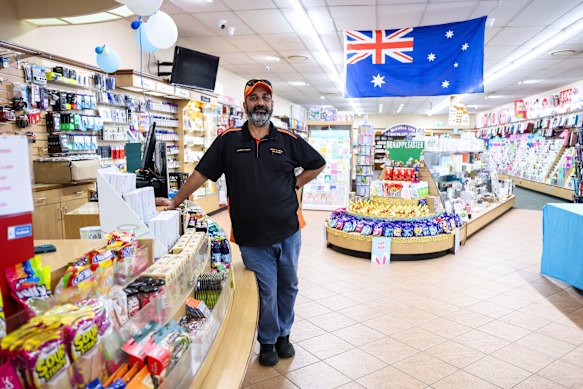
Manjit Lally, who owns the local newsagent and sat on the council, is on the lookout for good policy. He doesn’t think the major parties are serving it up – but nor is One Nation. “They blame immigration for everything,” he says.
“But particularly in Griffith, we have 59 migrant communities living here, who have never had an issue. Myself, I’ve been living here 26 years … We are the food bowl of Australia, we need workers. Nobody comes this way from the cities, everyone’s going to unis and the big institutions, not the farms. Who else can do the work?”
It’s a conundrum that also faces Flanagan, the farmer from Finley, as he contemplates his vote. Workers from Kenya, Indonesia and Malaysia keep his business viable.
“The migrant freezing stuff I think is a little bit too heavy-handed and it’s a bit like Trump and his tariffs,” he says. “I think if Pauline looked into it, or One Nation looked into it, they’d understand that we need this skilled labour. We need these people in our rural areas to support the businesses.”
Flanagan will probably vote for Dalton if she runs; he says she understands what farmers are facing. “She’s built the trust among a lot of people in the area,” he says.
But whoever he chooses, it’s unlikely to be the Liberals or Nationals. “The generation older than me were probably more rusted on to the Nats, but people my age are more open,” he says. “And once you change – it’s like changing tractors – you don’t go back.”
Cut through the noise of federal politics with news, views and expert analysis. Subscribers can sign up to our weekly Inside Politics newsletter.
Disclaimer : This story is auto aggregated by a computer programme and has not been created or edited by DOWNTHENEWS. Publisher: www.smh.com.au