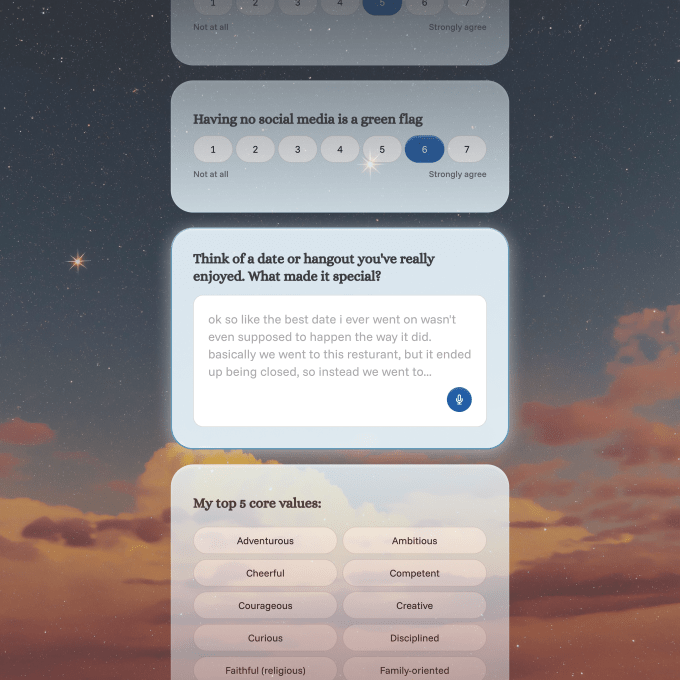
As Valentine’s Day approaches at Stanford, some students may be gearing up for first dates — not with people they met on Tinder or Hinge, but with matches from a service called Date Drop, designed by Stanford graduate student Henry Weng. Date Drop pairs students with potential dates once per week based on their responses to a questionnaire.
A Stanford whiz kid is trying to disrupt an established industry from his Palo Alto dorm? Stop me if you’ve heard this one before! But young adults are deeply disillusioned with the frustrating, demoralizing state of online dating. Why not try something different?
Over 5,000 students at Stanford have given Date Drop a try since its launch in the fall. It has also rolled out at 10 more schools, including MIT, Princeton, and the University of Pennsylvania, and Weng says he wants to roll out Date Drop more broadly in some cities this summer.
“Our matches convert to actual dates at about 10x the rate of Tinder,” Weng told TechCrunch. “Instead of swiping, we get to know each person deeply and send them one compatible match per week.”
At first, Weng didn’t intend to turn Date Drop into the foundation of a startup. Then, a close friend of his met their partner via Date Drop. “That was when I got the sense that this was less of a project,” he said.
Now, Weng thinks of Date Drop as just the first service from his startup, the Relationship Company, which is a public benefit corporation — — a type of company legally required to consider social impact alongside profits.
“This started as something I just wanted to exist on campus, and it became a company because people kept on asking for it in their schools and I needed resources to do that,” he said.
Techcrunch event
Boston, MA
|
June 23, 2026
Already, Weng has raised “a few million” from some angel investors, including Zynga founder and early Facebook backer Mark Pincus, who has taught business courses at Stanford (including to Weng). Andy Chen, a former partner at Coatue, and Elad Gil, an early backer of Airbnb, Stripe, and Pinterest, also invested in the Relationship Company.
“The long-term vision at The Relationship Company is about facilitating all meaningful relationships: friendships, professional connections, community, events,” he said.
It’s par for the course to use algorithms to predict if users of a dating service may be compatible with one another — that’s how dating apps work. But Weng says his model is more geared toward forging long-term connections, with 95% of Date Drop users saying they’re interested in relationships.
Weng explains that there are two core elements at play. First, the questionnaire needs to be thorough enough to capture a real picture of who someone is. “We do that through the questions, open-ended responses, a voice conversation, and other data that the users provide,” he said.
The next challenge is compatibility prediction. “Because we help people plan dates, we have data on which matches actually work out. So we have a model trained on real-world outcomes,” he said. “Once you have those two components, the actual matching is standard stuff from matching theory literature.”
Currently pursuing a computer science master’s degree at Stanford, Weng has oriented his education around the economic and mathematical concepts of matching. As a Stanford undergrad, he’d created his own major to study humans, matching, and incentives.
“I started to see how matching shapes so much of our lives,” Weng told TechCrunch. “Who your life partner is, who your friends are, what college you go to, which company you work for are all matching problems.”
Beyond his technical education, Weng found an unexpected class useful for learning to manage a startup: “Intro to Clown.”
“A core principle of clowning is that clowns are failures, and instead of fearing failure, they revel in it,” he said. “As a product builder, your entire journey is just repeatedly failing and getting back up. Clown class was a wonderful microcosm of that.”
So far, The Relationship Company has two employees besides Weng, along with 12 students who serve as campus ambassadors. Because their work revolves around forging matches, Weng has extended that mindset to how he manages the company. He offers employees a $100 monthly “relationship stipend,” which they can spend on dates, gifts, experiences, or anything that helps them deepen an important relationship of any sort.
“Relationships are the single most important factor in a person’s life,” Weng said. “There’s also great research showing that money spent on other people makes you happier than money spent on yourself.”
Weng’s fascination with how people form relationships has also informed how he goes about his day-to-day life.
“Date Drop has shown me how many interesting people are out there that you’d never encounter through your normal routines,” he said. “It’s made me more open to people I wouldn’t have crossed paths with otherwise.”
Disclaimer : This story is auto aggregated by a computer programme and has not been created or edited by DOWNTHENEWS. Publisher: techcrunch.com