
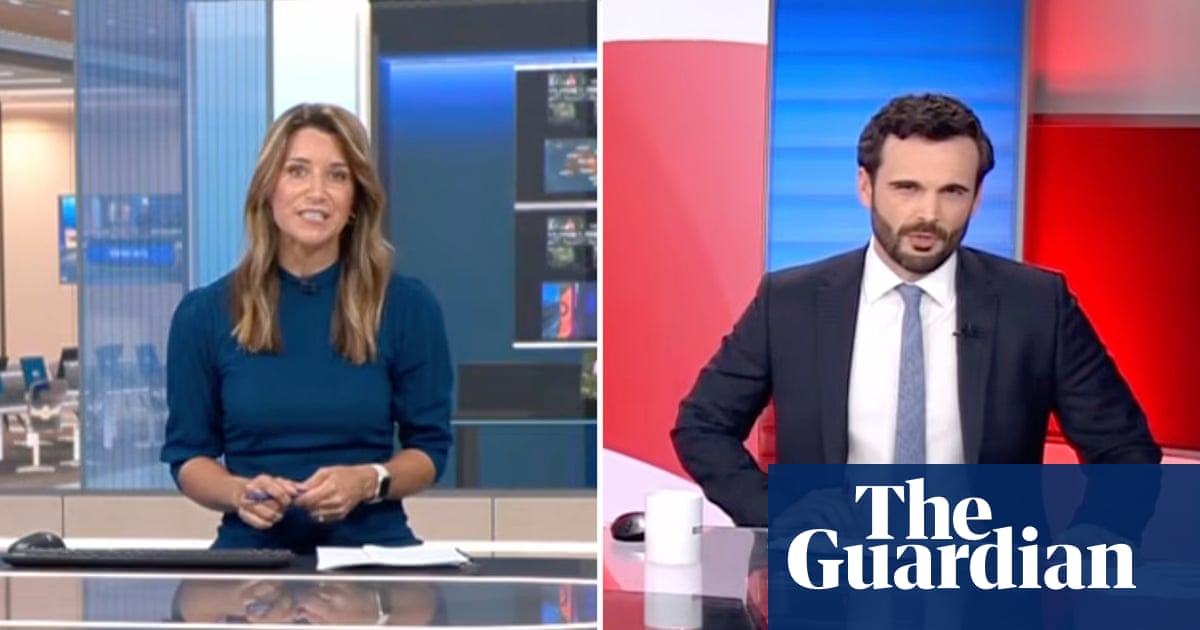
More than 2,000 ABC staff around Australia have walked off the job for a 24-hour strike, forcing ABC services across TV, radio and digital to use BBC World Service and repeat programming.
The ABC managing director, Hugh Marks, is defiant the ABC will not back down on staff demands despite the severe disruption.
At 11am, the ABC News Channel switched to broadcasting the BBC World Service as staff walked out in protest.
ABC radio Melbourne mornings host Raf Epstein announced just before 11am that staff were striking “because it’s an argument over how best to provide sustainable, secure work”.
“Staff and management really do agree on you being the priority and providing you with some quality programming. Staff and management disagree on how we get those sustainable and secure jobs. That’s the reason for the strike.
“We don’t like not talking to you and being with you, but I’ll be back on your radio on Friday morning.”
The local radio station then went into the 1988 hit Waiting for a Star to Fall by Boy Meets Girl.
Shortly before 11am, Triple J FM hosts said automated messaging would be aired during the strike.
At 11am, the song Monsoon by Emma Louise and Flume began, soon cutting to NWA’s Express Yourself – the song that was played 82 times in a row on the same station during ABC industrial action in 1990.
Flagship news programs including television’s News Breakfast, 7pm news bulletin, 7.30 and all radio news programs from AM to PM will be replaced by the BBC World Service as ABC staff take strike action for the first time in 20 years.
Staff are protesting what they say is a low pay offer which puts them behind inflation as well as work conditions and the broadcaster’s refusal to rule out replacing journalists with artificial intelligence.
“Obviously, when our staff are not available, we are going to be severely impacted,” Marks told ABC Sydney Radio earlier on Wednesday.
“We will do our best to ensure that obviously, the audiences have got access to information.
“We’ll be using BBC content where that’s appropriate and where that’s available to us.
“We will be maintaining services, but they won’t be of the standard that I would like to be on air.”
Marks apologised to audiences for the disruption and revealed there may be a trigger for staff to return to work after he changed the definition of emergency broadcasting at the 11th hour to include more than fires, floods, cyclones and natural events.
Exemptions were in place to ensure emergency broadcasting continues, as ex-Tropical Cyclone Narelle continued its path around the north-west of the country.
Marks said if there was a matter of national or international importance he would call on staff to break their strike action and come into work.
The chief executive of the Media, Entertainment & Arts Alliance (MEAA), Erin Madeley, said ABC journalists were already committed to returning to work if there was a major event that put audiences at risk, and she queried what he was able to change overnight.
Unions argued the offer of a 10% total pay rise over three years – 3.5% in the first year and 3.25% in the second and third years was too low and failed to address concerns about the staff appraisal process, career progression, night shift penalty rates and reproductive health leave.
In January, Australia’s annual inflation rate was 3.8%.
Marks said staff costs are 60% of the ABC budget and any increase would mean job cuts.
He denied the offer was below inflation because he said the last-minute offer of a $1,000 sweetener put staff ahead of inflation at 4.4%.
Announcements by presenters on broadcast television and radio programs about the impending strike rolled out overnight.
Marks said at least one of those statements about why staff were interrupting their work was inaccurate because it was not about job security, it was about pay.
The managing director was critical of the enterprise bargaining process and alleged the union had not moved its position in nine months.
“I’m finding it very difficult to deal with an organisation that I can’t wrestle into an agreement,” he said.
“And when we’ve got agreement, it then disappears under my feet.”
Madeley said it was not true to say the union has just stonewalled for the last nine months.
“There’s been considerable movement across a vast area of issues,” she told ABC Radio Sydney.
Marks said he felt terrible about pulling services from the public.
“And I’m sorry to some of those staff that I feel a really difficult position today because I know how difficult this can be for individuals,” he said.
Disclaimer : This story is auto aggregated by a computer programme and has not been created or edited by DOWNTHENEWS. Publisher: theguardian.com


