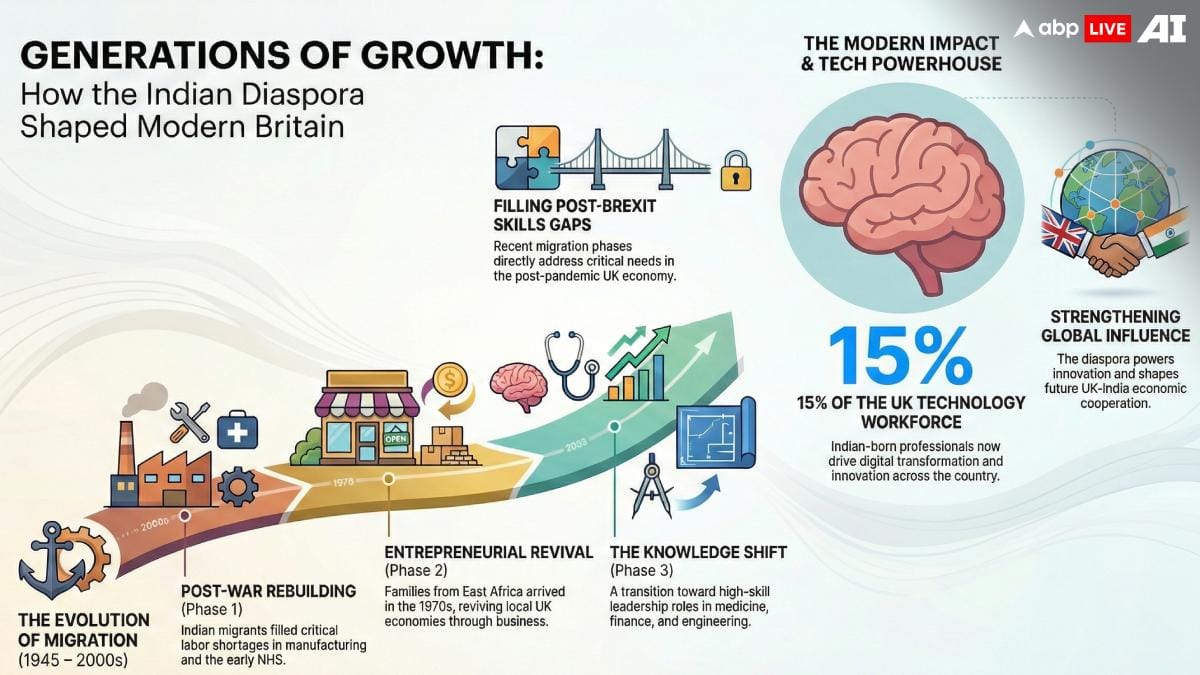
ABP Live Deep Dive: A newly released white paper in London has documented how generations of Indians have played a decisive role in shaping the United Kingdom’s economy, public services, and global standing. The report, unveiled on 5 February 2026, presents one of the most detailed examinations of Indian migration to Britain since India’s independence and highlights how this community has been central to the country’s transformation across eras.
The study has been brought out by Here & Now 365, which claims to be the UK’s first multicultural advertising agency founded by Manish Tiwari, in collaboration with the Aston India Centre at Aston University. It traces four distinct phases of Indian migration that together map more than 70 years of economic and social contribution.
Four Waves Of Migration That Shaped The Nation
The report begins with the period after the Second World War, when Britain was rebuilding and facing severe labour shortages. Indian migrants stepped into roles across manufacturing, transport, and public services. Their work helped stabilise a recovering economy and contributed to the early foundations of the National Health Service.
The second phase is linked to the early 1970s, when the expulsion of Asians from East Africa under Idi Amin forced thousands of families of Indian origin to seek refuge in Britain. Many among them arrived with business experience and entrepreneurial drive. They went on to revive local economies and establish enterprises that continue to support jobs and communities across the UK.
A third shift came as Britain moved towards a knowledge-driven economy. Migration from India increasingly consisted of skilled professionals in medicine, finance, engineering, and education. This phase marked a visible transition from labour-intensive roles to leadership positions in high-skill sectors.
The most recent phase, shaped by post-Brexit and post-pandemic needs, underscores how Indian professionals have filled critical skills gaps. The white paper notes that Indian-born professionals now make up around 15 per cent of the UK’s technology workforce, underlining their role in digital transformation and innovation.
Recognition From Policy, Academia, Business
Reflecting on the findings, Manish Tiwari said, “Indian migrants helped rebuild Britain after the war, powered its digital revolution, and strengthened its health and care systems in times of crisis. The Indian diaspora has played a defining role in building the tech superpower Britain is today and continues to contribute across every layer of society.”
From an academic standpoint, the report notes, “The Indian diaspora is woven into the UK’s growth story. The diaspora supports the UK’s public services delivery and powers innovation while also shaping future competitiveness and global influence through skills, enterprise, and people-to-people links with India.”
The white paper was formally launched at the House of Lords, bringing together lawmakers, scholars, business leaders, and cultural figures. Forewords in the report come from Navendu Mishra, Professor Aleks Subic, Sir Oliver Dowden, Dr Koolesh Shah, and Pankaj Sharma.
A panel moderated by Professor Pawan Budhwar featured voices from media, culture, and technology, including BBC representative Neetal Parekh, Chithra Ramakrishnan, Infosys executive Aga Biegluk, and Mastek UK Ltd representative Upasna Gupta.
The event began with the formal release of the report by Lord Loomba and Lord Bilimoria of Chelsea, followed by a vote of thanks from Ghanshyam H. Nabar of UICONNECT Ltd.
The report concludes that the story of Indian migration to Britain offers lessons not only from the past but also for future economic cooperation and people-to-people partnerships between the two countries.
Related Video
CONTROVERSY DEEPENS: NHRC Issues Notice to I&B Ministry Over “Ghuskhore Pandit”
Disclaimer : This story is auto aggregated by a computer programme and has not been created or edited by DOWNTHENEWS. Publisher: abplive.com