
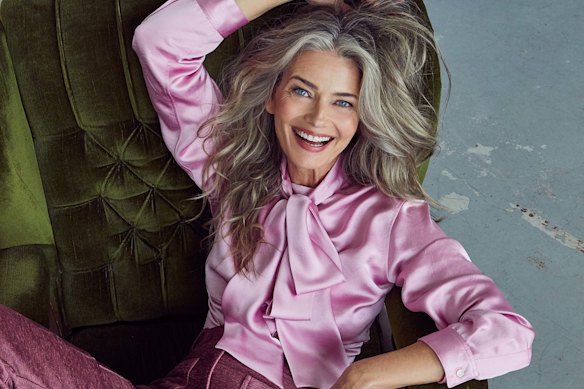
The Czech-born star of the fashion world explains why she’s resisted cosmetic surgery, and how she’s happier than ever after finding love after the loss of her long-time husband, musician Ric Ocasek.
Is that the woman who broke down on social media?” a friend asked when I mentioned I was interviewing Paulina Porizkova, the 1980s supermodel who was married to rock star Ric Ocasek of the Cars.
I’ll get to the breakdown later. The woman, Paulina, is sitting opposite me under sepia-toned light at a corner table in London’s Claridge’s Foyer restaurant. She is wearing a knitted Gabriela Hearst dress in cornflower blue, my favourite colour. “It would look great on you, too,” she replies generously when I compliment her outfit.
It strikes me that Porizkova must under-compensate for her extraordinary beauty a lot. And she is extraordinary. Her hair, long and full, is a pearly melange of silver and blonde. Her skin, untouched by Botox or fillers, is luminous. Not in that perfect plasticine way that’s 10 a penny in Hollywood. The glow is innate.
Good genes play a significant part. An unlimited supply of Estée Lauder skincare must do, too. But there’s something intangible at play here. She is happy. It’s written all over her face.
Porizkova, who turned 60 in April last year, signed on as Estée Lauder’s global brand ambassador earlier in 2025, a role she says feels like a gift, one she never knew she wanted, nor expected to be offered twice. She first posed for the beauty brand in 1988, a partnership that lasted seven years, making Porizkova a household name.
I wonder if news of a rematch will set her back in the eyes of the 1.4 million Instagram followers who view Porizkova as a marketing-free zone. The beauty industry has been peddling youth for decades; joining their ranks is a spurious stance for someone who is a vocal anti-ageing objector.
To its credit, Estée Lauder hired Porizkova not to propagate the narrative but to help change it. Also, the term “anti-ageing” is not Estée Lauder’s to cop to; it’s widespread, with deep roots in both beauty and medicine.
Still, Porizkova is unrelenting. When Lauder approached her for the gig, she laid her cards firmly on the table. “‘Number one, I will not do anti-ageing anything,’” she told Vogue when recounting her first meeting with the beauty giant. “‘So if you need that, I’m walking out right now.’ They all went, ‘We know, that is why we asked you.’”
Being heard is validating to Porizkova. “When I worked for Lauder in the 1980s, I was a model – and as a model, you are an object,” she recalls. “You are a clothes hanger or a canvas to put products on to sell to other people. And so it was not the happiest of my time in life.
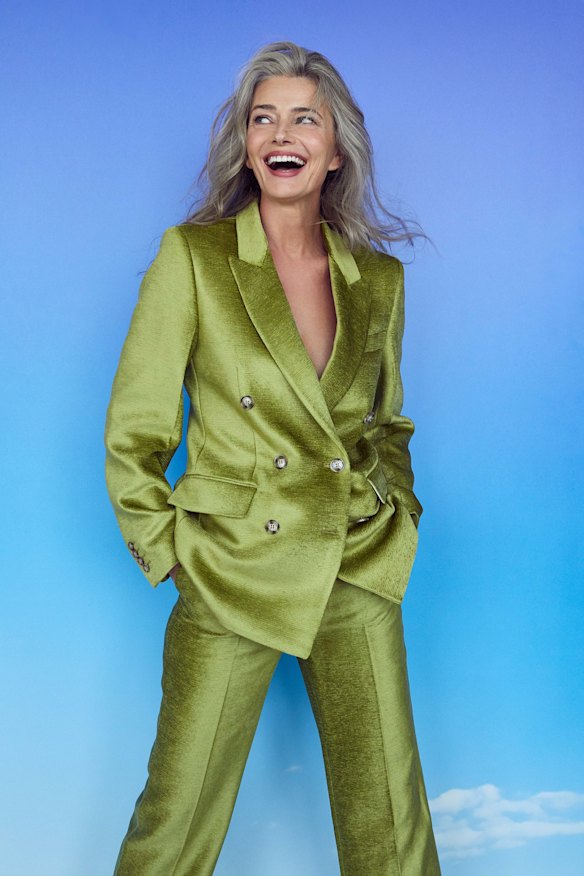
“I was incredibly blessed to have such a fantastic career. But I didn’t necessarily feel like I was important. All that was important was the way I looked. And, you know, as a young woman, it feels like half of you is being ignored.”
It’s hard to reconcile that Porizkova was just 15 when she was whisked off to Paris to begin her modelling career – at a time when fending off sexual advances from older male photographers was laughed off as part of the job. “I didn’t know the world should be any different. I thought, you know, that photographers greeting me in gaping bathrobes was just what you have to deal with.”
By 19 she had met her husband, rocker Ric Ocasek. He was 20 years her senior. But then Porizkova wasn’t your average 19-year-old. She had already survived so much, including a highly publicised political storm.
Born in then-Czechoslovakia to activist parents who fled to Sweden when she was three to escape the 1968 Soviet invasion, Porizkova was left in the care of her grandmother. She was eventually reunited with her mother and father but they divorced shortly after, a scar that left the nine-year-old pining for home and the maternal grandmother who’d raised her, inducing her first panic attack, she writes in her 2022 autobiography, No Filter.
Porizkova is as candid about her lifelong battle with anxiety as she is about the pitfalls of ageing in a youth-obsessed culture – a quality that has endeared her to an audience of midlife women battling the muddy waters of unrealistic beauty expectations. “For me, it’s a very narrow blade; the balance is tricky,” admits Porizkova, adding: “I haven’t done anything to my face, which I think is pretty obvious. And it’s not that I’m not tempted. I’m tempted on a daily basis.
“There are so many things that I could do to make myself look a little younger. And then I keep reminding myself that there’s nothing wrong with the way I look, besides society telling me that I should look younger.”
I was incredibly blessed to have such a fantastic career. But I didn’t necessarily feel like I was important.Paulina Porizkova, Supermodel
Porizkova’s formative views on ageing were established early on when she lived and worked in Paris. “There were these women in their 40s like Jane Birkin and Charlotte Rampling on the covers of Elle or Vogue wearing jeans and a little T-shirt, smoking a cigarette and, you know, a little worn looking, but very confident. And I thought, ‘Oh, this is where I’m headed.’ It seemed like something to look forward to, like I’m going to level up in confidence and gain the cool factor. Because at 17 I wasn’t cool, I was deeply insecure.
“In France, older women are seen as sexy. Not in America. Either they’re trying hard not to look their age or they disappear. You became invisible,” she says wearily, having lived in the US for 43 years.
Cosmetic surgery is off the table, though Porizkova is all for self-improvement. “I’m a big believer in exercise and, you know, healthy living in moderation.”
Exercise for Porizkova centres around ballroom dancing with her fiancé, whom she can’t mention without breaking into a smile. And strength training. “Of course, post menopause, I’ve been listening to all the advice on Instagram: I’m in the gym now lifting weights, which is sort of fun, because I like the challenge.”
Fun is a word Porizkova uses often during our conversation, mostly when talking about her partner, Jeff Greenstein, a writer she met in 2023, four years after losing Ocasek, her husband of 28 years.
She contemplates that period of her life with piercing sincerity. “It was the worst thing I’ve ever been through. I felt utterly alone. I took to Instagram because I was so lonely. Because my friends couldn’t come over and help me; nobody could come over. The things you think you can rely on – like friendships or family – were not available to me.”
The blows kept coming. Porizkova had been left out of Ocasek’s will. They were separated but still living together and in Porizkova’s eyes they had remained the best of friends. “Then it was COVID – and I was in menopause,” she adds. The perfect recipe for the aforementioned breakdown.
For two years Porizkova sat in a tunnel of grief. “I went from having fantasies of not waking up tomorrow and [yet] knowing that I can’t do that; I have two children that are grieving and so I have to be strong. I have to be captain of the ship, even though the ship is sinking.
“I read every self-help book on the market, I was deep in therapy. Ultimately, the thing that helped me heal was the realisation that nothing lasts. So in some way, [what happened to me] has given me this sort of renewed zest and gratitude for when life is good.”
The good is happening now on all fronts and her relationship appears to be central to it. Was it hard to navigate a vast and impersonal online dating scene in one’s second act? But for a brief fling with screenwriter Aaron Sorkin in 2021, it had been decades since Porizkova was single.
“I feel like I need to write a whole book on middle-aged dating,” says Porizkova. “How do you find the person you should have been with all along but you couldn’t have because you weren’t the person that you are now?” she contemplates. “Would I have seen the beauty of my mate 10 years ago? Probably not. I might have missed out. I might have just gone, ‘Oh, he would be a lovely friend’, because I misconstrued love – and I think a lot of us do – with passion; with the butterflies.
“What I discovered is that those butterflies are, in fact, a chemical attraction to what you already know. The worse your childhood was, the more likely you are to pick a shitty person, too. Because it’s like, ‘Oh yeah, my parents, please love me.’ It takes a while to understand it. You have to outgrow it. You have to sort of step into your own shoes.”
Before I depart, I ask for her favourite wellness practice. “Can I say making love?” she asks. I nod. “Then I’m going to say making love. It makes you look great.”
And this sums Porizkova up. On the one hand she is hell-bent on self optimisation. And equally, she doesn’t take herself – or her looks – too seriously.
“Chasing youth takes a lot of f—ing time, and a lot of f—ing money. I’m in the last third of my life. I might have 20 good summers left. Do I want to spend them in a dermatologist’s office trying to make ‘this’ look younger? No, I want to enjoy my life. I want to have the best time.”
Something tells me she is doing just that.
The Telegraph UK
Get the best of Sunday Life magazine delivered to your inbox every Sunday morning. Sign up here for our free newsletter.
Disclaimer : This story is auto aggregated by a computer programme and has not been created or edited by DOWNTHENEWS. Publisher: www.smh.com.au


