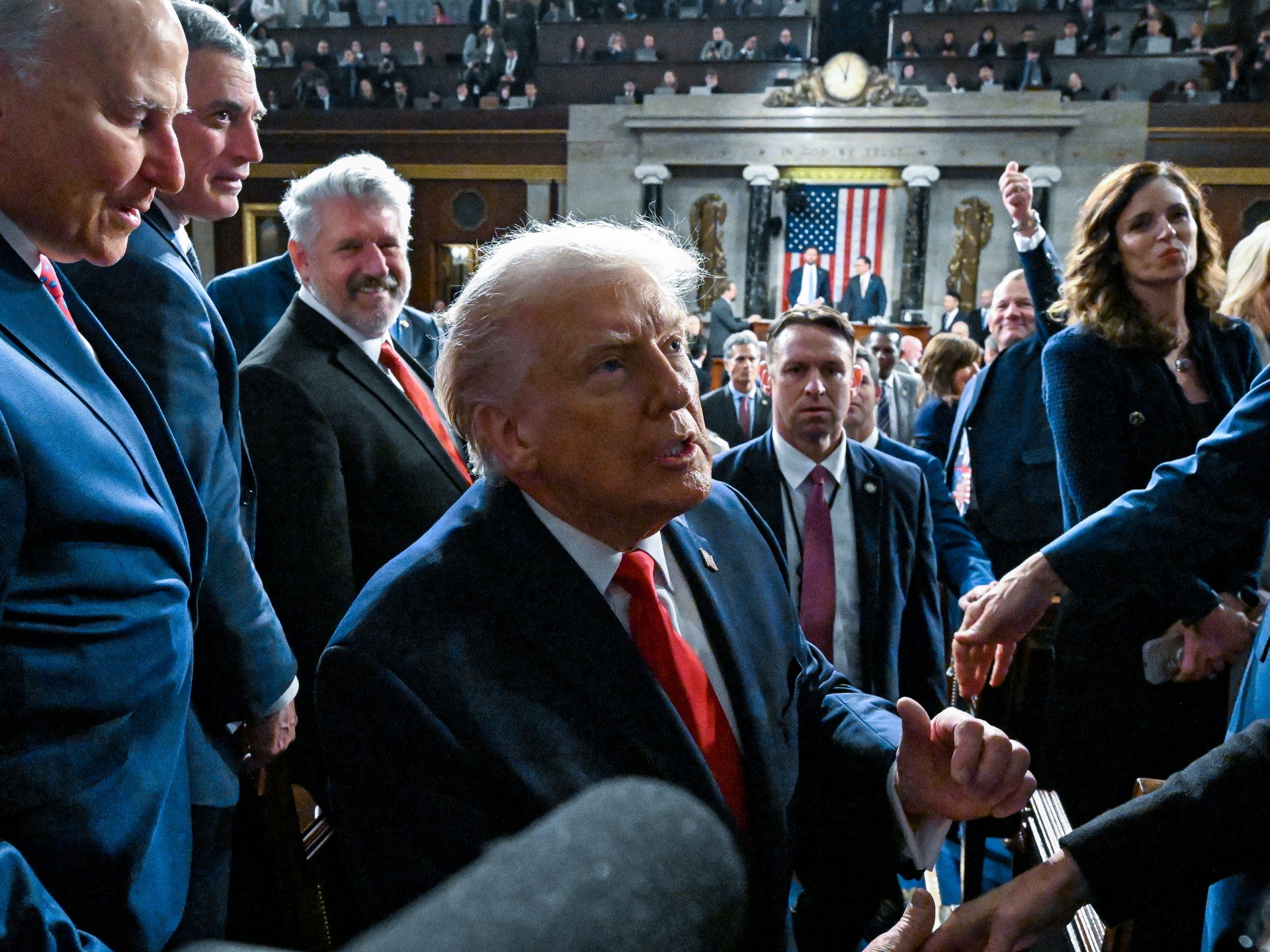
Washington, DC – United States President Donald Trump has hailed the first 13 months of his second term as nothing short of “transformative” during his State of the Union address, a message of victory the White House says he will continue to take on the road as he seeks to build support for his Republican Party before the midterm elections in November.
But the speech on Tuesday also underscored uncomfortable political realities for Trump, laying bare the vulnerabilities of a president who has relied on a flood of executive orders, unilateral actions and emergency declarations to build his agenda.
Recommended Stories
list of 3 itemsend of list
The Supreme Court’s ruling against his signature tariff policy – just days before the speech – underscored just how quickly Trump’s most brazen and signature actions could disintegrate amid a mountain of legal challenges.
“It was a speech to shore up his base of supporters,” said Aaron Kall, a professor at the University of Michigan who studies presidential messaging, “as opposed to extending olive branches to Democrats or trying to attract new supporters”.
It is a potentially constraining approach for a president who will need congressional support – including from vulnerable Republican lawmakers facing punishing re-election campaigns and centrist Democrats – to achieve many of his objectives in the months ahead.
“In some ways, Trump’s political fate and future relies upon getting some kind of buy-in or cooperation,” Kall said.
Another ‘Big Beautiful Bill’?
Trump’s most substantial legislative victory of his second term came in the form of a sweeping bill passed by the Republican-controlled Congress in July. He gave it top billing in his speech on Tuesday.
Advertisement
The legislation, dubbed by the president his “Big Beautiful Bill” and by critics as Trump’s “Big Ugly Bill”, codified several of Trump’s top agenda items from his campaign, including populist economic pledges to alleviate taxes on tips, overtime and Social Security benefits.
The bill included a raft of other top Trump agenda items: temporarily extending certain tax cuts that had been set to expire; deeply cutting funding for welfare, healthcare and foreign aid programmes; raising the national debt ceiling; rolling back clean energy incentives; and surging billions of dollars to both increase enforcement at the southern border and support Trump’s mass detention and deportation drive.
“Last year, I urged this Congress to begin the mission by passing the largest tax cuts in American history, and our Republican majorities delivered so beautifully,” Trump said during the speech although fact checkers have challenged his historic characterisation of the cuts in what they have assessed as one of several misleading claims the president made about his record and the economy.
“Thank you, Republicans,” he said.
Polls have shown the US public is not noticing a major change in their lived experience. Trump’s approval rating has slumped in the months since the bill was passed with views of his handling of the economy sliding as he entered the second year of his second nonconsecutive term in office.
“Trump takes credit for what he says are improvements that have been made, telling people why their lives are better or why they’re saving money from taxes or why costs are lower for gas,” Kall noted.
“But clearly there’s a disconnect between a good portion of the public vs the kind of story Trump’s telling.”
Trump on affordability
Trump on Tuesday did not call for another sweeping bill like the one passed last year but instead pitched several pieces of legislation broadly aimed at addressing the high cost of living.
While Trump has generally preferred a go-it-alone approach, his statements underscored that he still needs Congress for many of the policy initiatives he touted on Tuesday, even as he blamed Democrats and the administration of former President Joe Biden for the stubbornly high cost of living in the US.
For example, on healthcare, Trump hailed the 16 “most favoured nations” agreements his administration has struck with pharmaceutical companies. While full details of those agreements have not been released, they generally involve pegging prescription drug prices to the typically lower rates negotiated by foreign countries.
Advertisement
The deals have been the basis of the White House’s “TrumpRX” medication marketplace, an entity that the administration has pitched as a cheaper alternative for Americans willing to bypass insurance and pay cash for drugs. But Trump hinted at concerns over the staying power of the scheme.
“So now I’m calling on Congress to codify my most-favoured nation programme into law,” Trump said, although it remains unclear under what legal mechanism the deals could be legislated.
Trump then pointed to an executive order he signed last month that seeks to ban investment firms from buying single-family homes to rent. The phenomenon has contributed to a housing access and affordability crisis in the country and has become a particularly salient issue as the midterm elections approach.
“And now I’m asking Congress to make that ban permanent because all this for people, really, that’s what we want,” Trump said during the State of the Union, which came hours after Democrats pitched their own version of legislation aimed at the practice. “We want homes for people, not for corporations.”
Finally, Trump pitched a plan to boost retirement accounts for seniors by providing federal contributions to retirement savings programmes, known as 401(k)s. After the speech, his Treasury secretary, Scott Bessent, told NBC News that the plan could likely be achieved only through legislation.
Tariffs
The largest question mark over Trump’s economic initiatives has been on his tariff policy.
Trump has long framed aggressive tariffs on trade partners as part of his America First vision, saying it would lead to a hard reset on global trade that would incentivise US domestic industry growth.
During the State of the Union, he hailed his tariff policy as “one of the primary reasons for our country’s economic turnaround”, even as he lamented the Supreme Court’s “unfortunate ruling” deeming illegal large portions of the tariffs he announced last year.
Trump has since used a new authority to impose 10 percent tariffs on global trading partners, which he hopes to increase to 15 percent, saying on Tuesday that the plan would remain as is under “fully approved and tested alternative legal statutes”.
“Congressional action will not be necessary,” he said.
Still, the new measures will expire in 150 days, just months before the midterm elections, unless Congress acts. Some trade experts have questioned the legality of the programme with analysts at the libertarian CATO Institute think tank among those arguing the new tariffs “almost certainly violate the law”, opening the door to further legal challenges.
Meanwhile, refunds for levies collected from US businesses under the recently deemed illegal tariffs have not yet been addressed, leaving another potential political vulnerability for Republicans in the months ahead.
Trump on DHS standoff
Standing at the podium in the House of Representatives at the US Capitol, Trump showed little departure from the hardline approach to immigration that has defined the first year of his second term, even as the issue has become an increasingly political liability for Republicans.
Advertisement
Trump hailed what has been in effect a closure of the US border to asylum seekers, which he enacted under an emergency declaration that continues to face legal challenges likely bound for the Supreme Court. He used several guests to tie undocumented people to high rates of crime, a premise that has been challenged by several studies.
In one particularly theatrical moment aimed at Democrats in attendance, Trump asked lawmakers who agreed that “the first duty of the American government is to protect American citizens, not illegal aliens” to stand up. He did not mention two US citizens killed by immigration enforcement agents in Minnesota in January.
Exit polls showed Trump’s 2024 victory was, in part, buoyed by his hardline immigration stance, but more recent opinion polls have shown increased dismay over the tactics used. The issue is considered particularly fraught for Republicans facing strong Democratic challengers in the months ahead.
In the short term, Democrats have seized on the politically potent issue, holding up annual funding for the Department of Homeland Security (DHS) to press for greater oversight and reform. DHS oversees the Immigration and Customs Enforcement (ICE) agency and US Border Patrol as well as the Secret Service, Coast Guard, Transportation Security Administration and Federal Emergency Management Agency (FEMA).
“Tonight, I’m demanding the full and immediate restoration of all funding for the border security, homeland security of the United States and also for helping people clean up their snow,” Trump said during his speech as he appeared to suggest that FEMA – which rarely aids in snow removal – has been unable to respond to a recent storm that struck the US Northeast in light of the shutdown.
SAVE Act
Trump also revisited a defining message of his 2024 election campaign, his repeated claim that the US elections, including his 2020 loss to Biden, are marred by high rates of fraud and other forms of malfeasance.
Despite repeated studies, including from conservative organisations, finding tiny and largely inconsequential rates of voting fraud across decades of elections, Trump maintained during the address that “cheating is rampant in our elections”.
He called on Republicans to pass the so-called Safeguard American Voter Eligibility (SAVE) Act, a bill that would create higher documentation requirements when registering to vote and arriving at the polls as well as requiring states to hand voter rolls to DHS to identify noncitizens.
Rights groups have said the legislation would disenfranchise untold voters, noting, for example, that about half of US citizens do not have a valid passport.
The bill has passed the Republican-controlled House, but passage in the Senate would almost surely involve changing rules on the filibuster, a tool used by the opposing party to scuttle bills that do not meet a 60-vote threshold in the 100-seat chamber.
Changes to filibuster rules have long been viewed as a “nuclear option” by both parties.
Shifting priorities
The annual State of the Union address is an opportunity for presidents to make the case for their leadership and vision for the months ahead. They also reveal an administration’s shifting priorities.
For example, as Kall explained, with the US on the brink of escalation with Iran, uncertainty still lingering after the US abduction of Venezuelan leader Nicolas Maduro and Trump recently pledging $10bn in support of his Board of Peace, launched to address rebuilding in Gaza and other conflicts around the world, the president chose not to dive into foreign policy until more than 90 minutes into his speech.
Advertisement
Critics have seen Trump’s foreign adventurism as a direct contradiction to his campaign promises to end US intervention abroad.
Trump’s desire to take control of Greenland was another major point in his March address to a joint session of Congress. But after a so-far unsuccessful pressure campaign beginning in January against European countries, the self-governed Danish territory was not mentioned in this year’s speech.
Meanwhile, while marquee themes like the economy, immigration and trade remained constant from Trump’s last address to a joint session of Congress, other areas received no mention, including the formerly Elon Musk-led Department of Government Efficiency (DOGE), which made cuts to the federal government workforce, leading to agency disruptions but falling far short of savings pledges.
“The president has the benefit of how to frame the State of the Union,” Kall said. “Trump’s speech reflected the political reality of the time.”
Disclaimer : This story is auto aggregated by a computer programme and has not been created or edited by DOWNTHENEWS. Publisher: aljazeera.com