For more than two decades, Ratnakar Lavu’s career in technology focused on retailers including Macy’s and Bloomingdale’s. As his career matured, he moved into the C-suite to serve as chief technology officer at department store Kohl’s and global chief digital information office at sportswear giant Nike.
But in early 2024, Lavu took a big leap into an entirely new industry. He became CDIO at health benefits provider Elevance Health, which ranks No. 20 on the Fortune 500 with $197.6 billion in operating revenue in 2025, a 13% increase from the prior year. Lavu says that although the industries are vastly different, both can benefit from investments in technology intended to make it easier to serve customers.
“My past experience has been with large consumer brands; we’re always focused on leveraging technology to transform brands and create delightful, personalized customer experiences,” says Lavu. “At Elevance Health, I’m trying to do the same thing.”
To be sure, leveraging technology to bring “delight” to the complex and expensive healthcare system is a far loftier challenge than selling sneakers or designer purses. American satisfaction with U.S. healthcare costs is at the lowest level Gallup has recorded since 2001, with only 16% now saying they are satisfied, down from the all-time high of 30% in the first year of the COVID-19 pandemic. Nearly one in four say the U.S. healthcare system is “in a state of crisis,” while 47% believe it has “major problems,” according to a poll published in December.
Lavu says he believes that AI can help simplify the system and improve health outcomes, and he focuses his investments on three areas, all of which have some exposure to generative AI. For the company’s 45.2 million medical members, there’s a ChatGPT-like experience built into Elevance Health’s Sydney mobile app, where users can ask questions in natural language, such as, “I need knee surgery. Am I covered and if so, how much will my co-pay be?” Sydney can answer those questions. The chat feature can also recommend providers who are regionally close to the member and are also in network, which is more cost effective than an out-of-network health practitioner.
The second pillar centers on Elevance Health’s health plans, which include its Anthem Blue Cross and Blue Shield, Wellpoint, and Carelon brands. Lavu has deployed AI for prior authorization, a process that requires a doctor to obtain approval for a health plan before providing treatment or writing a prescription. AI is automating some of those requests, though humans are still in the mix for some evaluations.
Elevance Health has also built an internally developed AI chatbot called Spark, which leverages multiple large language models to handle document analysis and other common corporate tasks. Elevance Health says more than 60,000 associates use Spark and in the first half of 2025, 10 million messages were sent through the chatbot.
The company is also in the process of deploying an enterprise ChatGPT license across the company and is working with the AI startup to give tens of thousands of associates an opportunity to earn certifications in AI fluency, which includes responsible AI, prompt engineering, and more advanced AI-enabled work.
“We’re really dedicating our time and effort to make sure all our employees are upskilled,” says Lavu.
Lavu is still in the process of making meaningful headway on agentic AI, though he says this form of the technology is especially promising within healthcare, as it can handle more complex tasks across benefits and claims. He has been exploring agentic AI use cases across all three of Elevance Health’s priority pillars and expects to scale them more aggressively in 2026.
What Lavu is now focused on is setting up the proper guardrails to clearly define what tasks these agents can perform and, just as importantly, what they shouldn’t do. He wants to very precisely train them on only the right data needed to perform their tasks. And employees will always remain in the mix.
“A human can actually oversee multiple agents,” says Lavu. “But there has to be some oversight, because we want to ensure that the agent does not deviate from its task that it’s been assigned.”
John Kell
Send thoughts or suggestions to CIO Intelligence here.
NEWS PACKETS
Anthropic faces challenges on both home and foreign turfs. This week, Anthropic CEO Dario Amodei was summoned to meet with the Pentagon in Washington for a meeting to discuss how the AI startup’s technology is used in classified systems, as the Defense Department aims to use the company’s technology more broadly than allowed under a $200 million contract that was signed last year. The New York Times reports that the Pentagon has signed a deal with xAI and is getting close to another with Google, hoping those pacts can put pressure on Anthropic. Separately this week, Anthropic accused three Chinese startups—DeepSeek, Moonshot, and MiniMax—of using data from its AI systems to train their own chatbots. OpenAI has made similar claims and both have warned the practice is a national security risk.
Meta to spend billions in AMD chips deal. Meta and AMD (the sponsor of this newsletter) on Tuesday announced a multi-year deal to buy the latter company’s chips and computers to run AI models, a transaction that’s expected to be worth “double-digit billions,” according to Bloomberg, who attributed the figure to AMD CEO Lisa Su. Another part of the deal will allow Meta to take a financial stake of up to 10% in the chip company, which is similar to a deal that AMD struck with OpenAI last fall to provide chips in exchange for a performance-based stock warrant that would vest as specific milestones were met.
IBM’s shares take a tumble, thanks to Anthropic. Bloomberg reports that IBM’s shares had their worst day in more than 25 years after Anthropic said the company’s Claude Code tool could help modernize a programming language from 1959 but is still used by many governments and private companies to run financial, administrative, and business applications. Cobol still supports 95% of ATM transactions in the U.S. and 80% of in-person credit card swipes. IBM quickly responded to buffer the market fears. “The value IBM mainframe delivers has nothing to do with Cobol,” wrote Rob Thomas, IBM’s senior vice president of software and chief commercial officer in a blog post. He added that no matter how the application is written—be it Cobol, Java, etc.—”the language is not the source of that value. The platform is.”
Did an AI coding bot cause two outages at Amazon Web Services? A kerfuffle emerged between Amazon and the Financial Times after the news outlet reported that the tech giant’s cloud division, AWS, had experienced at least two outages that involved the company’s own Kiro AI coding tool, citing four people familiar with the matter. But Amazon issued a public rebuttal that asserted in both instances that the issue was a user error—specifically, misconfigured access controls—and not AI. Amazon told the FT that it was “a coincidence that AI tools were involved.”
Walmart says AI played a key role in its latest earnings report. Walmart, which recently lost the No. 1 spot on the Fortune 500 to rival Amazon, reported strong sales growth for the latest quarter due to rising demand from the grocery and online businesses. But CIO Dive homed in on the role of the retailer’s AI efforts, as new CEO John Furner told Wall Street analysts that technology and AI “is helping us create greater customer solutions, reduce friction, simplify decision-making and pinpoint where our inventory is.” Automation has also helped Walmart move inventory more seamlessly across its vast system. It now claims that 60% of stores receive some freight from automated distribution centers.
ADOPTION CURVE
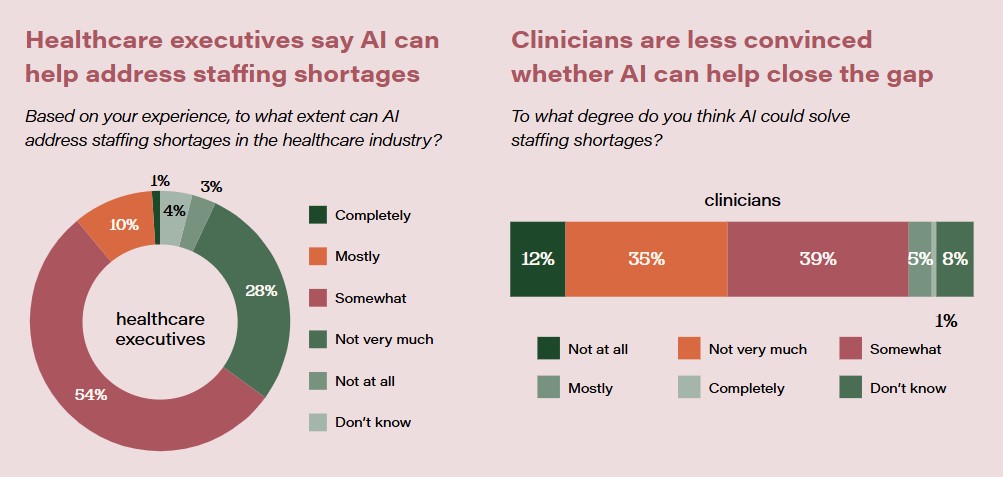
Healthcare executives are more bullish on AI than clinicians. As the global healthcare system is expected to face a worker shortage of at least 10 million by 2030, leading experts increasingly prescribe to the idea that AI can help. Three out of every four healthcare executives say that AI has a positive impact on care quality and 65% believe the technology can address staffing shortages “at least somewhat,” according to a survey of 1,347 clinicians and 167 executives fielded by Gallup and funded by healthcare education company Covista.
The study found that AI is already fairly pervasive across health systems: 71% say it is being used for documentation, 54% for electronic health records, and 48% for diagnostics. But even as AI use cases proliferate, clinicians remain a bit more skeptical than the top brass. Only 45% believe that AI can address staffing shortages “at least somewhat,” and a mere 6% believe it can solve the problem mostly or completely.
“With any innovation, any new technology, it’s hard to overstate the importance of trust,” Steve Beard, CEO of Covista, tells Fortune. “The way to do that is to get wins in places where the stakes are lower, in nondiagnostic, nonacute care settings.”
Courtesy of Covista
JOBS RADAR
Hiring:
– Code for America is seeking a CTO, a remote-based role for a company headquartered in Oakland, California. Posted salary range: $250K-$320K/year.
– Chief is seeking a vice president, head of technology, based in New York City. Posted salary: $285K/year.
– Town School for Boys is seeking a CTO, based in San Francisco. Posted salary range: $180K-$210K/year.
– CoralTree Hospitality is seeking a CTO, based in Englewood, Colorado. Posted salary range: $250K-$275K/year.
Hired:
– Xcel Energy announced the appointment of Rob Cain as CTO, effective immediately, succeeding Tim Peterson, who accepted a position outside of the Minnesota-based utility. For the past seven years, Cain served as a partner in the Minneapolis office of consulting firm McKinsey. He also previously served as a partner at consultancy PwC and as CIO at beverage giant Coca-Cola.
– Michael Baker appointed Rod Malehmir to the role of CTO, leading the engineering services and consulting company’s technology team of more than 400. Malehmir joins from consultancy Tetra Tech, where he served as senior vice president of AI and digital solutions.
– TripleKey appointed Jon Brown to the role of CIO. He joins the cybersecurity and software risk management company with more than 30 years of leadership experience, including serving as CIO for Veterinary Practice Partners, CIO of the North Carolina-based healthcare system Mission Health, and director of IT security at Wake Forest University Baptist Medical Center.
– American National Standards Institute has named Ed Anderson to serve as chief digital officer, effective Monday. Most recently, Anderson was chief administrative officer and chief financial officer for the nonprofit Habitat for Humanity International. He also previously held leadership roles at private charity World Vision International and as a presidential appointee with the U.S. Peace Corps.
– Volatus Aerospace announced the appointment of Krish Srinivasan as CTO, where he will oversee the unified engineering organization across Canada, the U.S., and the U.K. Srinivasan joins the drones company after most recently serving as CTO for the healthcare technology company CanAide. He also held leadership roles at healthcare-focused firms Greenway Health and Siemens Healthineers.
– Flywire appointed Patrick Blanc as CTO, overseeing the global engineering team and the technology strategy and execution across the global payments company’s platform and software. Most recently, Blanc served as CTO of French payments company Ingenico and also previously held technology leadership roles at Visa and PayPal.
– XiFin named Sanjay Kumar as CTO to lead the healthcare IT company’s AI innovation strategy. Kumar most recently served as CTO of medical device maker ResMed’s residential care software business. He also previously served as VP of engineering at Teradata, Intuit, and Sabre Holdings.
Disclaimer : This story is auto aggregated by a computer programme and has not been created or edited by DOWNTHENEWS. Publisher: fortune.com