
TOKYO, Mar 27 (News On Japan) –
AI is rapidly transforming everyday life, with its latest advancements now revolutionizing manufacturing, reaching even into areas once considered the exclusive domain of skilled artisans.
[embedded content]
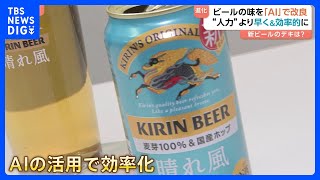
Nearly two years after its launch, Kirin Brewery’s “Harekaze,” recognized for its refreshing light blue packaging, has maintained strong sales, but the company is now looking to further evolve the product using AI.
Shunsaku Kameoka of Kirin Brewery’s product development group said, “We aim to create even better-tasting products by utilizing AI.”
Beer development has traditionally been a highly analog process, relying heavily on developers’ taste buds through repeated sampling to refine flavor.
“When adjusting aroma, we align it with our own sensory perception to determine direction,” Kameoka explained, noting that developers would repeatedly smell hops and rely on human judgment to pursue ideal taste.
For the first time, however, Kirin is attempting a product renewal using AI.
The company has developed its own preference-based AI system, “FJWLA (Fujiwara),” which has learned from 20 years of accumulated consumer research data and beer composition records. When analyzed, the system produces results quickly and visually.
Yuto Fujiwara of Kirin Holdings’ Beverage Future Research Institute said, “We can easily check results in a simplified way.”
The analysis breaks down elements such as aroma, taste, and hop content, with red indicating “delicious” and blue indicating “not delicious.” In one example, the hop component appeared in red, showing that many consumers favored it, leading developers to increase the hop ratio.
During internal product meetings, participants noted, “It achieves a pleasant hop aroma and a sense of drinkability,” and “It’s not too heavy, yet the aroma is clearly present and very enjoyable.”
The newly developed beer has been well received, with AI enabling faster and more efficient production compared to traditional human-led methods.
Fujiwara added, “We hope to develop AI that can analyze what kind of products should be created to ensure long-term repeat purchases.”
AI’s impact on manufacturing is not limited to food and beverages—it is also advancing into fields that have long depended on craftsmanship.
At a company producing machinery for metal component processing, where skilled labor has traditionally been essential, AI is now playing a central role.
Kiyoyuki Hirayama, president of Alm Co., said, “This is a fully domestic manufacturing AI. Everything can be operated through conversation.”
Workers select the desired component and give verbal instructions to an AI avatar, which confirms the task before proceeding.
The AI, trained on the expertise of veteran craftsmen, autonomously determines the necessary steps and completes the process in about 10 minutes.
In comparison, a craftsman with 10 years of experience typically requires around one hour to complete the same task.
In terms of quality, Hirayama noted, “You can see burrs appearing,” referring to imperfections in the human-made product.
The AI-produced components showed fewer burrs and higher precision.
Developers emphasize that the goal is not to replace human craftsmen, but to create a future in which both coexist.
Hirayama said, “To fully utilize the skills of craftsmen, leveraging generative AI is essential.”
Source: TBS
Disclaimer : This story is auto aggregated by a computer programme and has not been created or edited by DOWNTHENEWS. Publisher: newsonjapan.com