Energy demand from vast new data centres will leap tenfold over the next decade, exacerbating stress on the grid and driving up energy costs by around a quarter in NSW and Victoria and national greenhouse gas emissions by 14 per cent, unless properly managed, according to an analysis by the government-owned green energy investor, the Clean Energy Finance Corporation.
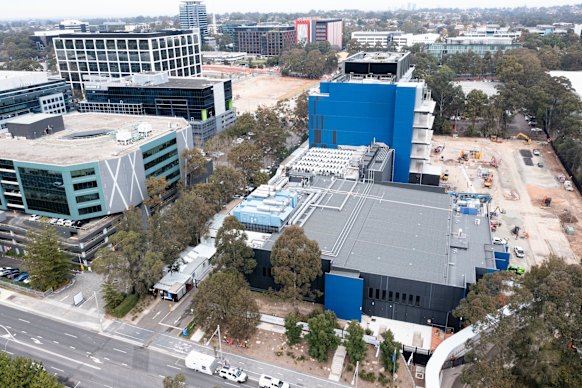
The Macquarie Telecom data centre in Sydney’s Macquarie Park.Credit: Janie Barrett
The CEFC called on Australian governments to consider developing policy or incentives to direct some new data centres to be built outside the metropolitan fringes in Renewable Energy Zones where they can use existing or planned new transmission lines, and consider requiring them to contribute to the cost of new grid connections the centres require, the CEFC recommends.
A new report into the industry’s energy demands commissioned by the CEFC forecasts that data centres could represent up to 11 per cent of Australia’s total electricity consumption by 2035, up from about 1 per cent today, as it meets new demand from data storage, cloud computing and digital infrastructure demand.
Such a surge would attract between $85 billion to $135 billion in investment, says the report by Baringa Consulting.
At present about half of all new planned data storage capacity is planned for western Sydney, and about a quarter for Melbourne.
The CEFC modelling considered a range of scenarios modelling the industry’s projected growth and the development of renewable energy capacity.
“Without additional renewable energy and storage, data centre growth could significantly impact the electricity market, potentially increasing wholesale electricity prices by 26 per cent in NSW and 23 per cent in Victoria by 2035 in the central case, compared to the baseline scenario, primarily driven by a need for more expensive gas peaking generation.
“This reliance not only drives up prices, but could also lead to a 14 per cent increase in grid emissions across the NEM. This is not specific to data centre load, but an inherent result of load growth tightening electricity supply in the short term,” says the report.
It said that to mitigate most of this impact an additional 3.2 GW of renewable capacity will be required over the next decade, in addition to wind and solar already expected to be built – enough for almost 5 million Australian households.
“While challenging, if the right incentives were in place to enable this additional renewable generation to be built in those time frames, price rises would be limited to 7 per cent for NSW and 6 per cent for Victoria, with emissions increases eliminated.
“Price rises could be further reduced by introducing additional flexibility through the deployment of a further 1.9 GW of large-scale battery energy storage systems.”
If governments collaborated on policies to manage the demand by co-ordinating on driving some of the new centres towards to Renewable Energy Zones outside metropolitan areas that had adequate grid and data collections, water supply for cooling the centres, and workforces, the new demand could help drive investment towards renewable energy and help stabilise the grid as it grows, said the CEFC’s head of infrastructure, Julia Hinwood.
The report finds that in some areas the development of large data centres can benefit grid management. The large and steady demand of data centres can reduce renewable curtailment, which sees green energy blocked from flowing onto the grid during peak generation periods when the sun strongest in the middle of the day.
This, in turn, could improve the business case for new renewable development and smooth grid supply and demand.
Hinwood said good planning could help Australia support the industry while avoiding problems faced in Ireland, where surging data centre demand now accounts for 21 per cent of energy, and Singapore, which had to introduce a moratorium on new centres.
A spokesman for Climate Change and Energy Minister Chris Bowen said Australia should keep building its reputation as a top choice for data centre development, and that the report showed that if “we get settings right” the industry can drive new investment in clean energy. “Our focus will be ensuring this doesn’t come at a cost to consumers.”
On Monday, a report showing individual data centres proposed for major cities are seeking daily water volumes equivalent to that used by 80,000 homes was published, prompting calls for stricter regulation and water efficiency standards.
At last month’s United Nations climate talks in Brazil, Melbourne Lord Mayor Nicholas Reece championed an initiative for cities around the world to develop shared guidelines and standards for low-carbon and water-efficient AI infrastructure.
At the time Reece said data centres and AI infrastructure currently accounts for 2 per cent of Melbourne’s energy consumption, which is expected to rise to 8 per cent in five years and 20 per cent by 2040.
Get to the heart of what’s happening with climate change and the environment. Sign up for our fortnightly Environment newsletter.
Most Viewed in Politics
Disclaimer : This story is auto aggregated by a computer programme and has not been created or edited by DOWNTHENEWS. Publisher: www.smh.com.au