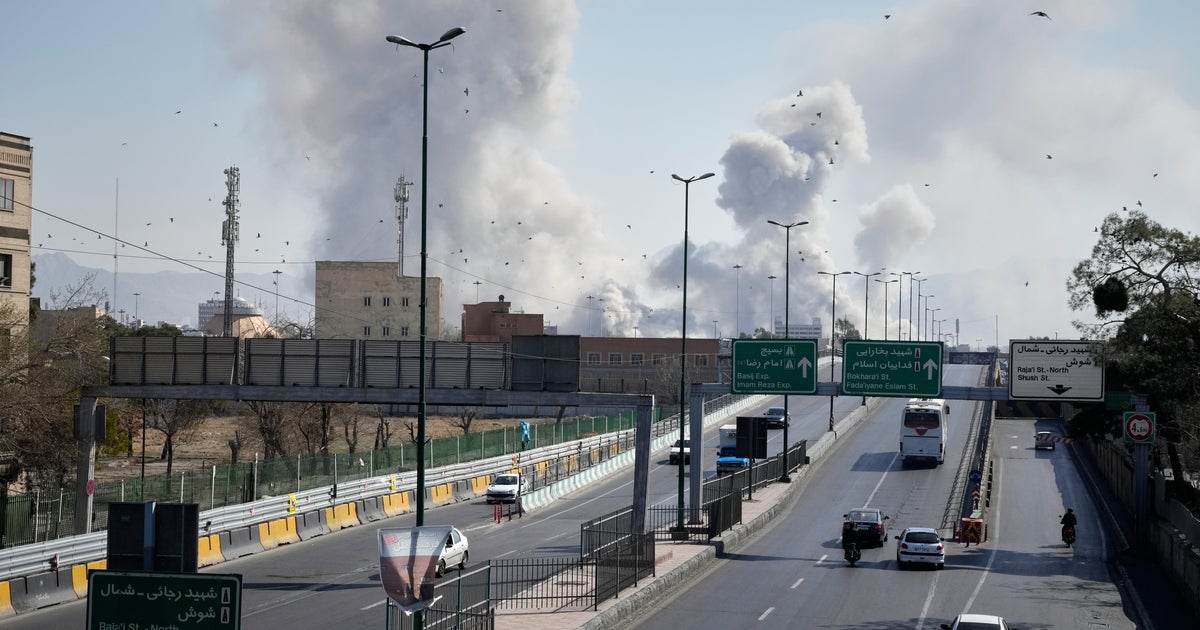
Washington — U.S. and Israeli airstrikes alone are unlikely to result in the ouster of the Iranian government, according to an expert in air campaigns, who said that the risks are growing for a more drawn-out war that could spread beyond the Middle East.
Robert Pape, a professor of political science at the University of Chicago who has studied air power for three decades, told CBS News 24/7 that history does not support the idea that bombing alone can unseat a regime and install a more friendly leader.
“The fact of the matter is, for over a century, states have been trying to topple regimes with air power alone and — I’m choosing my words carefully — it has never worked,” Pape told CBS News 24/7 on Friday. “We are heading toward the predictable result of growing risk, growing escalation. And I’m sorry to say this could go on for quite some time.”
Israeli airstrikes at the start of the war killed Supreme Leader Ayatollah Ali Khamenei and dozens of other top government officials, but the country’s military and senior clerics still control the levers of power. The Iranian Revolutionary Guard Corps has continued to launch retaliatory drone and missile attacks across the region, and a clerical body has been working to select the country’s next supreme leader.
Pape said the initial U.S. and Israeli strikes failed to “produce quick and decisive victory.”
“It’s ultimately a self-defeating policy practice politically. We are injecting nationalism, and the usual result is you get a more hard-line leader. This is why President Trump is saying, ‘I don’t want that one guy,'” he said, referring to Khamenei’s son. “It’s because he would be much worse than what we had before.”
President Trump warned Friday that he will accept nothing less than “UNCONDITIONAL SURRENDER,” and has not ruled out the use of ground troops.
The president has called for the Iranian people to seize the opportunity to overthrow the government, but he has also signaled he could accept a new leader in the current power structure if they are more amenable to the U.S. Mr. Trump has frequently cited the example of Venezuela, where American forces captured President Nicolás Maduro and installed an interim leader who is cooperating with the U.S.
Amos Yadlin, the former head of Israeli military intelligence, told CBS News on Friday that no reasonable person in the Israeli government or military believes regime change is feasible at this point.
Pape said that Iran “can do many things to prolong the war and hurt us and never fight a set-piece battle with us.”
“That’s how we lost the Vietnam War. And I’m sorry to say, we’re heading down a road where we don’t have a strategy to win,” he added.
U.S. allies in the Gulf have warned that they are running low on interceptors needed to take out Iranian missiles, CBS News reported Thursday, adding to concerns about the ability to replenish stockpiles of expensive weapons used to repel comparatively low-cost drones and missiles.
Pape said he began studying the effectiveness of bombing campaigns in the 1980s to understand how the U.S. lost in Vietnam, despite overwhelming advantages in technology and resources. He said he began working with the U.S. Air Force with the emergence of precision-guided weapons in the 1990s.
“All of a sudden you talked about intel. This was the whole idea. The idea is, ‘Wow, we have precision targeting. We’ll do this with precision intel. We really can now take down governments,'” he said. “And notice, we just can’t simply do that. We’ve tried over and over and over in the precision age. There’s a record of zero success in the last 30 years. And the reason is because the targeting is so mesmerizing, you don’t see the long war coming.”
Pape said the risk of the current conflict is that “this will not just stop at escalation in the Middle East. This will start to escalate more globally as the weeks and time goes on.” He said Iran and its proxy groups could begin to strike targets around the world.
“There’s not really a strategy here. Doubling down, talking tough and smack in front of your publics — that is the way democracies often get into these long wars,” he said. “And then those leaders basically look like embarrassments years later, because it turns out it just doesn’t work. So where is the strategy, is my question.”
Pape’s concerns mirror others expressed by analysts and experts in recent days as the outlines of the war have come into focus. Elliot Ackerman, a CBS News contributor and former CIA officer, told CBS News’ “The Takeout” earlier this week that the war is “incredibly risky.”
“It relies upon elements of Iranian civil society to rise up and take control of their government. We are toppling a regime in a region that is extremely complex. Iran is the second-largest country in the Middle East,” he said. “And I just am very skeptical that this isn’t going to get very, very messy and that it’s not going to be over for quite some time.”
Disclaimer : This story is auto aggregated by a computer programme and has not been created or edited by DOWNTHENEWS. Publisher: cbsnews.com