Australia and the United States share a tragic anniversary. On December 14 on Bondi Beach, 15 people were murdered at a Hanukkah celebration. On December 14, 2012, at Sandy Hook Elementary, 20 children were murdered along with six teachers and staff.
These killings are joined by more than the merciless slaying of innocents we saw in Sydney on Sunday and in Newtown, Connecticut, 13 years ago. For the men leading their nations in these moments of profound grief and anger, they also presented a powerful opportunity to do something big, something vital and something good.
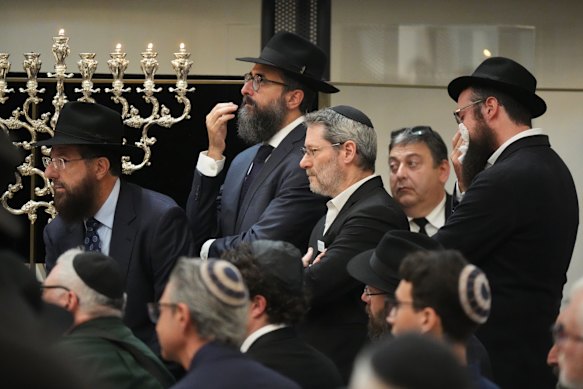
Mourners gather at a synagogue for the funeral of Rabbi Eli Schlanger, a victim in the Bondi Beach mass shooting, on Wednesday, December 17.Credit: AP
Barack Obama tried.
Within hours of the shooting, he made clear his intention to tackle the absurdly liberal gun laws that enabled 20-year-old Adam Lanza to get his hands on an assault rifle, shotgun and two semi-automatic pistols legally owned by his mother, who was also his first victim.
“These neighbourhoods are our neighbourhoods, these children are our children, and we’re going to have to come together and take meaningful action to prevent more tragedies like this, regardless of politics,” said Obama, who has since described the Sandy Hook school shooting as the darkest day of his presidency.
Politics had other ideas. A craven Congress and the influence of National Rifle Association ensured Obama fell six Senate votes short of securing gun law reform. Obama later reflected the defeat of that bill was the most bitter disappointment of his eight years in office.
Sandy Hook is now a byword, not only for the grief and trauma of school shootings, but the sclerotic dysfunction of a political system which, even after so many little kids were murdered in their classrooms, could not break the yoke of the gun lobby.
Anthony Albanese, within hours of the Bondi Beach massacre where a father and son apparently radicalised by Islamic extremism used a shotgun and hunting rifles to target and murder Jews, vowed to “eradicate” antisemitism, a hatred that has taken deep root in Australia since the start of Israel’s war against Hamas.
Borrowing from the imagery of Hanukkah, the prime minister said: “There are nights that tear at the nation’s soul. In this moment of darkness, we must be each other’s light.”
Three days later, Jewish leaders are wondering whether there are any lights on at the Lodge.
Instead of dedicating his energy and making best use of the extraordinary social licence his government and federal and state parliaments have to confront antisemitism wherever it ferments, the immediate response of Albanese and the National Cabinet he chairs was to strengthen Australia’s gun laws adopted after the Port Arthur massacre.
The architect of those laws, former prime minister John Howard, called it a diversion. I fear the truth is more banal and disappointing. Albanese has become so risk-averse, so hard-wired to cause least offence, he cannot see the potential of his own leadership in this awful moment.
National regulation of firearms can be improved and a review is sensible. But this is not the problem. Not in the eyes of Jewish people who send their kids to school under armed guard, pass through security gates to access their place of worship and reflexively tuck their Star of David pendants into their shirts when in unfamiliar company.
Jews aren’t asking for laws that make it harder for people who hate them to shoot them; they want the government to do something about the hate. In Victoria, the Allan government’s initial policy offering – money for more security guards at Jewish institutions, events and holiday camps and access to mental health services – was similarly underwhelming.
Tacked on the bottom of the press release was a paltry commitment of $250,000 for a “therapeutic intervention program” to combat extremism.
Jews keep telling us they don’t want to live behind higher walls or amid tighter security. We don’t expect any other community in Australia to live like this. Zionism Victoria president Elyse Schachna politely thanked the premier for the money but urged her to do something about the bigger problem.
What does this problem look like? Philip Zajac, the president of the Jewish Community Council of Victoria, sketched an all-too familiar picture.
“Antisemitism in Australia has not come out of nowhere,” he says. “We have seen it on the streets of Melbourne for years now; signs that call all Zionist terrorists and declare that Jews hate freedom. Chants to globalise the intifada.
“We have seen it online – influential, local influencers, doxing and attacking Jewish teenagers. Comments turned off on any news article that mentions Jews because the responses are too vile for the publication. And in the case of all of these real examples that I have mentioned, not a single charge has been laid, not a single consequence felt by the perpetrators.”
Jillian Segal, the prime minister’s special envoy on antisemitism, identified five months ago where reforms are needed. She wants children to be better educated at school about the Holocaust, Israel and antisemitism to be taught at school and for funding to be stripped from universities that indulge antisemitism. She wants us to take a harder look at whether our migration system is importing hatred against Jews.
Albanese, insists there is “ongoing work” in all these areas. “We have taken the report from the antisemitism envoy and what we are doing is busy implementing it,” he says.
If Albanese is to deliver what he has promised, he needs to get a lot busier. He will need to enlist state premiers, university vice-chancellors and willing partners in the union movement, arts, media and creative industries. “The prime minister alone, even though he is a very powerful figure, can’t implement the plan,” Segal says.
But first, he must show he is serious about trying.
Chip Le Grand is state political editor.
The Opinion newsletter is a weekly wrap of views that will challenge, champion and inform your own. Sign up here.
Most Viewed in National
Disclaimer : This story is auto aggregated by a computer programme and has not been created or edited by DOWNTHENEWS. Publisher: www.smh.com.au