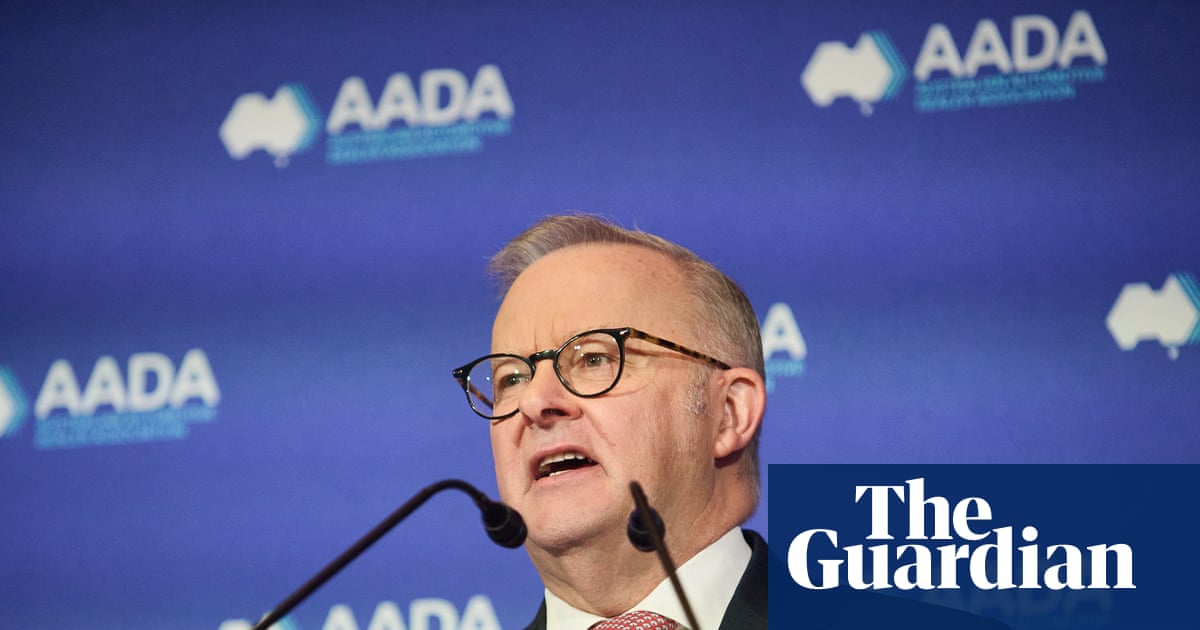
Anthony Albanese says the federal government is preparing new measures to help shield households from the economic fallout of the war in Iran, likening supply chain and fuel disruptions to the Covid-19 pandemic.
Announcing a snap meeting of national cabinet on fuel supply set to take place on Thursday morning, the prime minister used a speech to the Australian Automotive Dealer Association in Sydney to warn the international reality had shifted because of the US and Israeli-led bombings.
Albanese said stability and predictability in international affairs had gone, and major economic reforms of the 1980s and 1990s were no longer sufficient for the economy.
“It’s a different world now,” he said. “We need to acknowledge that, and we need to respond to that.”
National cabinet will discuss coordination efforts to ensure fuel shortages are minimised amid a massive spike in demand, including regional communities where some petrol stations have closed.
Albanese said better planning for disruptions would be a feature of the May budget.
He will chair Thursday’s virtual meeting with state premiers and territory chief ministers from Tasmania.
“We want to make sure that we do everything we can to shield the Australian economy, households and businesses from the worst of global uncertainty,” he said.
“This new global challenge demonstrates that we must keep building Australia’s self-reliance and our economic resilience.”
He likened the current crisis to the Covid-19 pandemic and disruption caused by Russia’s invasion of Ukraine, calling the war the third major economic shock in a decade.
The energy minister, Chris Bowen, said on Wednesday that Australia’s fuel supply remained “very solid”, with all deliveries into the country arriving as expected so far, despite uncertainty over passage through the strait of Hormuz. As much as a fifth of global fuel supply comes through the strategic waterway, bordered by Iran and the United Arab Emirates.
He said panic buying and stockpiling were causing shortages.
“We’ve faced real shortages, particularly rural areas, as we dealt with a 100% increase in demand in a very short period of time,” Bowen told ABC TV.
“Any supply chain is going to struggle with that, regardless of … what commodity you’re talking about.”
The government has already directed fuel companies to release nearly one-fifth of reserve petrol and diesel supplies, and relaxed standards to allow higher sulphur levels in fuel.
That move was designed to inject an extra 100m litres a month into the system for 60 days.
The Greens leader, Larissa Waters, called for national cabinet to consider free public transport to help drivers struggling with higher fuel prices.
“They should discuss making public transport free for as long as the crisis goes on for,” Waters wrote on social media. “And as the federal government is backing the war, they should pick up the tab.”
The opposition leader, Angus Taylor, said the agriculture sector would be hard hit by fuel shortages as it looks to winter crops and sowing season.
Taylor said Bowen was failing at his job.
“He has to be across where the fuel is, working with the companies to get it to customers, to get it to farmers, to get it to truckies,” he said.
“We should have Australian fuel serving Australians and that has not been the case.”
The transport minister, Catherine King, is holding a fuel security roundtable with key stakeholders from the transport industry on Wednesday.
Disclaimer : This story is auto aggregated by a computer programme and has not been created or edited by DOWNTHENEWS. Publisher: theguardian.com