
By Zach Hope
Singapore: Almost 1000 people are dead across Asia after the latest extreme weather events to hit the region, with hundreds more missing following floods, cyclones and landslides that devastated Indonesia and Sri Lanka over the past week.
At least 440 people have died on the large Indonesian island of Sumatra since Tuesday after a rare cyclone, called Typhoon Senyar, formed over the Malacca Strait and hit Aceh province hard, dumping torrential rain and triggering landslides.
Rescuers carry the body of a flood victim, in Agam, West Sumatra, Indonesia, on Sunday.Credit: AP
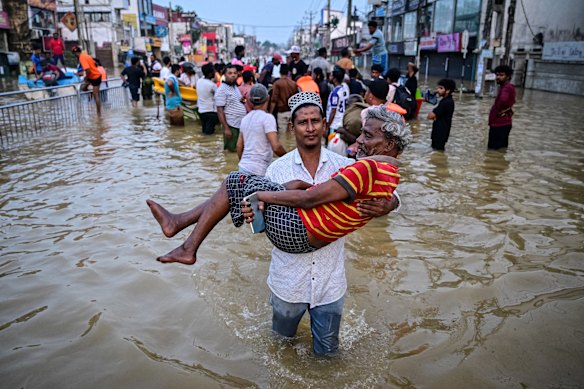
A Sri Lankan man carries another through a flooded street after heavy rainfall in Wellampitiya on the outskirts of Colombo on Sunday.Credit: AFP
Another 400 people across the provinces of Aceh, West Sumatra and North Sumatra remain missing, the National Disaster Management Agency said.
More than 2000 kilometres away, in Sri Lanka, the death toll from Cyclone Ditwah has passed 330, according to local media reports. That storm made landfall on Thursday. Nearly a million people have been affected by heavy rains and floods, forcing about 200,000 into shelters.
Overall, extreme weather across Asia over the past month has killed more than 1000 people – a toll that is expected to rise as rescuers pick through flattened villages and suburbs for those recorded as missing.
The catastrophes still unfolding in Indonesia and Sri Lanka follow record-breaking rain in southern Thailand last month that killed at least 160 people and which has been described by authorities there as a one-in-300-year event.
Typhoon Kalmaegi is also believed to have killed at least 200 people in the Philippines and was one of several storms to also hit Vietnam, where at least 90 people, mostly in the central regions, were killed in flooding.
The north-east monsoon season, typically from November to February, corresponds with wetter months in the southern portion of South-East Asia.
But the extreme rain in Thailand may have also been influenced by a La Nina at the same time as a negative Indian Ocean Dipole, said the Singapore-based ASEAN Specialised Meteorological Centre, as well as the interplay of Typhoon Koto in the Philippines and Cyclone Senyar in the Malacca Strait.
Another factor may be rising sea level temperatures. Asia’s average temperature in 2024 was about 1.04 degrees above the 1991-2020 average, ranking as the warmest or second-warmest year on record, depending on the dataset, the World Meteorological Organisation said.
“Normally, we have three seasons – hot, rain and cold. But our seasons have changed. They are not stable,” Teerapat Kutchamath, Thailand’s director-general of the Department of Disaster Prevention and Mitigation, told this masthead last week.
with Reuters
Disclaimer : This story is auto aggregated by a computer programme and has not been created or edited by DOWNTHENEWS. Publisher: www.smh.com.au