Fresh from a narrow and bruising loss in the federal seat of Kooyong, newly preselected Malvern candidate Amelia Hamer shies away from the suggestion she is a treasurer-in-waiting.
But the 32-year-old stockbroker and Oxford graduate speaks fluently – and frequently – of her experience with balance sheets and revenue streams and is happy to promote herself as part of a new generation of Liberals seeking to reclaim the party’s reputation for economic management.
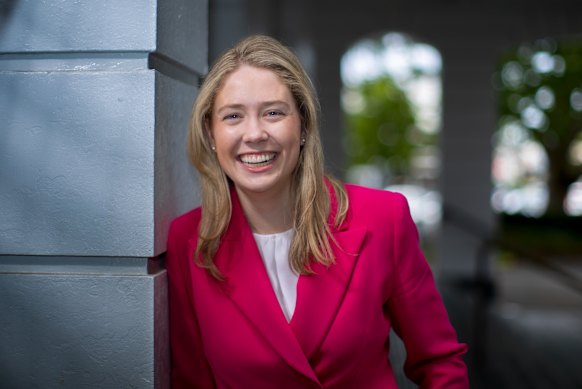
Amelia Hamer has been endorsed as the Liberal Party’s candidate for the state seat of Malvern at Victoria’s 2026 electionCredit: Simon Schluter
It’s a reputation the Victorian division of the Liberal Party has struggled to hold on to, cycling through shadow treasurers and repeatedly failing to land an economic blow on the government despite ballooning debt and infrastructure blowouts.
“I analyse company balance sheets … company profits and losses, I think we can take those skills and actually apply that when we open the books for when we get into government,” Hamer told The Age.
“We are going to need people in those positions (on the frontbench) who actually know how to do that.”
If she wins the seat of Malvern next November, Hamer insists she will be happy to serve in any way she is asked. But alongside her economic pitch, she is already floating a policy: allowing homeowners to spread stamp duty costs over years rather than pay upfront.
Hamer said that by securitising that obligation – packaging up future debt to sell to investors – Victoria could still receive the revenue upfront.
“You may have to pay more to pay it over a period of time, but if the difference is $50,000 or $100,000 upfront versus paying it over 10 years, I think it would make a really big difference to people, particularly when they are looking to upsize,” she said.
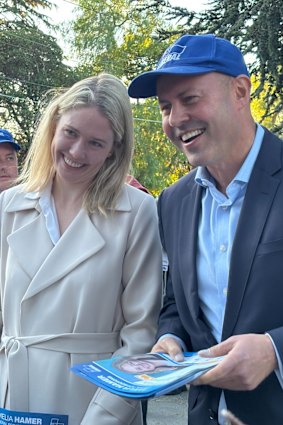
Josh Frydenberg and Amelia Hamer with a pre-poll voter in Malvern during the federal election.Credit: Rachael Dexter
“It’s something that I want to push for.”
In Victoria, the state government has started to unwind stamp duty on new commercial and industrial purchases in favour of an ongoing land tax, but it remains an upfront payment on residential homes. In NSW, former premier Dominic Perrottet gave some first home buyers the option to pay an annual property tax instead of stamp duty. It was later abolished by the Minns government.
Hamer, who came close to winning the federal seat of Kooyong in May, embodies a cohort the Liberals have been losing to in the so-called teal movement: female, Millennial, financially literate and a renter. But it was the “renter” label that proved a liability in her campaign.
Hamer was and remains a renter, but her pitch as someone who understands the struggles of tenants dissolved when she was forced to admit she also owns two properties, an apartment in Canberra and a million-dollar London flat. She rents a townhouse in Hawksburn with her partner Ross and his two children when they stay.
After the election, rumours swirled within Liberal circles that the leak of her investment portfolio came from within the party, an allegation Hamer refuses to speculate on. Her main frustration is that the “gotcha moment”, as she describes it, was a distraction for the Liberal campaign.
But a bigger problem, Hamer said, lay in her party’s failure to present a clear policy agenda, a shortcoming she believes the Liberals must fix.
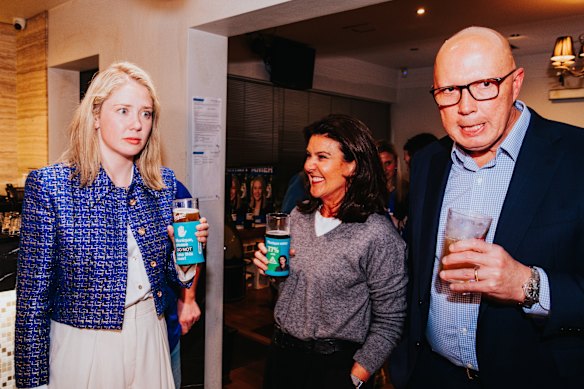
Hamer, in the photo that came to symbolise her election loss in Kooyong.Credit: James Brickwood
“People expect from an opposition party that they come in, and they say what they are going to do, and I think the team hadn’t fully refined and agreed on that,” she says of the federal team.
Her diagnosis also echoes criticism levelled at the Victorian Liberals, who have spent more than a decade in the political wilderness, struggling to define what they stand for beyond opposition.
Late last month, Hamer was preselected as the party’s candidate for the blue ribbon seat of Malvern following Michael O’Brien’s resignation. Less than a year out from the election, Hamer is odds-on to win the seat that has been a safe electorate for the Liberals since it was first contested at the 1945 election.
But the role she seems to quietly be pitching for – an economic portfolio in a Coalition government – might be harder to secure.
According to a recent poll, Labor’s primary vote has slumped, giving the Coalition an 11-point primary vote lead.
But the Coalition still needs to win 16 extra seats to seize government, meaning Hamer may have to wait a little longer before putting her economic ideas into practice.
Hamer believes the path back to government lies in a formula which worked for her great-uncle, former Victorian premier Rupert “Dick” Hamer.
He led Victoria from 1972 to 1981, overseeing reforms that expanded equal opportunity, removed gender discrimination in the public service and decriminalised homosexual acts. Dick Hamer’s government also invested heavily in cultural and civic infrastructure, including the development of the Victorian Arts Centre.
Hamer argues that her great-uncle’s government was economically responsible, showing compassion and care for people in need – lessons she believes will resonate to a new generation of Victorians.
“I think we have got an opportunity to do the same thing.”
Hamer said recalibrating the party’s economic message must occur alongside broader renewal.
“We need to be grounded in reality about what Victorian society looks like today. Victoria is significantly more diverse than it was when I grew up, we need to listen to those communities. We need to listen to young people.”
Hamer fears the Liberal Party’s current message isn’t resonating with younger voters who have “fallen off the aspiration bandwagon” amid harsher economic realities – an assessment she offers with the full knowledge that her own circumstances undeniably offered her a smoother ride.
“I have been very fortunate in my life, I went to a very good school, I had parents who love me, I studied overseas and worked in different cities and gained a whole wealth of different experiences and I see myself as very fortunate,” she said.
“I want to advocate on people’s behalf … my personal circumstances are irrelevant.”
While the rental faux pas may have bruised Hamer’s reputation, it hasn’t deterred her from wading into the housing debate. Instead, she’s leaning in.
Her stamp duty policy idea is pitched squarely at younger voters without her headstart.
Start the day with a summary of the day’s most important and interesting stories, analysis and insights. Sign up for our Morning Edition newsletter.
Most Viewed in Politics
Disclaimer : This story is auto aggregated by a computer programme and has not been created or edited by DOWNTHENEWS. Publisher: www.smh.com.au