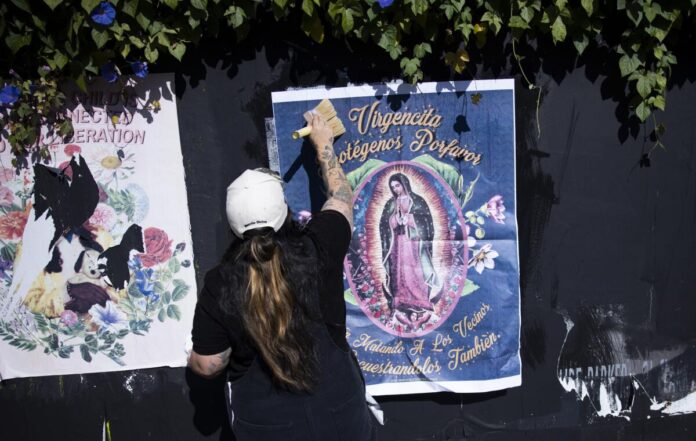
Johanna Toruño stands under the hot Los Angeles sun, focused, a slight smile crossing her face as she works. She’s wearing black overalls, Bad Bunny x Adidas sneakers and a baseball cap that reads “Hecho por inmigrantes” (Made by immigrants). She presses a fresh poster onto a dark wall in downtown L.A., smoothing the paper with care. The image evokes a prayer to the Virgen de Guadalupe, an icon for many Catholic Latinos, asking for protection against the killings and disappearances related to deportations affecting Latino communities in the U.S.
After finishing the wall close to midday, she heads to a nearby coffee shop adorned with queer and pro-immigration signs. With a warm, charming tone, Toruño calls herself a quiet and kind person. Her work, however, is anything but quiet. Bold in color and direct in message, it turns city walls into public pleas and political declarations.
She doesn’t need to describe herself as compassionate; a decade of street art dedicated to dignity, immigration and queer survival already testifies to that commitment.
Nearly 10 years after launching the Unapologetic Street Series, Toruño has become a prominent voice in contemporary political poster art. The 36-year-old Salvadoran-born queer artist treats public space as both canvas and convening ground, using city walls to spark dialogue and collective presence.
Her posters have traveled far beyond L.A., appearing in New York and Bologna, Italy. While her visual style has shifted over the years, her purpose has stayed consistent: to make political art accessible and embedded in the communities it speaks to.
Her work has taken on renewed urgency in recent months as L.A. has seen an intensified wave of federal immigration enforcement operations that have left neighborhoods on edge. Raids and targeted arrests across the city have fueled fear and disrupted local life, prompting activists and community groups to scramble to adjust their strategies amid shifting and increasingly aggressive tactics by federal agents. In that climate, Toruño’s posters function not only as art but as public declarations of solidarity, visibility and resistance.
And for her, public art is infrastructure — a way to build community and offer language for feelings that often go unexpressed. “I’ve always wanted my work to bring something of substance in public spaces to help us reimagine a better future and a better right now,” she says.
Johanna Toruño presses a poster that reads: “Virgencita, protégenos por favor. Están matando a los vecinos y secuestrándolos también,” meaning “Holy Virgin, please protect us. They are killing our neighbors and kidnapping them too.”
(Kayla Bartkowski / Los Angeles Times)
Existence is political
Toruño was almost 10 when she emigrated from El Salvador to the United States, carrying with her the visual language of a country emerging from civil war. The conflict that ended in 1992 resulted in the deaths of 75,000 civilians, forced more than a million Salvadorans to flee the country and caused severe economic devastation for those who remained.
Walls in her childhood were not just that; they were collective diaries — painted testimonies of grief, resistance and survival. In those public spaces, art wasn’t solitary. It was communal, political and unavoidable. “I just carried that with me,” Toruño said, sitting in the coffee shop Ondo. “When I got older, I realized that my journey was going to end up in art somehow.”
Politics, she says, was never abstract. Growing up in a small town in Virginia — “the capital of the Confederacy,” as she puts it — she felt that simply existing was political. “I’ve always been a person who’s not only self-aware, but aware of everything,” she says. “So I already knew I was a queer immigrant teenager in the South, and that gave me a very unique experience. I cherish that experience a lot.”
But her path to art wasn’t direct. Toruño dropped out of high school amid personal instability and lack of resources, later earned her diploma and pursued a paralegal certification, motivated by her own experiences navigating the U.S. immigration system. “I wanted to help people,” she says. Art was not the plan, but service was.
From SoundCloud to city walls
After a series of relocations and random jobs, the project that would become the Unapologetic Street Series finally began in New York in 2016, first as spoken-word experiments on SoundCloud, then as small black-and-white posters plastered onto city walls.
The artist smiles as she reminisces about those early experiments. 2016 feels vivid, she says, and thinking about a younger version of herself trying to make sense of that moment — while navigating formats like SoundCloud and letter-size sheets — brings her a little bit of joy. “I wanted a way to connect with people,” Toruño remembers. “We were entering a time of unknown and a lot of fear. I wanted to create something that was worth a damn.”
Not much has changed since then, she admits. The bottom line, the artist explains, is that the project began as a way to speak up about situations impacting her community — and that urgency has never disappeared. “The work has remained the same,” she says with a serious tone. “There has never been a point where I created something just for s— and giggles.”
Even when Toruño works on what she calls “passion projects,” such as incorporating childhood characters or pop culture references, the work remains political and resilient. Alongside the art, Toruño organizes gatherings, installations and community events, turning the project into a living network.
She even says she chose the streets for their radical accessibility. Her work doesn’t require museum tickets, institutional support or a trip across town. “I like the accessibility of it,” she says. About 90% of her artwork is free to download online as well.

Johanna Toruño’s work engages themes of immigration, queer identity and conflict, often reflecting diaspora experiences. She designed posters in support of Palestinians in 2024.
(Carlin Stiehl / For De Los)
An adoptive home
Although the project was born on the East Coast, Toruño says it grew up in L.A. She first visited the city as a teenager, drawn by family ties and the Central American diaspora. California is home to nearly half a million Salvadoran immigrants, making it the second-largest Latin American immigrant community in the state after Mexican immigrants, according to recent data from the Public Policy Institute of California.
In 2017, community spaces in Boyle Heights housed one of her exhibitions, helping her build relationships with local residents. She moved permanently around 2021. “L.A. has been essential to [the project‘s] growth,” the artist recalls.
With a small gold “LA” necklace glinting against her black overalls, Toruño says L.A. is the closest thing to Central America she has found in the U.S. Her work is rooted in the diaspora experience and living here has brought her closer to those roots. Creating through the distinct perspective of a Salvadoran immigrant is the only way her process feels logical. And this authenticity resonates deeply with her community.
However, she firmly maintains that she is not a representative voice for the community. “I think everybody has a voice. They’ll just introduce it differently,” Toruño insists.
Imagining a dignified city through art
Her process is fast and intuitive. She designs on an aging iPad, hand-collages elements, scales the images digitally and prints large-format posters. Installation is immediate, sometimes accompanied by site-specific arrangements: the location of posters often depends on the lighting of the street or the aesthetic of the nearby shops.
But public art is impermanent by design; posters may last months or disappear within hours. Some are defaced. Others are cherished. She is used to both.
While pasting the new “Virgencita” poster, she notices an older one of hers to the left — a portrait of transgender activist Marsha P. Johnson — hanging half ripped. Toruño smiles, unfazed. The message, she says, already did its work. She rarely references institutions or agencies when she speaks. Instead, Toruño uses the language she learned from the women in her family, like her mother — one of care, protection and resilience — turning art into gestures of collective comfort for those who need it, rather than direct confrontation.
This ethos is encapsulated in one of her favorite posters, which declares: “Blessed are the queers cooking each other’s meals.” It honors chosen families and mutual care, capturing the core of her practice. Consequently, when she’s asked about her vision for L.A., she speaks less about policy and more about dignity.
“I wish for people to live in a dignified and equitable world,” she firmly says. “To live a life where we don’t have to work to live.”
Toruño resists the label of activist but embraces the political nature of her work. Instead, she situates herself within a lineage of artists who have used public space to reflect and reshape their communities. “I’m one of many,” she adds. “I’m very proud to be a part of a committed group of folks who, for a very long time, have been a difference in their communities.”
On L.A. walls, her art continues that lineage: public prayers, political declarations and invitations to imagine something better, not in the future but right now.
As Toruño leaves the coffee shop, the glue on the nearby posters begins to dry, and pedestrians slow down to read them. The posters will weather, peel, maybe disappear by morning. But for a few hours, a day, a month or a year, they will sit there, quietly interrupting the city’s noise with a message meant for anyone who needs it. For Toruño, that fleeting moment is enough: a conversation started, a community reflected, a public prayer left in plain sight.
More to Read
Disclaimer : This story is auto aggregated by a computer programme and has not been created or edited by DOWNTHENEWS. Publisher: latimes.com