What does cooking fries in pure beef tallow have to do with Australia’s Winter Olympics identity?
More than you’d think.
The common denominator is Steven Bradbury, whose name and story became an international phenomenon – to the point where the concept of “doing a Bradbury” has outgrown the man who actually did it.
Bradbury, now 52, recalls recently hearing a group of people in their 20s using the phrase that he inspired, completely oblivious to the fact that he was standing right there with them.
“They didn’t even know that I was the guy,” he laughs.
“And I just sort of walked away smiling. But they got the context right – and I get that I’m the luckiest individual Olympic gold medallist in the history of sport, but the other side of that is, everyone knows you don’t wind up in the final in anything because you started a couple of weeks before.
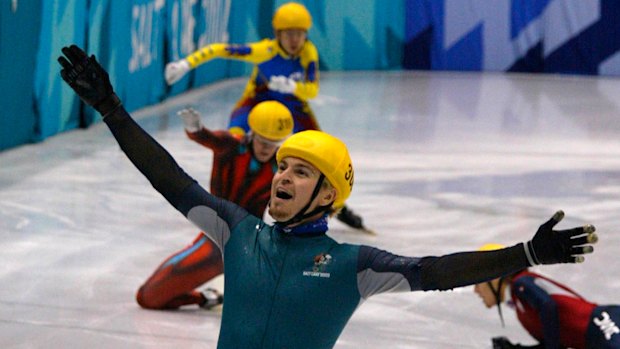
Steven Bradbury wins gold in 2002.Credit: Reuters
“I trained five hours a day, six days a week for 14 years to become an overnight success, and that’s really what ‘doing a Bradbury’ means: that you’ve worked hard enough or long enough at something to put yourself in position.
“If you’re willing to give all of yourself to something, you do it with passion, and you do it for a long time, you get good … you might get lucky.”
Almost a quarter of a century since his unlikely gold medal at the 2002 Winter Olympics, Bradbury is finding new ways to do … well, a him.
If you pick the right afternoon in Brisbane and head to his brewery, on the other side of Castlemaine Street from Suncorp Stadium, you might find him behind the bar, pulling beers, or ferrying the best hot chips you’ve ever tasted to your table. Steven is doing a Bradbury in the hospitality industry.
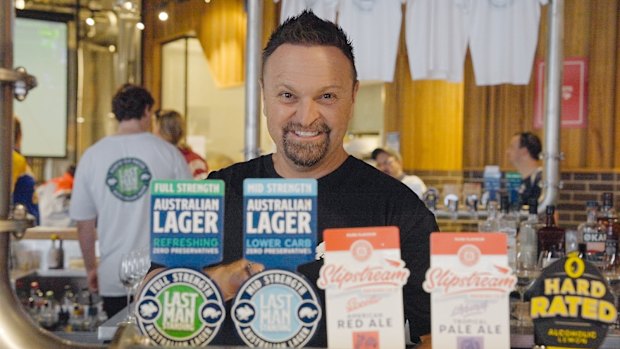
Steven Bradbury behind the bar at Last Man Standing, his brewery across the road from Suncorp Stadium in Brisbane.Credit: Last Man Standing
All of their fried food is cooked in pure beef tallow – which is what McDonald’s, KFC and all the rest did 30 years ago, until they switched to hydrogenated oils. The “old-school way”, Bradbury reckons, is not only tastier, but healthier. And all of the beers they serve, they either brew themselves, or come from a locally owned label.
The place is called Last Man Standing, and its logo features a tortoise and a hare. It’s a reference to Bradbury’s personal mythology: he was, of course, the only speed skater who hadn’t fallen down when his four competitors crashed out on the final turn in the men’s short-track 1000m gold medal race.
Sure, he was lucky. But it wasn’t a fluke, because he’d put himself in a position to get lucky.
In the same spirit, Last Man Standing has positioned itself as an Australian-owned outlier in a beer market dominated by foreign multinationals, quietly nailing the fundamentals while everyone else chases scale, relying on the belief that those are the things that will matter in the end.
“People don’t believe you when you tell them that Great Northern and XXXX are Japanese-owned beers, but they are. The profits of all the mainstream beers don’t stay in this country,” Bradbury says.
“We want to be the little Aussie battler that takes on the big guys – like I did in the Winter Olympics, and like our athletes will be doing in Milano-Cortina.”
Bradbury’s victory was Australia’s first gold medal at the Winter Olympics and sixth overall; since 2002, there have been 15 more medals, including five gold. But Australia’s perception of where we sit in the realm of snow sports, he argues, does not match the new reality.
It is still a case of “punching well above our weight”, but Australia’s contingent of 50-odd athletes for Milano-Cortina will contain a dozen solid gold medal hopes. That’s serious business, and not just for a plucky beach nation obsessed with the Summer Games.
“We’re not the Jamaican bobsled team or Eddie the Eagle anymore. That’s an offence to the Australian Winter Olympic team, and has been for a long time,” Bradbury says. “We’re not numbers-fillers. We’ll have a legitimate medal contender every single night in Milano-Cortina.”
What Australia doesn’t have, in comparison to the more dominant, traditional Winter Olympic countries, is depth.
“I think most things in life come down to bang for your buck,” Bradbury says.
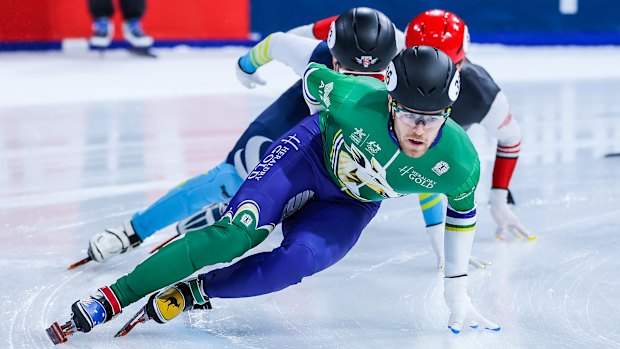
Brendan Corey represents Australia in a world tour event in Milan earlier this year.Credit: SOPA Images/LightRocket via Getty Images
“For example, in my sport, short track speed skating, we’ve got one guy: his name’s Brendan Corey, and he’s a chance for a medal in the 1500. Bang for your buck to fund one athlete who might get a medal at the Olympic Games? That’s freaking amazing value for money.
“And that’s the case with a lot of our winter sports programs. We’ve got people at the top level, but if they get injured at the wrong time, we don’t really have somebody to step into their skates or skis.”
Corey, now 27, has spent the past two and a half years embedded with the Italian short-track team, training at altitude near Bormio – which forms part of one of five venue ‘clusters’ for the Milano-Cortina Games, which will be spread out over more than 22,000 square kilometres across northern Italy – because Australia does not have a domestic training group strong enough to replicate the demands of elite racing. In turn, his endurance ability benefits the Italian skaters; Corey’s role is to lead the group, set the tempo and break the wind so everyone else can draft behind him.
It’s hard, unglamorous work, but the hope is that Corey would have picked up a few tactical tips and tricks.
“He’s got unfinished business from Beijing,” Bradbury says.
“He didn’t rank as highly as he could have, should have, but I know better than anyone that short track is incredibly unpredictable. Brendan probably needs to learn, in my opinion, how to race a little bit more patiently. Sometimes he cranks up the turbo boost a couple of laps too early.
“If he can bide his time and wait for the right moment to move in the race, then it reduces the risk. Things can still go wrong, but a lot about short track is about minimising the risk and turning on that turbo boost at the right time in the race. Nobody can do it perfectly. Sometimes you get it right, sometimes you get it wrong, but you need to be able to get it right more often than not.”
The Winter Olympic Games will be broadcast on the 9Network, 9Now and Stan Sport.
News, results and expert analysis from the weekend of sport sent every Monday. Sign up for our Sport newsletter.
Most Viewed in Sport
Disclaimer : This story is auto aggregated by a computer programme and has not been created or edited by DOWNTHENEWS. Publisher: www.smh.com.au