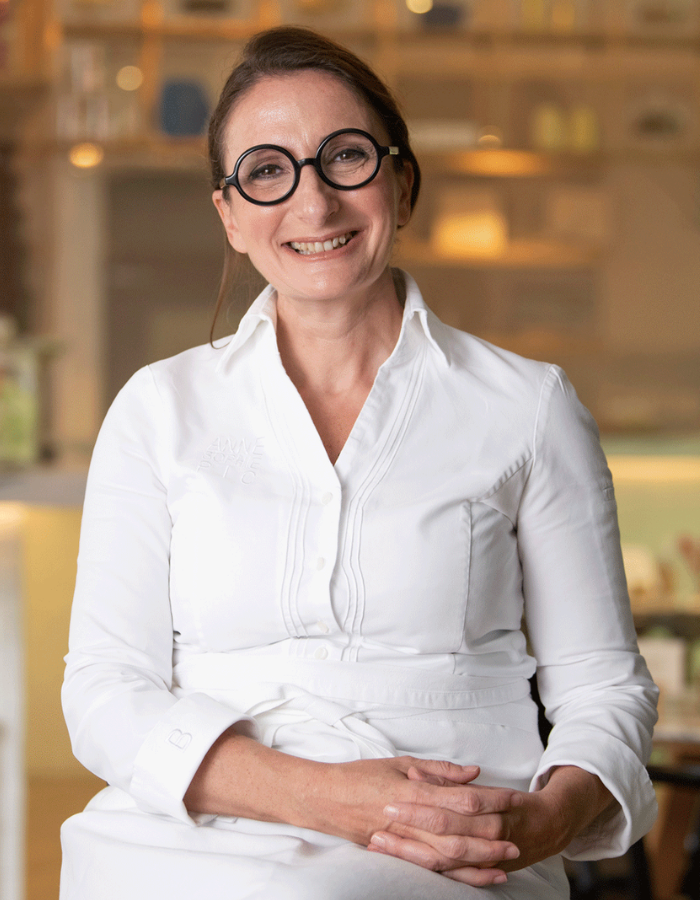
It is a truth universally acknowledged in the culinary world that Anne-Sophie Pic is in possession of a great legacy. What she has built on top of it makes her truly fascinating. To sit across from her, even in the transcript of an interview, is to understand that her cuisine follows a different logic. It is composed like a scent you cannot quite place but desperately want to follow.
Her childhood was steeped in the atmosphere of her father’s three-Michelin-starred restaurant. She grew up surrounded by the excitement of the dining room as it permeated her very being. She remembers the feeling of the guests, the happiness of her parents—her father cooking, her mother running the service. It was a “wonderful time” of sensory immersion. The day was marked not by a clock, but by the smells that would drift through the house. This personal olfactory clock would later become the cornerstone of her identity.
It is this very identity that makes the question of legacy so pertinent. How does one hold the weight of a family name—the “Pic style” of sauce-making passed down from her grandfather and father—while also forging a new path? For Anne-Sophie, the answer lies in balance. She speaks of being caught between two essential ingredients: respect for the past and a burning desire for innovation. The former required her to understand the soul of her family’s cooking. The latter, she explains, comes from being a “self-made woman.” Having taken a detour through business school and internships in the perfume world at places like Cartier and Chanel, she did not follow the traditional route through the kitchen ranks. This outsider’s perspective gave her permission to view cuisine through a different lens. “In my mind,” she says, “it was a question of perfume, olfaction.” Before the taste, there must be something to smell. This approach transforms a dish from a meal into a memory.
This philosophy finds a natural home in her Dubai outpost, La Dame de Pic. Conceived with her husband and business partner, the restaurant was born from a desire to bridge the formal and the familiar. The space is elegant while offering a service that allows guests to feel at ease and comfortable in the presence of greatness. It provides a setting where her signature approach—the unexpected pairings, the intricate layers—can be experienced without the stiff formality of a bygone era.

Being one of the most celebrated female chefs in the world comes with a relentless gaze. One might assume that the pressure of expectation could stifle creativity. Anne-Sophie, however, views it through the lens of humility. Her family history contains not just triumph but also stories of loss, of stars being lost and painstakingly regained. This has instilled in her a profound understanding of the industry’s fragility. “You can be very high,” she reflects, “but you have to practice with a lot of humility and sensitivity, because it’s something moving all the time.” This conscientiousness, this awareness that a dish is never finished but only abandoned for the next iteration, keeps her grounded and her work vital.
This groundedness informs the advice she offers to young women hoping to enter the culinary world. Her counsel is refreshingly simple in an industry often defined by bravado: act with sincerity. She recalls returning to her father’s kitchen and being met with skepticism from male chefs who questioned her place there. The industry has changed in the three decades since, she acknowledges, but the core struggle for legitimacy remains. Her advice is twofold. First, cultivate self-confidence and follow your intuition—that feeling in your heart. Second, do not isolate yourself. “I suffered from not asking people,” she admits. “I wanted to manage by myself, and sometimes I would have been quicker if I had listened.”

This need for collaboration extends to her own creative process. Leading a team, she must balance the rigid “rules” of the kitchen—the classic brigade hierarchy established by Escoffier—with the need for individual intuition. For her, the rules provide a structure for growth, allowing a commis to become a chef de partie. Within that frame, she encourages her team to challenge convention and invent their own approaches. The key, she believes, is to guide with a sense of justice and timing, creating a space where creativity emerges from inspiration rather than a schedule. For that, she emphasizes the importance of a trustworthy team that allows her the space to step back and let curiosity breathe.
When asked about the often-discussed “feminine strength” in her cooking, she demurs from a rigid definition. For her, it is simply about being oneself. A woman will naturally cook as a woman, just as a man cooks as a man, though the lines can blur beautifully. The true distinction, she posits, lies in management. There is a maternal quality to feminine leadership, a tendency to take care of others and to nurture. It is a strength, she notes, but one to be wielded consciously, lest one forgets to take care of oneself in the process.

This nurturing instinct, paired with her daring creativity, finds perfect expression in her most iconic dish, the Berlingo. This pasta creation began as a personal challenge. As a French chef, she felt no legitimacy in creating a “gastronomic pasta.” Her solution was to reach out to her friend, the Italian great Nadia Santini, who gave her the confidence to proceed. What began as a garnish evolved into a dish in its own right, filled with a symphony of cheeses. It stands as a testament to the power of collaboration and the courage to step outside one’s cultural comfort zone.
Anne-Sophie’s palate is turning increasingly towards the vegetal. We are, she notes, living in an “umami period,” where people crave the deep, fermented satisfaction found in cheese, wine, and bread. Her philosophy, which she calls “sufficiency,” involves using vegetable ingredients to provide a new point of view. Whether accompanying Wagyu beef or a delicate fish, she seeks to give aromas to the protein through the vegetable, creating a dialogue on the plate. She likens the experience to a perfume, where the first spoonful offers a certain intensity and the second reveals an entirely new sequence. Her cooking honors the past, savors the present, and thoughtfully inhales the future.
– For more on luxury lifestyle, news, fashion and beauty follow Emirates Woman on Facebook and Instagram
Images: Supplied & Feature Image: Supplied
Disclaimer : This story is auto aggregated by a computer programme and has not been created or edited by DOWNTHENEWS. Publisher: emirateswoman.com