Dr Melanie Jansen meets parents on the worst day of their lives. She believes reading and writing poetry can help doctors and family members cope with the unthinkable – and the health sector is starting to agree.
Dr Melanie Jansen clearly remembers the first incident in a hospital that inspired her to write a poem.
She was a junior medical student at the University of Newcastle assisting in the emergency department at John Hunter Hospital. An elderly man with Parkinson’s disease had had an acute gastrointestinal haemorrhage and it was suspected he had breathed blood from his stomach into his lungs.
Jansen was tasked with taking a blood sample from the man’s wrist. She got the needle in on the second try, and then racked her brains to analyse the results from the ABG (arterial blood gas) machine.
What happened next made it into the poem.
The blood pressure cuff inflates with a sound that reminds me of a tyre being let down. As I watch, a tear slides down the old man’s cheek … In the midst of all the urgent activity, all I can see is an old man crying.
“I just remember feeling really sad about that man, and also seeing how little I knew, and how far I had to go before I could do this job,” Jansen recalls.
Many years later Jansen is both a pediatric ICU specialist and an award-winning poet, one who is about to have her first verse collection published under the title All That Could Be Lost.
The children’s intensive care unit is no place for the fragile soul. While the mortality rate in Australia is blessedly low, at under 3 per cent, in a busy hospital that equates to losing on average one child a week. “We live in the pointy end of life and death,” Jansen says.
The question everyone always wants to know is: how can she stand it?
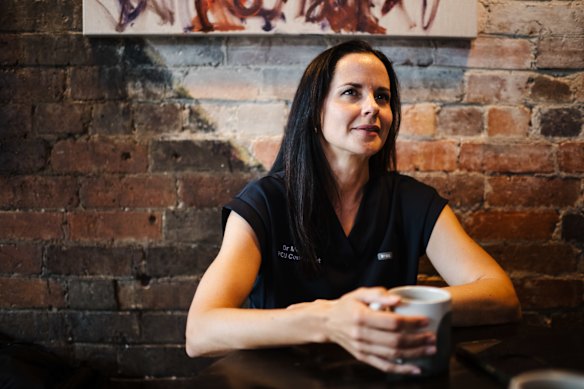
“I really liked the idea of when you do something for a child you get so many years out of it,” she says. “And you can change the whole course of their life if things go right early.
“I like that you get to have some relationship … to look after their whole family, and to make that really awful time of their life just a bit easier.”
We’re speaking in Fables Bar & Cafe inside the Princess Theatre in Woolloongabba, Brisbane. Jansen gets coffee here daily, and often settles into her seat to write. It’s a sanctuary from her work at the Queensland Children’s Hospital and her duties as the mother of a four-year-old.
Meeting Jansen here brings to mind her devastating poem Re-entry, in which she makes idle chit-chat with a friend over coffee while trying not to think about a baby who has died after being assaulted by its father.
A poem titled Breaking Bad News recounts her reporting a teenager’s death to six of his closest relatives. Jansen recognises the look of disorientation on their faces: “Is the floor level? The chairs stick, the doorhandles don’t make sense.”
In the book’s opening salvo, Some Days the Air is Soft, which won a prize in the Hunter Writers’ Centre’s Grieve competition in 2022, Jansen writes: “My mirror showed me three grey hairs today, gifts from other people’s children.”
Elsewhere she urges herself to “prepare to marinate in tragedy. Learn to hold it – it’s only for a moment – for those whose once-in-a-lifetime tragedy it is.”
“The risk of the serious doctor writing poetry is that you imagine you’re having a holiday when you write, like there’s something soft about it, and there’s nothing soft about it.”Dr Mark Tredinnick, poet and literary academic
“I can’t read the book without crying. It’s harrowing,” says poet and literary academic Dr Mark Tredinnick OAM, who mentored Jansen through the Australian Writer Mentoring program.
Jansen impressed him by showing she was willing to take poetry “as seriously as surgery”; to bring “the scalpel to the page”.
“The risk of the serious doctor writing poetry is that you imagine you’re having a holiday when you write poetry, like there’s something soft about it, and there’s nothing soft about it.”
He showed Jansen’s work to other poets. Among those who concurred on its quality was Steve Meyrick, Tredinnick’s colleague at 5 Islands Press, who encouraged Jansen to submit poems that deal with other personal topics – love poems, nature poems, poems about the end of her marriage – all of which appear in the book.
“Her work is not just a solipsistic exercise in expressing herself,” Tredinnick affirms. “Melanie has managed to transfigure personal experience into human experience.”
Jansen grew up without medical ambitions. Her family lived on a semi-rural property in Logan, and she diplomatically describes her schooling as “colourful”.
“The scar on my finger is from surgery I had to have after being attacked by one of the [female] students. I can’t even remember what for.”
She hastens to add that she did not have a “disadvantaged, terrible, Trent Dalton-esque upbringing” – her childhood was “lovely”, just different to what the typical Australian doctor might have experienced.
She saved money working in hospitality after leaving school, then went backpacking in Europe. On a bus between Nice and Barcelona she got chatting to a girl her age from Melbourne, who mentioned she was planning to study medicine.
“I remember thinking: ‘Oh. You seem pretty much like me, maybe I could do that.’” Once the idea of medicine took hold, it began to feel “like a calling”.
She had another love, however. While studying for her medical degree at the University of Newcastle, Jansen took a year off to focus on music. She took classes in jazz piano and singing, wrote songs and rehearsed diligently with her band.
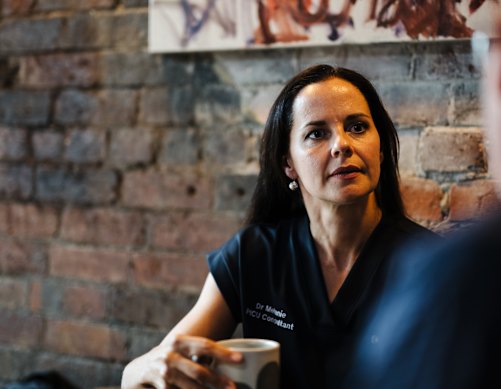
“Everybody was like: ‘Do you want to leave medicine if this gets really successful?’ And I was like: ‘No!’ I really liked being a doctor, and I realised how stressful being a musician is.”
She hasn’t given up entirely, playing sporadically in a combo made up of cardiology specialists from around the world that gets together to gig during conferences – most recently in Washington DC.
Jansen has always had a strong sense that the dichotomy of art versus science is bunk.
While completing her paediatric training, she also enrolled in a masters in philosophy. As a Churchill Fellow she visited the Fondazione Lanza in Padua, where she asked bioethicist Professor Renzo Pegoraro about the value of the humanities in medicine.
“And he said: ‘Well Melanie, in medicine you need to learn about science, but it’s humans who get sick, and the humanities teach you about humans.’
“People call them ‘soft skills’,” Jansen says. “And I think, these aren’t soft skills, they’re just skills that we haven’t defined well, but they can immensely impact the decisions [doctors] make. We have evidence that practitioners who are engaged with the arts have higher empathy and maintain it throughout their career.”
“It’s humans who get sick, and the humanities teach you about humans.”Renzo Pegoraro
Dr Fiona Reilly is a paediatric emergency physician at the Royal Children’s Hospital Melbourne and heads up the Australian Centre for Narrative Medicine.
She sees the value of Jansen’s writing as twofold. It can help healthcare workers deal with exposure to other people’s pain and suffering.
“Some people call it ‘moral injury’, it’s being talked about a lot as a huge factor in burnout. Writing can help us, and reading poetry allows us access to those stories.”
It can also help parents and families: “Understanding that, for example, your child has had a profound impact on one of the staff who cared for them. I think it helps for them to know their children are really important to us.”
One Sunday a few years ago, before the morning ward round, Jansen read a short poem to her colleagues: Emily Dickinson’s If I Can Stop One Heart from Breaking. Its message of doing one good thing for someone, and thereby making life worthwhile, hit home. She now regularly reads poetry as part of medical and nursing education sessions.
A poem by American poet Edward Hirsh, I Did Not Know the Work of Mourning, is a particular favourite. “I can give them an hour-long talk on the statistics of how people grieve – this poem just communicates it to them in a moment.”
An intensive care colleague, Dr Albert Kim, was mentored by Jansen at Westmead Hospital in Sydney. He remembers the first time she sat the doctors down and read them poetry.
“It was such a shock, because there was this huge contrast with the work that we do. I remember telling Melanie I felt like it was like education in how to be a human.
“There have been many occasions where she’s helped me and other people to think about how we’re feeling, and process our emotions and experiences.”
“I felt like it was like education in how to be a human.”Dr Albert Kim
The sensitive nature of Jansen’s subject matter is not lost on her. Often, circumstances are altered in her work, names suppressed or changed; but not always. The poem Lily Ivy Grace is about a real little girl who died, published with the parents’ permission.
It’s a heartbreaker. Jansen writes how Like your namesakes, you blossomed with unique beauty … As though the souls of our earthly flowers clustered close to you, knowing they could only hold you for this one sparkle in time.
“There are some families that I’ve given poems to,” Jansen says.
“Especially if I’ve done the actual palliative care, and been there with them when their child dies, I send them a card in the next couple of months to let them know we’re thinking of them. The few families who have contacted me after have been happy that I did.”
All That Could Be Lost is published by 5 Islands Press. Dr Melanie Jansen is launching the book at Fuller’s Bookshop, Hobart, Saturday, February 28; the Princess Theatre, Brisbane, on Monday, March 9; at Readings Carlton, Melbourne, on Friday, May 15; and at Woollahra Gallery at Redleaf, Sydney, on Saturday, June 20.
Disclaimer : This story is auto aggregated by a computer programme and has not been created or edited by DOWNTHENEWS. Publisher: www.smh.com.au