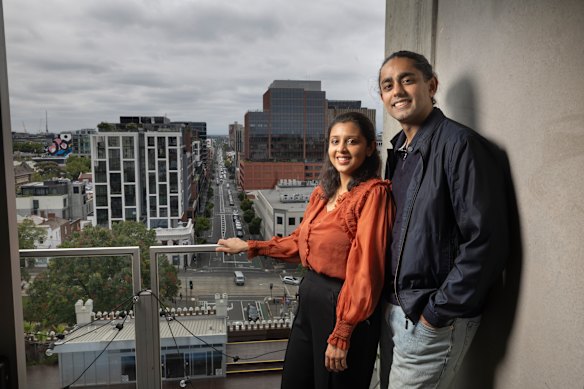
When Ashish Sharma moved to East Melbourne, he was struck by how quiet the suburb was despite being on the cusp of the city.
“It’s just an oasis of calm,” the 36-year-old said. “My dad told me, ‘You’re in the most liveable suburb, in the most liveable city in the world.’”
Ashish Sharma and Manali Purohit love the calm East Melbourne provides in the midst of the inner-city.Credit: Jason South
His partner, Manali Purohit, 36, moved to Melbourne from Mumbai to join him almost exactly a year ago. She said she fell in love with the suburb immediately.
A recent KPMG report named East Melbourne as the most liveable suburb in Melbourne if money was no object, snatching the crown from Parkville, but the cost of homes in the area varies.
Terry Rawnsley, KPMG’s director of planning and infrastructure economics, said the audit looked at factors such as services in the area, access to work, commute times, walkability and affordability.
“So it’s no surprise it was up the top,” he said.
East Melbourne fits three of Melbourne’s major green spaces – Treasury and Fitzroy Gardens, and Yarra Park – as well as several smaller reserves within its tiny 1.9km² bounds. It’s home to the MCG, St Patrick’s Cathedral and state parliament, and is a short walk to the CBD.
It also has a limited supply of housing.
Turnover of its heritage houses is so low that Cotality does not generally provide a median house value, but said it was $3,447,492 across 29 sales over the past 12 months – almost $2.5 million more than the $977,579 Greater Melbourne median.
By contrast, the median unit value was only $778,006, albeit more than 20 per cent above the $642,431 Greater Melbourne median.
Despite this contrast, Sharma believes East Melbourne apartments are still affordable for the location.
“I bought [our] apartment using the Victorian Homebuyer Fund,” he said.
The scheme, retired last September, allowed first home buyers to buy with a 5 per cent deposit, with the state government contributing 25 per cent of the purchase price for an equivalent share in the property.
Greg Bisinella, president of residents’ association the East Melbourne Group, says the idea the area is all heritage mansions is a misconception.
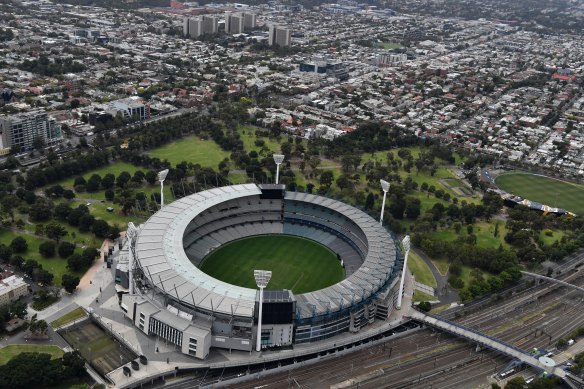
East Melbourne includes the MCG and a number of green spaces.Credit: Joe Armao
“Seventy per cent of us do live in apartments,” he said. “Including myself.”
Ray White agent Elli Blanco, who sold Sharma his apartment in 2024, agreed that there was space at the lower end of the market, despite perceptions.
“I mean, obviously, it is going to be a little bit more expensive,” he said. “But there are still very good buys, especially in the current market, if you want to get your foot in the suburb.”
At the upper end, a Victorian mansion on Albert Street was sold by the Royal Australian and New Zealand College of Obstetricians and Gynaecologists to a developer for $24.75 million, settling in 2021, while a Hotham Street period home was sold by Colliers residential boss Tim Storey for $17.75 million last year.
Sharma, Purohit and Bisinella all noted that the suburb borrowed a lot of its amenities from neighbouring suburbs.
“It has no traditional pub, there are only a couple of restaurants,” Sharma said. “It would be nice if there were a few places that stayed open late.”
Purohit, a chef, said: “We seem to have much less compared to Collingwood and Fitzroy.”
The pair are opening a cafe in Fitzroy North in April.
But they said the lack of a night-life, while still being walking distance to hubs like Collingwood, Richmond and the city, probably added to East Melbourne’s charm.
“Smith Street is super busy and noisy every Thursday, Friday, Saturday night,” Purohit said. “[East Melbourne] feels quiet and more like a home.”
Rawnsley said a lot of East Melbourne’s liveability could be attributed to the fact it was planned 150 years ago, when walking and public transport were the core of urban design.
“A lot of communities today, especially in greenfields, are thinking more about the car as a primary way to get around,” he said.
“There has been a bit of apartment development over the last 10 years, but it’s on the periphery. You can walk through that central core now and, putting aside the Teslas, it could be 1926, not 2026.”
Sharma would like to see more development, and more people able to move into the suburb.
“Melbourne has such a huge demand for affordable housing with proximity to the city,” he said. “I think East Melbourne can do better in that regard.”
Bisinella is more cautious. He said that despite often being labelled NIMBYs, the East Melbourne Group was not anti-development, just concerned about overdevelopment.
“Our group spends an enormous amount of time fighting planning applications in VCAT,” he said.
He sees the group’s role as not just preserving the area’s liveability for residents, but for those from neighbouring suburbs too.
“I know that many of the dog walkers, and people from Richmond, come up to Yarra Park to spend some time with their canine friends,” he said. “Those sorts of things should be retained for future generations.”
Most Viewed in Property
Disclaimer : This story is auto aggregated by a computer programme and has not been created or edited by DOWNTHENEWS. Publisher: www.smh.com.au