Apple is experiencing the most extensive leadership transformation since its visionary CEO and cofounder Steve Jobs died in 2011, with a wave of departures across artificial intelligence, design, legal, operations, and financial divisions that will reshape one of the world’s most valuable companies.
The iPhone maker announced last week that Lisa Jackson, its vice president of environment, policy, and social initiatives, will retire in January, while Kate Adams, who has served as general counsel since 2017, will retire late next year. These departures follow a cascade of recent exits including AI chief John Giannandrea, who announced his retirement this month, and Alan Dye, the head of user interface design since 2015, who left to join Meta. Bloomberg also reported that Johny Srouji, Apple’s chief chip architect for Apple Silicon, is mulling an exit, but the 61-year-old executive threw cold water on those rumors Monday, saying “I love my team, I love my job at Apple” in a memo to staffers.
Speaking of Meta, Mark Zuckerberg’s social media empire has been the beneficiary of Apple’s exodus. Billy Sorrentino, another senior design director, chose to leave for Meta with Dye, and Ruoming Pang, who headed Apple’s AI foundation models team, also left for Meta in July, taking approximately 100 engineers with him. Ke Yang, who led AI-driven web search for Siri, and Jian Zhang, Apple’s AI robotics lead, also left for Meta this year.
But perhaps the biggest change at the top this year has been Chief Operating Officer Jeff Williams, who decided to retire in July after 27 years with Apple. He was long considered the top candidate to succeed CEO Tim Cook. Also this summer, CFO Luca Maestri stepped back from his role to instead oversee corporate services starting in the new year, while Kevan Parekh took over as CFO.
Succession planning and Tim Cook’s future
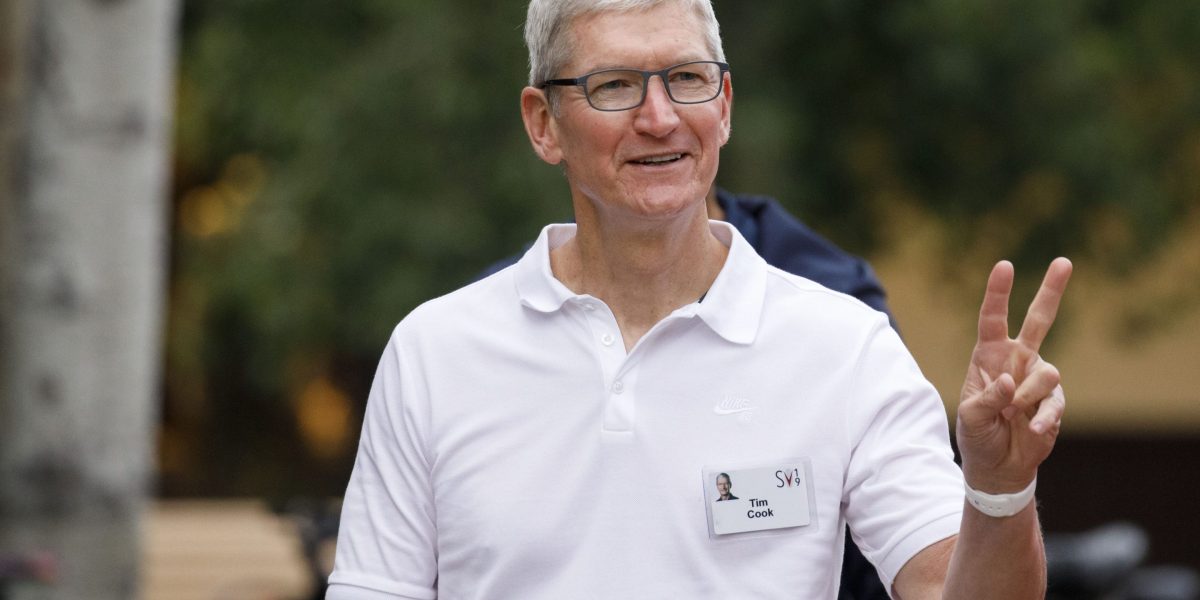
The scale of the turnover has been striking, but the timing appears connected to succession planning. Both Bloomberg and the Financial Times have reported that Apple is ramping up efforts to prepare for Cook, who turned 65 in November, to potentially retire in 2026. He has led the company since 2011 and grown its market cap from roughly $350 billion to $4 trillion.
John Ternus, Apple’s senior vice president of hardware engineering, has emerged as the leading internal candidate to replace Cook. Ternus, 50, joined Apple’s product design team in 2001 and has overseen hardware engineering for every generation of iPad, the latest iPhone lineup, and AirPods. He played a crucial role in the Mac’s transition to Apple silicon.
The choice of Ternus would mark a departure from Apple’s recent operational focus under Cook. While Cook and Williams both had operational backgrounds with expertise in global supply chains, Ternus brings technical hardware expertise. His selection would signal that Apple is prioritizing product innovation as it faces challenges in new categories like the Vision Pro and competition in artificial intelligence.
Apple’s new AI leadership
Apple is bringing in Amar Subramanya, a veteran of both Google and Microsoft, to lead its AI efforts. Subramanya spent 16 years at Google, eventually becoming head of engineering for Google’s AI assistant Gemini, before a brief stint at Microsoft as corporate vice president of AI. He will oversee Apple Foundation Models, machine learning research, and AI safety, reporting to software chief Craig Federighi.
Subramanya’s hire signals Apple’s determination to accelerate its AI capabilities after falling behind competitors like Google and OpenAI. His experience building large language models at Google positions him to help Apple develop competitive generative AI products, a critical battleground for tech companies in the coming years.
Apple’s new design leadership
On the design front, Stephen Lemay is replacing Dye as the head of user interface design. Lemay has been with Apple since 1999 and played a key role in designing every major Apple interface from the original iPhone to the latest operating systems.
The promotion of Lemay has reportedly been met with enthusiasm inside Apple. Blogger and podcaster John Gruber, who has covered Apple for decades and has deep ties within the company, wrote that employees are borderline “giddy” about Lemay taking over.
“Sources I’ve spoken to who’ve worked with Lemay at Apple speak highly of him, particularly his attention to detail and craftsmanship,” Gruber wrote. “Those things have been sorely lacking in the Dye era.”
This internal promotion contrasts sharply with how Dye’s departure was received. Dye had overseen UI design for a decade but faced internal criticism over design direction and product quality. Lemay’s appointment represents a return to the company’s design-first philosophy that characterized Apple’s earlier innovation phases.
Apple’s new operations and supply chain leadership
Sabih Khan, who has been with Apple for 30 years, took over as chief operating officer in July, succeeding Williams. Khan joined the executive team as senior vice president of operations in 2019 and has overseen Apple’s global supply chain for the past six years. Khan will also now oversee environment and social initiatives, taking on some of Lisa Jackson’s former responsibilities.
Khan’s appointment represents continuity in operations while consolidating responsibilities across the executive suite. His deep knowledge of Apple’s manufacturing and logistics networks positions him to navigate ongoing supply chain challenges, particularly as the company diversifies production beyond China.
Apple’s new legal and regulatory leadership
Jennifer Newstead, currently Meta’s chief legal officer and a former legal adviser to the U.S. State Department, will become Apple’s general counsel on March 1, 2026. In a consolidation of responsibilities, Newstead will oversee both legal and government affairs, effectively merging the roles previously held by Adams and Jackson.
Newstead brings significant international law and regulatory expertise at a critical time for Apple. The company faces increasing scrutiny from antitrust regulators worldwide, particularly in the European Union and the United States. The Justice Department and 16 attorneys general filed an antitrust suit against Apple last March, alleging the company’s policies hamper competition and make it difficult for consumers to switch phones. A trial date is not yet set, but suffice to say Newstead’s work will be cut out for her once she starts.
Her appointment underscores Apple’s focus on navigating complex regulatory environments while addressing regulatory challenges around AI development and data privacy. Her experience in government affairs at Meta, where she managed relations with policymakers globally, makes her well-suited to handle Apple’s expanding regulatory obligations.
Apple’s new financial leadership
Kevan Parekh assumed the chief financial officer role on January 1, 2025, replacing Luca Maestri, who had held the position since 2014. Parekh brought deep familiarity with Apple’s financial operations, having worked in the company’s finance division previously. His transition to CFO continues Apple’s pattern of promoting experienced insiders to top roles, though his tenure also reflects the company’s need for steady financial stewardship amid market volatility and shifting investor expectations.
Apple’s inflection point
The departures span functions critical to Apple’s competitive position. Beyond the visible departures, Apple has lost significant talent in AI research to its competition in Silicon Valley, namely Google, Microsoft, and OpenAI. Apple is attempting to address this through high-profile hires like Subramanya, but the scale of departures suggests internal friction or strategic shifts that pushed executives to explore opportunities elsewhere.
The consolidation of responsibilities—particularly having Newstead oversee both legal and government affairs, and Khan handling operations and environmental initiatives—suggests Apple is also tightening its executive structure. This could be driven by cost considerations or by a desire to create clearer lines of authority as the company prepares for potential leadership transitions.
Despite the upheaval, Apple is positioning these changes as strategic rather than reactive. The transitions of Williams, Maestri, and others were described as “long-planned successions” in company announcements. Cook has publicly praised the incoming leaders and emphasized continuity, even as Apple assembles what amounts to an entirely new leadership team for its next chapter.
Cook himself remains a question mark. While some reports suggest he could retire in 2026, the executive has been adamant about his plans. In January, Cook told CNBC he would never retire, at least in “the traditional way,” adding he would “always want to work.” Still, all the reliable reporting since that on-air interview points to scenarios in which Cook will step back from day-to-day operations.
Looking ahead
Whether this new generation can maintain Apple’s innovation momentum while navigating AI competition, regulatory pressure, and the eventual departure of Cook himself remains the defining question for the company’s future. The success of Ternus, Newstead, Lemay, Khan, and Subramanya will determine whether Apple can accelerate its AI capabilities, maintain design excellence, navigate regulatory challenges, and sustain the company’s position as one of the world’s leading tech companies.
The changes also reflect a shift in Apple’s strategic priorities. Under Cook, the company has excelled in operational efficiency and global supply chain management. But under Ternus—if he indeed becomes CEO—the company may place greater emphasis on hardware innovation and product differentiation, particularly in emerging categories where AI and design intersect.
The appointment of Subramanya to lead AI, combined with the return of Stephen Lemay to design, suggests Apple is doubling down on what made it successful in the first place: breakthrough products with cutting-edge technology with thoughtful design.
It all suggests 2026 will be a pivotal year for Apple, which is expected to accelerate its AI efforts, roll out new phone designs, and fend off regulators to secure long-term positioning in the rapidly changing landscape.
For this story, Fortune journalists used generative AI as a research tool. An editor verified the accuracy of the information before publishing.
Disclaimer : This story is auto aggregated by a computer programme and has not been created or edited by DOWNTHENEWS. Publisher: fortune.com