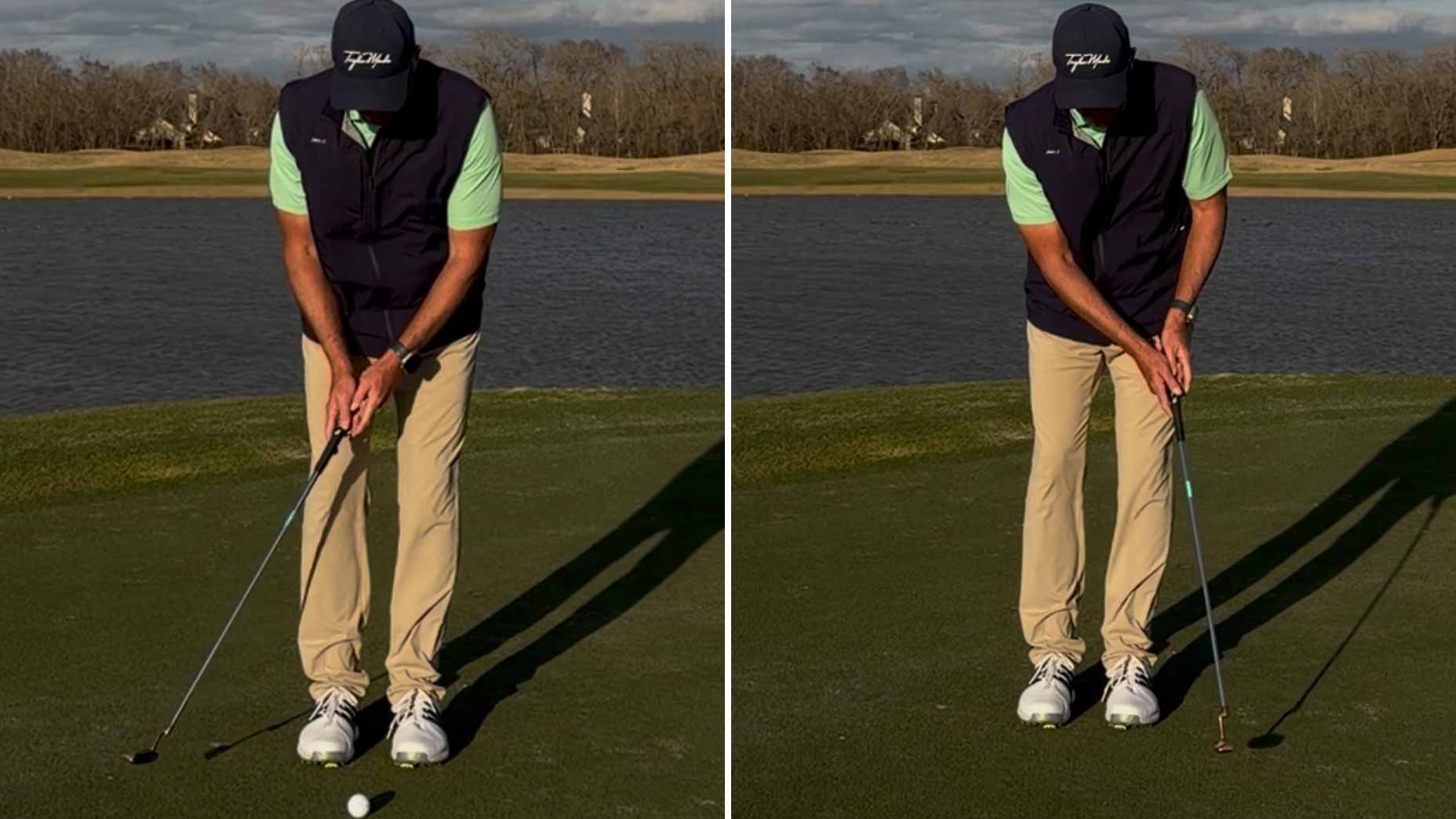
Some of the greatest putters of our era, when asked to describe their putting motion, say some variation of the following: “I try to create a lively putterhead.”
To the average golfer, this can sound confusing. But let’s dive a little deeper to figure out why they’re describing what they do in that way and answer a more relevant question: How can we apply that to our own short game?
A “lively” putterhead imitates an object we’d see in motion elsewhere in everyday life. Think of it as a pendulum and think of other versions of pendulums we see in day-to-day life, from the grandfather clock to the playground swing to the wrecking ball. In each example, the energy and tempo on both sides of the motion are the same. One side is not faster than the other. A true pendulum has a backswing and a forward swing of equal length.
It’s also important to understand where a pendulum reaches its greatest speed. Contrary to I might have assumed, it’s not at the bottom of the arc. The greatest acceleration occurs during the initial descent, as gravity begins to act on it. This is what allows the motion to remain balanced and equal on both sides.
So, how does this apply to striking a golf ball during the putting motion? The difference is that the ball introduces an interruption and resistance at the bottom of the pendulum at the moment of impact. Because the energy of the pendulum is equal on both sides, striking the ball at the bottom changes the appearance of the motion. The stroke will look longer going back and shorter going through.
From a technical standpoint, learning to make a longer backswing with a shorter follow through is the first step toward creating a more “lively” putterhead. This idea challenges much of the traditional instruction many golfers have heard for years. “Accelerate through!” has long been a staple of putting advice. But that cue promotes a lively handle, not a lively putterhead.
Remember, the fastest point of a pendulum is during its initial descent, not at the bottom and not past the ball.
When golfers first try making longer backswings, they often hit putts too firmly. This usually happens because they’re still holding onto the “accelerate through” mindset. What we want is a lively putter head, not a lively handle. To achieve this (and to avoid hitting putts too far) we must do something that feels counterintuitive: we must feel as though we are slowing down the handle as the downswing begins. Yes, decelerating the handle.
From a physics standpoint, when one end of an object slows down, the other end speeds up. That’s exactly what we’re trying to create: a faster, freer putterhead without excessive force.
If we accelerate the handle during the downswing, we actually slow the putterhead. That produces a true decelerating stroke — the opposite of a lively putterhead.
To make this intentional slowing of the handle more achievable, the backswing must be faster than most golfers are used to. The old instruction to take it “low and slow” tends to encourage dragging the handle rather than creating a true pendulum motion.
A longer and faster backswing is essential to producing a lively putterhead. It naturally encourages the handle to slow during the downswing, allowing the putter head to swing freely and deliver energy efficiently, without sending the ball too far.
A lively putterhead requires a longer backswing than follow through.
Courtesy of Tommy O’Brien Jr.
This approach also requires a different mindset around distance control. With a lively putter head, distance is determined in the backswing and not the follow through. The farther you want to hit a putt, the longer and faster your backswing must be to store the appropriate energy for the downstroke.
Many golfers attempt to use the same short backswing for nearly every putt and then adjust distance by hitting harder during the downswing. This typically results in short backswings and long follow throughs, which is the opposite of what elite putters do.
The best putters with lively putterheads allow the length and speed of the backswing to vary. Counterintuitively, a backswing that feels longer and faster — perhaps even slightly out of control — often produces greater control overall.
One final benefit of creating a lively putterhead is how much easier it becomes to square the face at impact. Swinging the putterhead, rather than manipulating or controlling it, makes it far simpler to return the face square time after time.