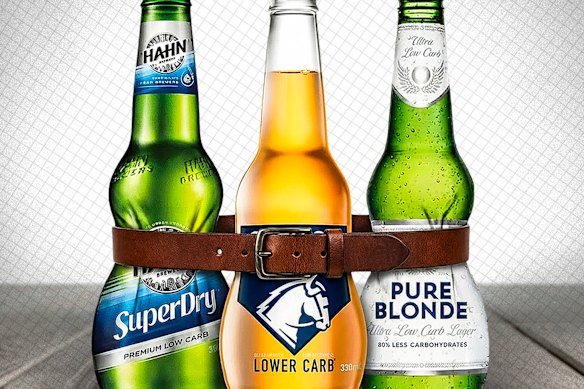

Containing just 99 calories in a 330-millilitre bottle, Hahn SuperDry is one of a growing number of beers advertised as “low-carb” and “99.9 per cent sugar-free”.
Great Northern Brewing Co’s Original Lager, on the other hand, contains about 102 calories in its 330-millilitre bottle but is not advertised as low-carb, despite the calories – the actual measure of how much energy is in the beer – being almost identical.
The key difference between how the two are marketed is that the SuperDry has fewer carbohydrates, but more alcohol (4.6 per cent versus the lager’s 4.2 per cent).
Research published this month in Health Promotion International suggests this marketing tactic of promoting alcohol as low-carb, low-sugar or low-calorie is working.
Exposing more than 2000 people to examples of booze with different health claims on the label, researchers found volunteers were more likely to rate beverages with low-carb or low-sugar claims as healthier, while still agreeing all were generally bad for you. The effect was strongest for low-carb claims – and, for women, for low-calorie claims.
“These health claims kind of trick the consumer into thinking that they are healthier,” said Asad Yusoff, a researcher at the George Institute who led the study. “They pose the same risk to consumers.”
To add to the confusion, unlike food, beer companies are not presently required to put calorie counts on their labels unless they specifically claim it is low-carb.
“It’s actually impossible at this stage for a consumer to be able to properly compare a product that claims to be low-carb and one that doesn’t,” said Dr Mia Miller, a researcher at the National Drug and Alcohol Research Centre. (The requirement is being phased in over the next three years.)
But the alcohol industry disagrees with the researchers’ critique.
They point to research done by the government’s food standards agency. It found that although people do think low-carb beers are slightly healthier for you, that doesn’t make them more likely to buy them.
“Australians are increasingly embracing moderation,” said Alistair Coe, executive director of Alcohol Beverages Australia, which represents the major manufacturers. “Alcohol consumption is at its lowest level in around 60 years, risky drinking has fallen significantly across the population, and underage drinking has more than halved over the past two decades.”
Where do all the calories come from?
So how can a low-carb beer contain similar amounts of calories to a full-strength brew?
The answer is in the alcohol content.
Many low-carb beers have similar alcohol volumes to full-strength beers.
Pure Blonde Low Carb is 4.2 per cent, Carlton Dry clocks in at 4.5 per cent, and Hanh SuperDry is 4.6 per cent. A “full-carb” Corona is 4.5 per cent alcohol, while VB and Crown are 4.9 per cent.
“It’s a low-carb food to start with. So going ‘low carb’ makes little difference to the calories,” said accredited dietitian Dr Tim Crowe.
When burnt by our bodies, each gram of carbohydrates contributes four calories of energy. Alcohol is also eventually burnt as energy, and it is much more energy-dense than carbohydrates or protein – contributing seven calories of energy.
Generally, most of the calorie content in a glass of beer or a bottle of wine comes from the alcohol, not carbohydrates.
In Pure Blonde Ultra Low Carb, for example, 1.1 standard drinks are worth 77 calories – out of the 85 in a bottle.
And alcohol comes with unique health risks. A meta-analysis of 572 studies including 486,538 cases of cancer found heavy drinkers dramatically increased their risk of cancer in the mouth, throat, colon and liver.
“The places where alcohol causes cancer are the places where it touches the body,” said Professor Simone Pettigrew, head of food policy at the George. “It is a toxin. Your brain resists this idea because people drink it all the time.”
It is not entirely clear how alcohol causes cancer. The body metabolises it first into acetaldehyde, a chemical that can bind directly to DNA, potentially damaging or mutating it; acetaldehyde is also the main chemical component of cigarette smoke.
Zero-alcohol beer: a Trojan horse?
In concert with the rise in low-carb beer is a growth in zero-alcohol beers, which more than doubled in prevalence in Australian alcohol stores between 2022 and 2024.
However, a 2024 study of Dutch university students found that most people just add zero-alcohol drinks to their normal drinking habits, rather than drinking less booze.
“People will say to us, ‘I would normally switch between alcohol and soft drinks,’” Pettigrew said. “Now they switch between alcohol and zero alcohol. They are drinking these zero-alcohol products, but it’s not in place of their regular alcohol.”
While alcoholic beverages are generally not allowed to be sold in supermarkets in Australia, the same restriction does not apply to zero-alcohol brands.
“Zero-alcohol advertising can be a way for the alcohol industry to get their brand out there in places where they otherwise would not be able to advertise – because of exposure to children,” Pettigrew said.
The alcohol industry argues there is no evidence zero-alcohol beers are simply being added to people’s existing drinking habits.
“Australia has a world-leading alcohol marketing framework,” said Coe. “The Responsible Alcohol Marketing Code applies across all media and includes specific rules for products with no or very low alcohol. Despite these drinks containing zero alcohol, the strict code still applies to protect minors.”
 Liam Mannix is The Age and The Sydney Morning Herald’s national science reporter.Connect via X or email.
From our partners
Disclaimer : This story is auto aggregated by a computer programme and has not been created or edited by DOWNTHENEWS. Publisher: www.smh.com.au