A missing Monday crowd. A silent Friday lunch. These are the CBD areas transformed by Melbourne’s vanishing 20 per cent.
In a city crawling out from the long shadow of the coronavirus pandemic, almost 10,000 fewer people walk through some of Melbourne’s busiest areas daily.
Hulking office precincts resemble concrete wastelands twice a week, and businesses plaster frenzied advertisements over walls and phone screens, vying for attention beside shuttered shopfronts.
Melbourne has become an “80 per cent city”, according to an analysis of City of Melbourne pedestrian data, which looked at six key inner-city locations, and found that four out of every five footsteps returned to CBD pavements.
The data in the interactive map above shows that the busy pockets of Melbourne CBD tell a similar story: foot traffic plummeted during lockdown and hasn’t yet returned to pre-pandemic levels.
At Southern Cross Station on weekdays, foot traffic is 65 per cent of what it was pre-COVID. At Flinders Street Station, it has returned to 77 per cent. In Bourke Street, foot traffic is just over half of what it once was; however, it rebounded after Mecca’s flagship store opened there last winter.
This is the portrait revealed by a decade of foot traffic data, exposing a city that never recovered after COVID-19 permanently changed it.
And it begins, as many trips into the city do, at Melbourne’s largest and busiest train stations.
At Southern Cross, foot traffic nosedived by 35 per cent since 2018-19. In 2024-25, about 17,700 people were clocked near its Collins Street entrance on an average weekday.
The station’s outskirts are still busiest during morning and evening peaks, but foot traffic is down for every hour of the day compared with 2018-19. Between 8am and 9am, when office workers tend to arrive in the city, about 2700 pedestrians are recorded on a typical weekday, down from about 4100 six years ago.
Working from home is the biggest contributor to Melbourne’s plummeting pedestrian numbers, KPMG urban economist Terry Rawnsley says. The decline at Southern Cross Station is almost “bang on” as workers attend the office three days a week, instead of five.
The flow-on effects are less obvious, unless you are a trader forced to accept that business has radically changed.
Take, for instance, Cecconi’s Flinders Lane: an upmarket Italian restaurant catering to high-level corporates for two decades. It has all but scrapped its first Friday dinner sitting because the post-work crowd is non-existent.
Company executives tell operations manager Nicoletta Sylvester they have more desks than staff in the city, especially on Mondays and Fridays.
The Southern Cross Station sensor records an average of about 20,000 pedestrians on Tuesdays, Wednesdays and Thursdays, but that figure drops to about 14,400 on Mondays and 11,700 on Fridays.
Of the primary office attendance days, Tuesdays are the busiest by a small margin, followed by Wednesdays and then Thursdays, the data shows.
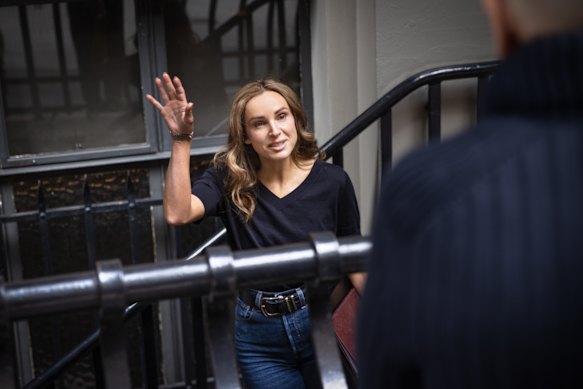
The post-COVID spending boom is a distant memory, Sylvester says.
“You know, last Friday I remember looking [around] – it would have been four o’clock in the afternoon, and there was hardly any foot traffic,” she says. “I was like: ‘Where is everyone?’
“Even if there was just one extra day that people were coming into the CBD, I think that would be different.”
The Allan government is poised to make working from home a legal right in 2026, and hospitality venues now face the additional battle of competing with more suburban restaurants and cafes, which opened out of necessity during COVID (Cecconi’s opened its own Toorak venture soon after, in 2023).
It takes more work to entice diners back into the city; when they make it there, many are no longer satisfied with just a meal – they want a dining experience and feeling like they’re getting value for money, Sylvester says.
The shift in attitudes has forced businesses to invest more in social media and marketing, or risk being weeded out of the industry.
Melbourne Lord Mayor Nicholas Reece argues that the city has “found a new rhythm”, with less foot traffic in some areas – but more people spending big.
“When people are in the city, they are making the most of it, spending more on dining and weekend retail compared to pre-pandemic levels,” he says.
“Melbourne is at its best when our workplaces are full – and we will keep advocating to businesses and the state government to get more workers back into the office.”
Sylvester says the days are gone when businesses could rely on CBD positioning, quality products and knowing their market to guarantee success. Instead, they have to be strategic – for example, by taking advantage of leasing incentives offered by landlords due to Melbourne’s high vacancy rates.
Melbourne’s office vacancy rate remains the highest of any Australian capital city, after COVID created a “perfect storm” that only began subsiding in the past 18 months, commercial real estate agency CBRE’s research manager Cameron Douglas-Perrine says.
The vacancy rate is sitting at about 19 per cent, up from about 3 per cent in 2019 – on par with the lowest in the country before the largest supply wave in more than two decades.
The timing also coincided with corporations, including the big banks, racing to secure Melbourne office space in a tight market – only to be met with disastrous post-pandemic office attendance.
Douglas-Perrine believes the direct correlation between foot traffic and office vacancy is a big indicator of where people want to work.
“Occupiers are very conscious of how their leasing decisions will impact office attendance, and they don’t want to lease a space if no one is going to use it,” Douglas-Perrine says.
The notorious Docklands has one of Melbourne’s highest office vacancy rates, about 21 per cent as of 2025. To the east, the city’s “Paris end” has recovered well post-COVID, with a vacancy rate of about 12 per cent.
Between February 2020 and September 2025, more than half of metropolitan Melbourne’s 6600 job losses across the big four banks were based in Docklands, according to Finance Sector Union data.
ANZ, headquartered in Docklands, flagged another 3500 job losses late last year.
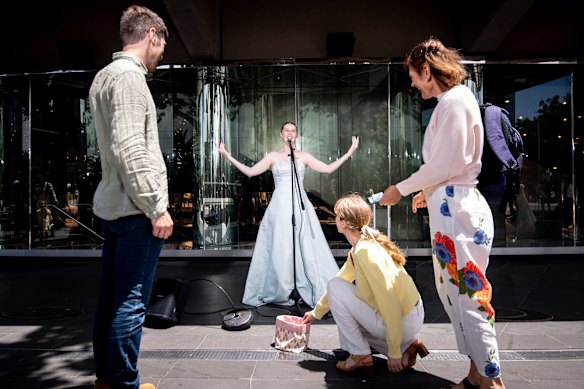
Opera-singing busker Lucy Diggerson, who performs primarily in the St Kilda Road arts precinct, says Docklands is among Melbourne’s least popular locations for buskers.
She suggests more cultural attractions in the area, which would bring more people in.
“[Docklands is] not a [busking] area compared to the arts centre or the national gallery, where there are a lot of people around, usually on a weekend,” Diggerson says.
Melbourne’s retail vacancy rate currently sits at about 7 per cent, compared with an average of 3 per cent before the pandemic.
It’s a figure that sets up what urban economist Rawnsley describes as an “overlay” of retail change, driving down foot traffic in the CBD, as fewer people choose to shop in the city over the likes of Chadstone Shopping Centre in Melbourne’s south-east.
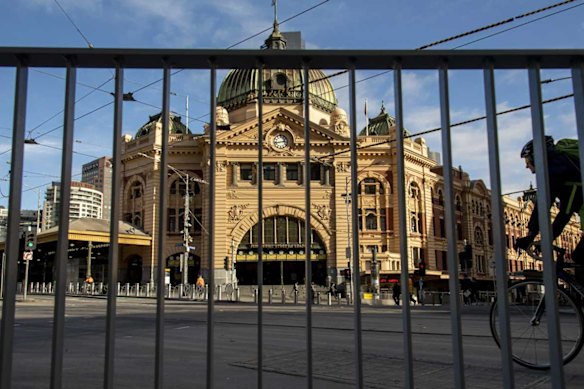
The story is slightly different in the Flinders Street Station underpass, but the impacts are muted by local tourism and attractions, Rawnsley says.
Foot traffic there has dropped 23 per cent since before COVID, equating to a daily average loss of almost 8800 pedestrians. Argentinian restaurant Asado is within earshot of the station, and has a poster out front promoting its “bottomless” $90 Saturday lunch.
Oliver Gould – executive chef of the broader San Telmo Group, which owns Asado – says it’s one of several offers across the business, in a post-pandemic world where everyone is “fighting for a piece of the pie”.
It has become a question of not of who has an offer, but whose offer is best, he says.
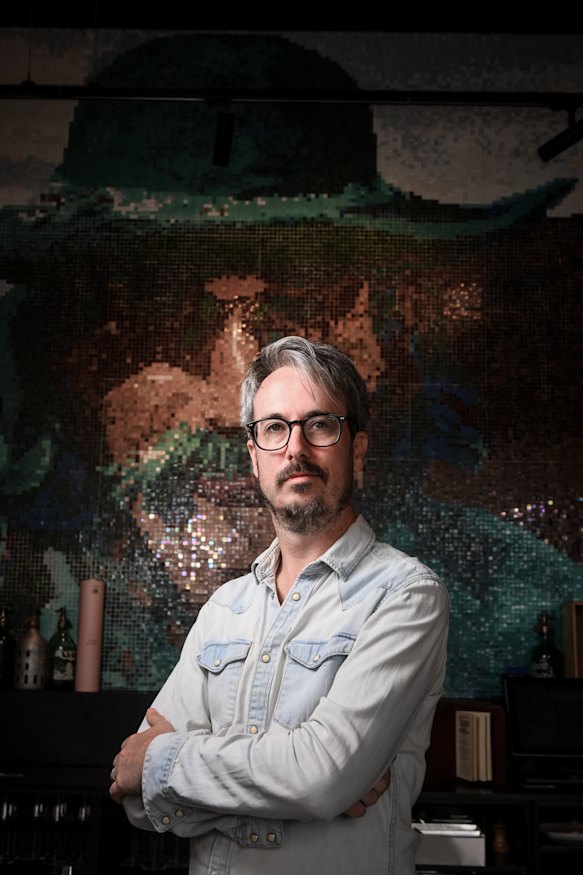
Gould believes Melbourne will never return to being a “five-day-a-week city”; while the multi-venue hospitality group recovered well post-COVID, it’s the small, independent businesses that will struggle most.
“That lunch trade in the city is going to struggle for the next few years, and a lot of venues need that lunch trade to survive,” Gould says.
“I think it’s accepting it. I don’t think there’s anything that anyone can do to change [it].”
The executive chef has started noticing more restaurants in the city with sheer curtains in their windows. It could be a design choice, or it could – as he suspects – be concealing a greater truth: the number of people in Melbourne has dwindled, and the city will never be the same.
Start the day with a summary of the day’s most important and interesting stories, analysis and insights. Sign up for our Morning Edition newsletter.
Disclaimer : This story is auto aggregated by a computer programme and has not been created or edited by DOWNTHENEWS. Publisher: www.smh.com.au