Dick Van Dyke turns 100 on Saturday, an event so eagerly anticipated that for him not to do so would seem cosmically wrong. It may be generationally vain of me to imagine that the beauties of “The Dick Van Dyke Show” and “Mary Poppins” are known and loved by those after their time, but as they remain available to watch and are still shared by parents with their children, it seems likely.
Although Van Dyke’s professional schedule isn’t what it was — a canceled public appearance in June made headlines, sending waves of concern throughout the nation — he has remained visible over the last decade in interviews and social media posts, often dancing or exercising, and the odd acting job. In 2023, he appeared on “The Masked Singer” as “The Gnome” and guested for a four-episode run on “Days of Our Lives” as a man with amnesia. (It won him — another — Emmy.) He marked his 99th birthday by appearing in a Coldplay video, shot at his Malibu home, dancing to “All My Love” as Chris Martin sings at the piano. (They went on “Jimmy Kimmel Live!” together.) His latest book, “100 Rules for Living to 100: An Optimist’s Guide to a Happy Life,” came out last month, following “My Lucky Life In and Out of Show Business” (2011) and “Keep Moving: And Other Tips and Truths About Aging” (2015).
Friday brings a PBS special, “Starring Dick Van Dyke,” appearing as part of the “American Masters” series — and who would deny that he has earned that title? (An unconnected film, “Dick Van Dyke 100th Celebration,” will play exclusively at Regent Theaters on Saturday and Sunday.) Directed by John Scheinfeld (“Reinventing Elvis: The ’68 Comeback,” “The U.S. vs. John Lennon”), it’s a celebration of a man and an artist easy to celebrate, a bringer of joy whose signature song — from “Bye Bye, Birdie, “ which made him a Broadway star and led to his becoming a movie star and a TV star — is “Put On a Happy Face.” Though the actor’s alcoholism is addressed here, in a long excerpt from a 1974 Dick Cavett interview — he’s been sober since 1972 — dark times are generally elided. The end of his first marriage, to Margie Willett, the mother of his four children, is expressed only by the words “drifting apart” and digitally erasing her from a family photo; it should be said here that Van Dyke has no official connection to this film and is not newly interviewed here.
Gathered together among the performance clips that are the main reason to watch the film are testimonies from famous friends and fans, which amount to: Van Dyke was a delight to know, to work with, or to watch. We hear from Carol Burnett, seen with him in pre-fame clips from “The Garry Moore Show” and together again in his own 1976 variety show “Van Dyke and Company” (brilliantly improvising an unplanned slow-motion fight between a couple of oldsters). Julie Andrews, his “Mary Poppins” co-star, does not think that Van Dyke’s controversial Cockney accent is all that bad, “and he was so rivetingly entertaining, funny and sweet, one really didn’t get bothered by it.”
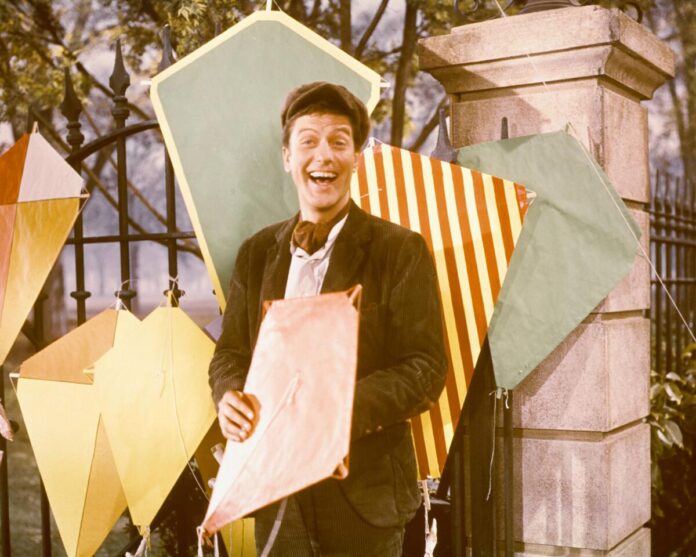
Dick Van Dyke in a publicity still for Disney’s musical film “Mary Poppins.”
(Silver Screen Collection/Getty Images)
Steve Martin awards him “a likability factor of 10,” and Martin Short (seated inevitably next to Martin) recalls scribbling “DVD” in a script meaning “do Dick Van Dyke.” Ted Danson, another long-limbed actor, on whose sitcom “Becker” Van Dyke guested in a run of episodes as his father in “a serious turn,” says that “he did all the human things but in such an elegant way.” Jim Carrey — himself noted for a certain Van Dyke-like rubberiness — thinks the star’s famous trip over an ottoman in the opening credits of his sitcom, is “not a pratfall, it’s a metaphor; if you tumble, you got to pop right up and laugh at yourself, because you’re ridiculous — we’re all ridiculous — and life is an obstacle course of unforeseen ottomans.”
Conan O’Brien compares him to Gumby and dances with him on his TBS talk show. Larry Mathews, who played son Ritchie on “The Dick Van Dyke Show,” pronounces him “chill.” We also get Pat Boone, on whose late ‘50s variety show Van Dyke appeared; Karen Dotrice, who played little Jane Banks in “Poppins”; NPR media analyst Eric Deggans, providing context; and Victoria Rowell, from Van Dyke’s 1993 mystery series, “Diagnosis: Murder,” which ran three seasons longer than “The Dick Van Dyke Show” and may, in some circles, be what he’s best known for.
And there are, of course, archival interviews with the late Carl Reiner, who created “The Dick Van Dyke Show” and calls its star “the single most talented man that’s ever been in situation comedy,” and co-star Mary Tyler Moore, whose sexual chemistry with Van Dyke, as Rob and Laurie Petrie, was something new for television in 1961 and rarely equaled since. (They were perhaps the only sitcom couple who danced and sang together.) That series, which ran until 1966, when Reiner and company, not wanting to get stale, pulled it from the air, was the perfect frame for the star’s gifts, an unusually lifelike workplace/family comedy that made room for Van Dyke’s silent-movie physical comedy and reactions.
Purely as a film, “Starring Dick Van Dyke” does suffer some from the challenge of tracking a 100-year life and a career that runs back more than eight decades; it’s something of an unwieldy hodgepodge whose flow, like many such documentaries, depends on who agrees to talk, what they have to say, what photos and films are available (and affordable) and, of course, what interests the filmmakers. Disappointingly, there are no clips from the 1971 sitcom “The New Dick Van Dyke Show,” which Van Dyke dismisses here but I quite liked, and surprisingly, no mention of the 2004 reunion, “The Dick Van Dyke Show Revisited,” written by Reiner and featuring all the surviving cast members. (I also have some issues with the kooky framing graphics.)
But there’s so much to see (and hear), going back to a snippet of the future star on local radio in Danville, Ill., where he started working as a teenager, and footage of him in the Merry Mutes, the lip-syncing double act that started his nightclub career in the late 1940s; various unsuccessful stints as a morning show anchor (with Walter Cronkite), a cartoon show host and a game show host; and performing “Put on a Happy Face” alongside Broadway castmate Susan Watson.
Appropriately, the most time is dedicated to “The Dick Van Dyke Show” and “Mary Poppins” (along with “Mary Poppins Returns,” in which Van Dyke, as the aged son of the aged banker he surreptitiously played in the first film, danced on a desk — at 93. The production and rehearsal photos are delightful — and a gift to Moore and Andrews fans as well — with everyone looking young and beautiful. He paints himself as “lazy” and “lucky,” not driven (except to earn a living for his family), “not an actor.” But the world decided for itself.
Apart from the 1968 “Chitty Chitty Bang Bang,” a sort of “Poppins” redux that has a considerable consistency of its own, and the Reiner penned-and-directed “The Comic,” a 1969 drama about a silent film comedian reckoning with the talkies, his post “Poppins” theatrical films are relegated to a single description and a collage — not even a montage — of posters. More attention is paid to “The Morning After,” a 1974 TV movie in which Van Dyke played an alcoholic businessman; it was around then that he went public with his own drinking problem.
Toward the end, the documentary sometimes has the air of a promotional piece, with accounts of charities Van Dyke supports. But two hours of Van Dyke performances cannot help but be entertaining. All you need to do is set up the clips and get out of the way. A man desperately searching for a handkerchief while trying to stifle a sneeze, the world’s oldest magician making a comeback — these hilarious bits require no context.
Inevitably, it is also a story of time, given a century of photos and films marking every stage of life. His long arms, his long legs and his overall all length are not what they used to be. But the long (which is not to say sad) face is as recognizable and expressive as it ever was.
More to Read
Disclaimer : This story is auto aggregated by a computer programme and has not been created or edited by DOWNTHENEWS. Publisher: latimes.com