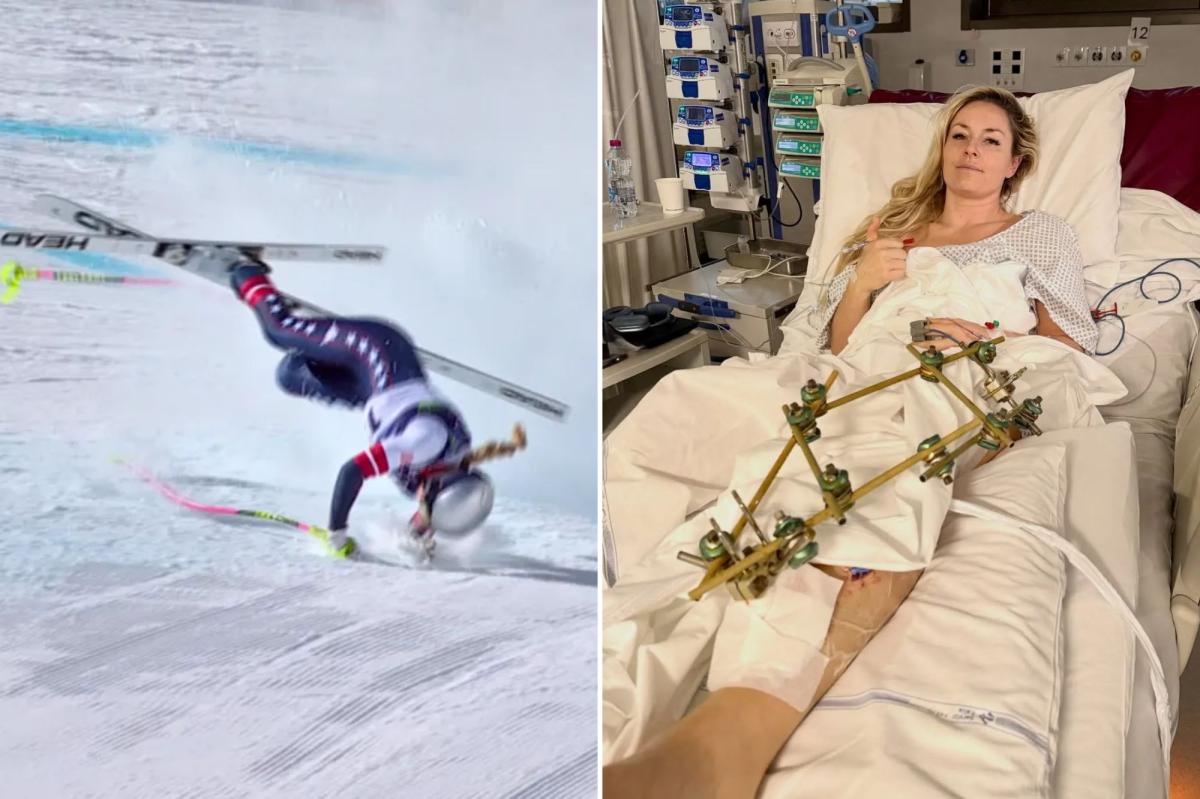
Thirteen seconds into Lindsey Vonn’s downhill ski run a week ago, disaster struck.
What had been shaping up to be one of the most impressive comebacks of all time was shattered as split seconds after clearing the fourth gate, she caught air, her right arm hooked into the gate and she flipped.
Vonn, 41, and no stranger to injuries through her 26-year pro career, hitting the ground with the impact of a motorcycle collision.
Medics rushed in and Vonn had to be airlifted off the mountain.
The injury came just a week after she also wiped out at the women’s downhill World Cup in Crans-Montana, Switzerland, needing another airlift.
Instead of seeing Vonn collect a medal on February 11, she was pictured in a hospital bed, recovering from a complex tibia fracture, scaffolded into a fixator device. She has a course of five surgeries scheduled in total. It may also mean the end of her professional career.
To reach the pinnacle of a sport and become an Olympian, athletes train hard, drive through pain and push themselves beyond their limits in pursuit of glory. Sadly, that can lead to serious physical agony in later life.
During the 2020 Olympics in Tokyo, according to the British Journal of Sports Medicine, there were 9.1 injuries per 100 athletes over the course of the games. When you consider there were approximately 11,600 athletes, that equates to over 1,288 injuries.
The same publication found one third of 3,300 athletes surveyed reported ongoing pain and functional limitations after sustaining injuries.
“I’ve had days where I can’t eat because I am in so much pain,” five-time Winter Olympics skeleton racer Katie Uhlaender told The Post.
Uhlaender has endured a litany of injuries including a shattered knee, a fractured ankle and a torn hip muscle, added, “The moments that I don’t have pain, all of a sudden the world is filled with light.”
Fragile and aching bones plagued pentathlon athlete R. Keith McCormick during and after his Olympic run. He made alternate in 1976 in Montreal and scored a place on the pentathlon team, dubbed the Golden Boys, in 1980. However, that was the year Jimmy Carter boycotted the Russian games and McCormick did not get to go.
Remembering how he trained from 5:20 in the morning until 10:00 at night, he described himself and his teammates as being “a wad of gristle” at the end.
“I fractured two vertebrae, there was a rotator cuff injury, I broke my jaw while fencing,” McCormick, now a chiropractic physician and the author of “Great Bones: Taking Control of Your Osteoporosis,” told The Post. “You don’t stop.”
Things crept up on him in his 40s, when he didn’t yet know he had osteoporosis.
“I was doing a little relay race with a friend. I picked up a little stick and broke a vertebra. I had reached a breaking point. All of a sudden, everything broke loose and started breaking,” he added, also noting his condition is under control through diet and modified exercise.
Jennifer Sey, now a successful athleisure wear entrepreneur with her XXXY Athletics, represented the US at the 1985 World Championships for gymnastics and was a frontrunner for the 1988 US Olympic gymnastics team before being sidelined for what she later learned was a broken foot, further injured through training and competing with the injury.
“At 40,” she told The Post, “I was limping more and more. I went to the doctor, and he thought I had been in a car accident. He said there was no cartilage at all, and my left ankle was shattered. Now I’m in my 50s, and some days it’s really hard to walk. That sucks.”
Cutting back to this past week in Italy, Vonn was not alone in disturbingly painful finishes. Jessie Diggins fought a rib injury to keep going and complete a cross-country skiing race. She made it to the end and won bronze. “I need a new body,” Diggins quipped afterward.
Despite consequences of bad timing and over training, as well as the potential for long-term pain, there is an element of athletic heroism associated with what the Diggs and Vonns of the world do. “Lindsey went out there [despite a recent knee replacement] and it wasn’t even a question; of course she was going to try,” said Uhlaender. “The beauty of her chasing her dream, despite the obstacles, is what this is all about.”
Never mind how the winning mindset also leads to injuries and the exacerbation of injuries.
US snowboarder Chloe Kim also knows what it means to play while hurt. She came into the Olympics with serious shoulder damage, having dislocated it during training in Switzerland. Kim, who snagged gold in 2018 and 2022, rolled into Livigno, Italy, with a shoulder brace on and this year Silver had to suffice.
“In my eyes, I’m a winner because I was able to persevere right through,” she said after medaling. “A month ago, I wasn’t even sure I would be here.”
For Vonn, herself a winner of a Gold and two Bronze medals at the Olympics, while she has expressed optimism for a full recovery, she could face serious consequences from her latest injury.
Dr. Bertrand Sonnery-Cottet, warned to the French-language RMC Sport outlet that in their most extreme, “some injuries like [the one sustained by Vonn] can end in amputation,” as reported by the Daily Mail.
Completely focused on playing through their injuries, Olympians have been known not to stop even after cripplingly painful breaks, snaps and tears happen —even mid competition.
Gymnast Kerri Strug won a gold medal at the 1996 Summer Olympics in Atlanta, but sustained a horrific injury which would leave anyone else curled up on the ground.
After a dodgy first attempt, which had her coming down awkwardly and tearing two ligaments in her ankle, she sucked up the pain, gave it a second shot, scored the necessary 9.493 out of 10 to secure a gold medal in gymnastics for the US team.
In terms of what Olympic athletes are trained to do, Strug asked in the Houston Chronicle, “Do they sometimes take it to another level? Possibly, but that is what it requires.”
However, the injury ended her career as an Olympic gymnast.
Manteo Mitchell would agree with Strug’s sentiment. During the 2012 Summer Olympics in London, Mitchell was running the 4 x 400 meters relay when he broke his left fibula halfway through his portion of the race.
Pushing through the pain, he finished his lap and contributed to America qualifying and ultimately medaling. But, he told The Post, “the next day I couldn’t walk. It took 17 weeks of physical therapy to get back to running.”
Though 2012 was his last Olympics, Mitchell continues to stay fit, train and compete. He has no regrets about doing what he did for his country.
“I knew I would risk injury by continuing to run, but I was wearing USA across my chest,” he said, speaking for all kinds of hurt American athletes who compete through the pain and deal with consequences later. “An entire country and billions of people were watching me. I had to get back to that line.”
Disclaimer : This story is auto aggregated by a computer programme and has not been created or edited by DOWNTHENEWS. Publisher: nypost.com