Asia remains the world’s fastest-growing region—and its momentum shows little sign of slowing. According to 2025 McKinsey estimates, the region is set to contribute as much as 40% of global growth by 2040.
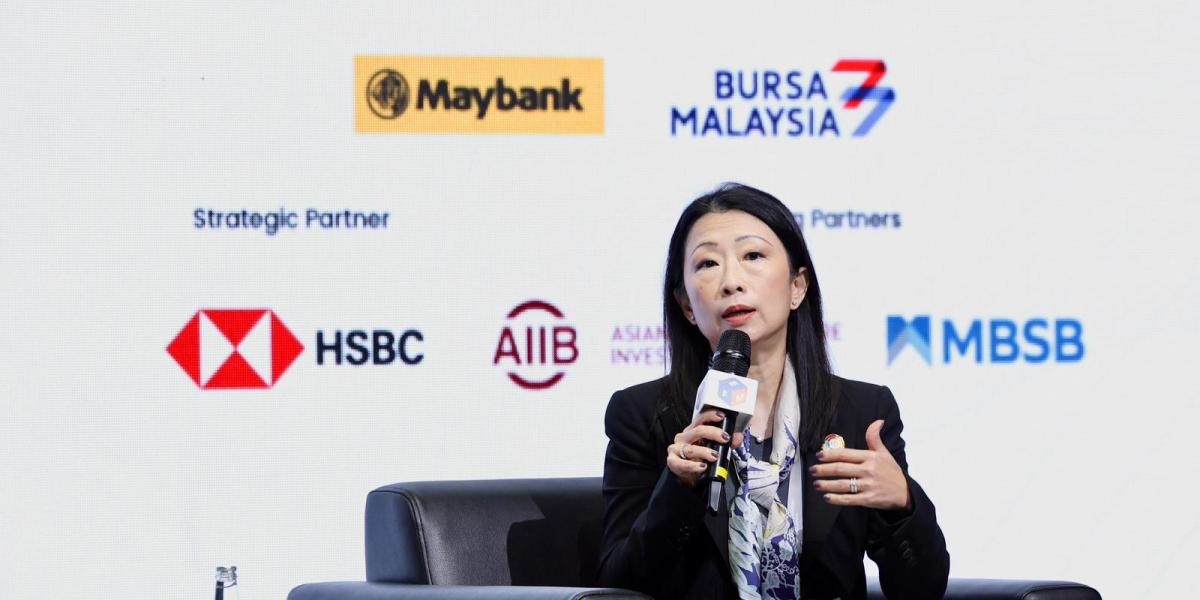
“That growth trajectory is going to continue,” Kim-See Lim, the chief investment officer of the Asian Infrastructure Investment Bank (AIIB), tells Fortune at the sidelines of the Forum Ekonomi Malaysia. “Asia has a young population base that is very tech-savvy and, with that, productivity and knowledge transfer will really go up.”
A Malaysian native, Lim is optimistic about her home country’s economic prospects. Malaysia’s unemployment rate stands at just 2.9%, while the ringgit recently touched a five-year high.
Last October, the AIIB inked cooperation agreements with four Malaysian banks—Maybank, CIMB, AmBank and BPMB—to mobilize $6 billion to finance green infrastructure projects across Southeast Asia. Lim calls that “the first step towards supporting economic growth in Malaysia and the surrounding region.”
Energy makes up a sizable part of ASEAN economies, with firms such as Thailand’s PTT, Indonesia’s Pertamina, and Indonesia’s Perusahaan Listrik Negara (PLN) sitting in the top ten of Fortune’s Southeast Asia 500 ranking.
Developed by Asia, for Asia
The AIIB was established in 2015, in a China-led effort to foster sustainable economic development and improve infrastructure connectivity in Asia. (Chinese president Xi Jinping proposed the initiative in 2013, during a state visit to Indonesia.)
“In 1980, China didn’t have any expressways, no electrified railways, no modern airports, nothing in terms of so-called modern infrastructure,” Jin Liqun, AIIB’s founding president, told Fortune in an interview last year. “Yet by 1995, China’s economy started to take off. From 1995, other sectors—manufacturing, processing—mushroomed because of basic infrastructure.”
AIIB bank boasts 111 countries as members, including other large economies like India, France, Germany and the U.K. (Both the U.S. and Japan declined to join)
Unlike other multilateral development banks such as the World Bank, the AIIB’s work is more narrowly focused on infrastructure. The AIIB doesn’t “prescribe” what its members should do, Lim says. “That’s what we’re really here for, to listen to countries’ needs and see how we can support them.”
Still, despite its positioning as an alternative to existing MDBs, the AIIB works closely with its peers in development finance. Since AIIB’s founding, Lim says they’ve undertaken over 130 projects—and mobilized over $32 billion of co-financing—with other peer MDBs.
The AIIB is investing in infrastructure throughout Southeast Asia, particularly in the areas of transit and mobility. The bank is funding the construction of bridges and toll roads, as well as upgrading metro infrastructure in the Philippines, where cities like Manila suffer from heavy traffic congestion. The AIIB is also providing over $400 million in funding to expand Thailand’s U-Tapao International Airport, which serves neighboring tourist hubs like Bangkok and Pattaya.
On Feb. 10, Singaporean infrastructure firm Keppel announced that it received a total of $125 million in AIIB commitments for a private credit fund targeting sustainable infrastructure projects throughout Asia-Pacific. The AIIB-Keppel partnership eventually hopes to mobilize $1.5 billion in funds towards projects developed by Keppel.
“ASEAN is the fifth largest economy in the world,” Lim said to Fortune last week. “There is strength in those numbers. Whether it’s for trade, power, or just the sharing of knowledge, there is strength in that grouping.”
Disclaimer : This story is auto aggregated by a computer programme and has not been created or edited by DOWNTHENEWS. Publisher: fortune.com