Staff reporter
Updated ,first published
The Australian sharemarket has slumped at the open after US stocks fell sharply as the market punished companies seen as potential losers from artificial-intelligence technology.
The S&P/ASX 200 was down 73.1 points, or 0.8 per cent, at the open, with eight of 11 industry sectors in the red. Tech stocks have been the biggest weight on the local index after more artificial intelligence jitters hit Wall Street overnight.
Westpac shares rose 1.3 per cent after the banking giant said it made $1.9 billion in net profit in the December quarter, which was 5 per cent higher than the quarterly average during the September half. Amid stiff competition in retail banking, Westpac said its net interest margin, which compares funding costs with what it charges customers, had fallen 3 basis points to 1.79 per cent. The Sydney-based bank said there had been a fall in impaired loans – a trend also seen at Commonwealth Bank.
“We are optimistic on the outlook for the economy and expect demand for both business and household credit to remain resilient. Our strong financial foundations provide us with the stability and capacity to support our people, customers, shareholders and the broader economy,” Westpac chief executive Anthony Miller said.
It has been a mixed start for the rest of the big four, with ANZ Group jumping 1.3 per cent while Commonwealth Bank and National Australia Bank each retreated 0.2 per cent.
Technology stocks again came under heavy pressure after sharp falls overnight on Wall Street. WiseTech tumbled 11.8 per cent, Xero lost 4.4 per cent and technology One was 5.9 per cent lower in early trade.
Cochlear shares crashed as much as 16 per cent to a multiyear low of $205.71 after the delayed rollout of its new Nexa implant delivered a half-year result that was below the market’s expectations.
Revenue dropped slightly to $1176 million while net profit dropped 10 per cent to $195 million. A strong Aussie dollar may also hit the bottomline with the company saying earnings could drop $30 million if current exchange rates prevail.
Mining stocks were lower across the board as commodities’ prices retreated with BHP slumping 1.1 per cent, Fortescue down 0.4 per cent and Rio Tinto 0.8 per cent lower. Gold miners slumped as the price of the safe haven fell with Northern Star losing 2.3 per cent and Evolution Mining shedding 4.2 per cent.
Virgin Australia has replaced its respected chief of its loyalty program Nick Rohrlach in a shake-up designed to “accelerate customer-facing initiatives”.
Rohrlach, CEO of Velocity Frequent Flyer “has decided now is the right time to leave the airline and prioritise the next chapter in his family life”. He led the airline’s loyalty program since 2021.
The airline has named former Qantas executive Andrew Cleary as the airline’s chief customer officer and Velocity CEO, replacing Rohrlach, effective April 30. Virgin shares added 1.1 per cent.
Energy stocks lost ground as oil prices fell by more than 2 per cent overnight. Woodside Energy was down 0.9 per cent, Santos lost 1.7 per cent and Ampol retreated 1.1 per cent in early trade.
The Australian dollar was weaker at US70.87¢ at 10.44am AEDT.
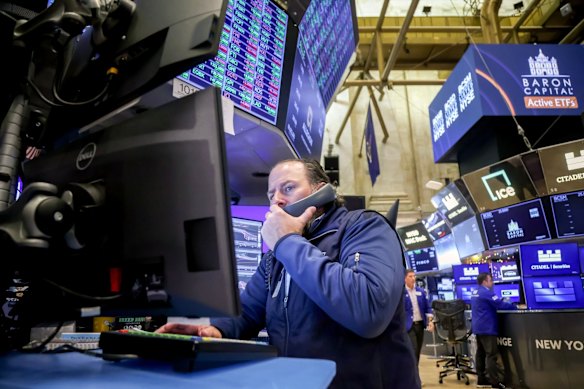
On Wall Street, the S&P 500 sank 1.6 per cent for its second-worst day since Thanksgiving, though it’s still near its all-time high set late last month. The Dow Jones Industrial Average dropped 669 points, or 1.3 per cent, and the Nasdaq composite fell 2 per cent.
AppLovin lost nearly a fifth of its value and tumbled 19.7 per cent, even though it reported a stronger profit for the latest quarter than analysts expected. Like other software companies, it’s come under pressure from worries that AI may undercut its business while fundamentally changing how people use the internet.
Cisco Systems dropped 12.3 per cent despite likewise topping analysts’ expectations for profit and revenue last quarter. The tech giant indicated that it may make less profit off each dollar of revenue during the current quarter than it did in the past quarter.
Analysts said that could be an indicator of higher prices for computer memory that everyone is having to pay amid the rush driven by AI.
More broadly, questions are rising about whether businesses that are spending heavily on AI will end up seeing high-enough profits and productivity to make the investments worth it.
In the bond market, Treasury yields fell as investors looked for safer places to park their cash. A report also said slightly more US workers filed for unemployment benefits last week than economists expected.
Still, the number was lower than the prior week’s, which is a signal that the pace of layoffs may be improving. It also followed a surprisingly strong report on the job market from Wednesday, which said the nation’s unemployment rate improved last month.
A strengthening job market could push the Federal Reserve to hold interest rates steady and keep its cuts on pause, even if President Donald Trump keeps loudly and aggressively calling for lower rates. While lower rates can give the economy a boost, they can also worsen inflation.
It all raises the stakes for Friday’s upcoming report on inflation at the US consumer level. Economists expect it to show inflation slowed to 2.5 per cent last month from 2.7 per cent in December.
A separate report on Thursday said that sales of previously occupied homes slumped last month by more than economists expected, which also weighed on yields.
With AP
The Market Recap newsletter is a wrap of the day’s trading. Get it each weekday afternoon.
From our partners
Disclaimer : This story is auto aggregated by a computer programme and has not been created or edited by DOWNTHENEWS. Publisher: www.smh.com.au