Stan Choe
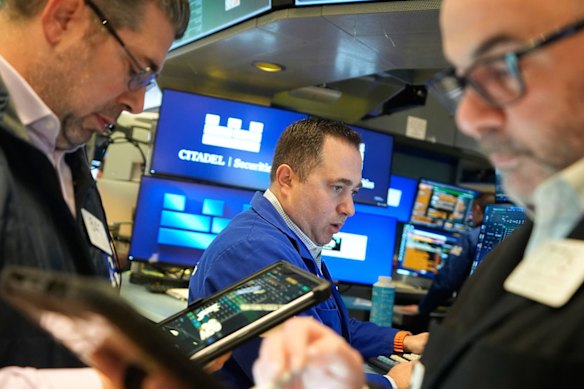
The US stock market is rebounding from two days of punishing swings after oil prices stopped spiking and reports gave encouraging updates on the economy.
The S&P 500 rose 0.8 per cent in midday trading and is on track to claw back most of its loss since the war with Iran began. The Dow Jones was up 301 points, or 0.6 per cent, as of noon Eastern time, and the Nasdaq composite was 1.3 per cent higher.
The Australian sharemarket is set to claw back some of the previous session’s heavy losses, with futures at pointing to a rise of 0.9 per cent, at the open. The ASX slumped by 1.9 per cent on Wednesday. The Australian dollar was trading at US70.63¢ at 5.18am AEDT.
The strength followed a scary start to Wednesday, when South Korea’s Kospi stock index plunged 12.1 per cent for its worst day in history. Uncertainty about the war has sent prices in financial markets careening up and down hour by hour this week, with most taking their cues from what the price of oil is doing.
Oil prices moderated as trading moved westward from Seoul and the rest of Asia to Europe and across the Atlantic. After briefly topping $US84 per barrel, the price for a barrel of Brent crude, the international standard, eased back to $US80.88, a dip of 0.6 per cent. A barrel of benchmark US crude fell 0.6 per cent to $US74.14.
Stocks also got a boost from increased hopes for the US economy.
One report said growth for US businesses in the real estate, finance and other services industries accelerated last month at the fastest pace since the summer of 2022. Encouragingly for inflation, it also said prices for such businesses are increasing at a slower rate, at least before the war with Iran began.
A second report suggested US employers outside of the government picked up their hiring last month. That could be a hopeful signal for the more comprehensive report coming Friday from the US government about the strength of the job market.
In financial markets, worries are centred on how long the war with Iran could last, how high inflation will go because of more expensive oil and how much corporate profits will sink because of it.
The US stock market has a history of shaking off military conflicts in the Middle East relatively quickly, though that comes with a caveat that oil prices don’t jump too high. That has some professional investors suggesting patience through the volatility, at least when it comes to financial markets.
Not everyone is optimistic.
“I think the Iran situation is getting out of hand, and I think that US President Donald Trump miscalculated enormously,” said Francis Lun, CEO of Venturesmart Asia. “The situation is very grim.”
On Wall Street, a mix of companies helped drive Wednesday’s rise.
Stocks enmeshed in the crypto industry climbed as bitcoin’s price rebounded back above $US73,000. Coinbase Global jumped 15.3 per cent, and Robinhood Markets rallied 7.8 per cent.
Retailers and travel companies strengthened with hopes that a solid economy and an easing for jumps in petrol prices will mean their customers may have more to spend.
Ross Stores climbed 7.4 per cent after reporting better profit and revenue for the latest quarter than analysts expected and saying it’s entering 2026 with “solid momentum.” Expedia Group rose 3.6 per cent.
Big Tech stocks, meanwhile, were the strongest forces lifting the market. Nvidia added 1.5 per cent, and Amazon rose 3.1 per cent. Because they’re among the biggest stocks in the US market in terms of total value, their movements carry more weight on the S&P 500.
In stock markets abroad, indexes rose in Europe following sharp drops in Asia. France’s CAC 40 climbed 0.8 per cent, and Germany’s DAX rallied 1.7 per cent. That came after losses of 2 per cent for Hong Kong’s Hang Seng and 3.6 per cent for Japan’s Nikkei 225, along with Seoul’s historic plunge.
In the bond market, Treasury yields were relatively steady after jumping early in the week with worries about worsening inflation. The yield on the 10-year Treasury held at 4.06 per cent, where it was late Tuesday.
Wednesday’s strong reports on the economy were welcome news for the Federal Reserve, whose job it is to keep the US job market healthy and inflation low. The Fed’s job has become more difficult because of the jump in oil prices, which is pushing upward on already high inflation.
The Fed could keep interest rates high to keep a lid on inflation. But high interest rates would also keep borrowing costs more expensive for US households and companies, grinding down on the economy.
The central bank had earlier indicated it planned to resume its cuts to interest rates later this year, in hopes of giving a boost to the job market and economy. Because of the war and higher oil prices, traders are have pushed their forecasts further into the summer for when the Fed could begin cutting rates again.
From our partners
Disclaimer : This story is auto aggregated by a computer programme and has not been created or edited by DOWNTHENEWS. Publisher: www.smh.com.au