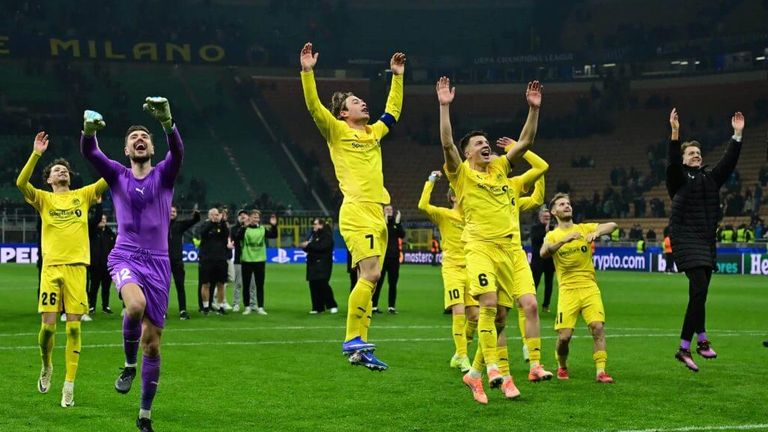
Atalanta pulled off a thrilling, last-gasp turnaround to make it to the Champions League last 16. Juventus battled valiantly into extra-time with 10 men. But that show of fight hasn’t lifted the dark cloud which settled over Italian football this week.
A 98th-minute penalty, converted by Atalanta’s Lazar Samardzic, means there will be Italian representation in the next round of the Champions League knockouts.
But their giants have fallen.
There was a certain irony on Tuesday night at the San Siro. Moments before kick-off, Inter Milan welcomed club legends Ronaldo Nazario and Christian Vieri onto the pitch as special guests – two figures whose partnership once demonstrated the might of what Serie A once was.
Come full-time, that period has never felt further away. What followed on the pitch was Inter – 10 points clear at the top of Serie A – being knocked out by a Bodo/Glimt team who are currently in pre-season.
They were not just beaten; they were well beaten, against a team making their first-ever Champions League appearance this season, let alone an appearance in the knockout stages.
And losing their knockout play-off to Norway’s first Champions League proper team for nearly two decades was not just a low for Inter, but it confirmed one for Italian football.
The following day, Juventus salvaged some pride but a 7-5 aggregate loss to Galatasaray is still a stunning exit for the previous powerhouse of Serie A.
Reigning Serie A champions Napoli fell at the first hurdle, failing to progress from the league phase. AC Milan aren’t even in European competition this season.
While Bologna and Roma continue to fly the flag in the Europa League, Fiorentina finished 15th in the Conference League table – requiring a play-off against Polish side Jagiellonia Bialystok to make the last 16 of that competition.
And speaking of play-offs, it could get worse. Italy’s national team need one to avoid a third absence from a World Cup tournament – a competition the nation has won four times. So what has happened to Italian football across the board?
It has been pretty clear this season that the Serie A teams have not been able to cope with the demands of the European competition – particularly the speed of play.
“Italian teams play at a slow pace,” Fabio Capello told Sky in Italy. “When they face teams that run and press, they don’t have the quality, aren’t accustomed to playing at a high pace, and make mistakes.
“This is the key. Right now, we are not accustomed to being aggressive. As soon as they increase the pace from the Italian league, they are stopped because a challenge is too hard – a player’s ear is touched, and they go down, all these things.
“These are the results. We play at a slow pace, unfortunately, and when it happens, it’s hard to be dangerous.”
The numbers back that up. The direct speed of Italy’s top-flight has been on a downward curve in the last five seasons, with many describing the current style of play as slow, compared to the rest of Europe’s big five leagues.
Serie A have the second-lowest direct speed of play out of their European rivals, only the French top-flight has a lower speed – with no Ligue 1 clubs qualifying for the top eight positions in the table.
The Premier League’s speed going on an upward curve in the last 12 months could explain why they have fared well this season – with all six of England’s teams safely and comfortably through to the last 16 across the board.
The speed of play could also have something to do with a dip in player quality in the league, partly due to a lack of investment put in by clubs.
Where are the net generation of Italian stars?
Last summer, the most expensive transfer made by an Italian club was Christopher Nkunku’s £36m from Chelsea to AC Milan.
The most exciting signings, and arguably the most successful, were free transfers Kevin De Bruyne, Luka Modric and Jamie Vardy.
Milan relying on 40-year-old Modric for creativity, Juventus having ex-Bournemouth defender Lloyd Kelly as a starting defender – who was sent off in the second leg against Galatasaray – and Davide Frattesi going from nearly joining Nottingham Forest in January to starting in the Champions League defeat to Bodo perhaps tells you everything you need to know about the level.
And while Serie A is relying more and more on older and more experienced players, there is a lack of promising Italian youth coming through.
Since June of last year, only one capped player for the national team is under the age of 24 – Inter’s young forward Pio Esposito. England have managed a dozen.
In 2025, Italy also gave 1.9 per cent of their Serie A minutes to eligible players under the age of 21. That’s the second-lowest out of the top 50 leagues in world football. Only the United Arab Emirates Pro League managed fewer.
It has been the case for a while. According to the CIES Football Observatory, between 2020 and 2025, Italy produced just 413 football exports. It ranked 24th in the world, behind the United States, Japan and Russia.
The other four nations in Europe’s big five leagues all managed over 1,000 players in the same category. Italy’s players – young or old – are just not as fancied by Europe’s elite.
A traditional tactical problem?
Also at the heart of Italian football is a lack of tactical innovation. While other leagues have done well to take new tactical insight from the rest of Europe, Italy seems a little stuck in its ways.
Italian coaches Max Allegri, Maurizio Sarri, Luciano Spalletti and Antonio Conte have all been passed around Italy’s top clubs in recent years, without much differentiation.
Even Atalanta replaced now-Roma coach Gian Piero Gasperini with ex-Fiorentina coach Raffaelle Palladino and Inter did the same with Parma’s Christian Chivu coming in for Simone Inzaghi. Every Serie A appointment seems within its own boundaries.
Cesc Fabregas’ overachieving Como revolution is a good example of what happens when you take tactical ideas from elsewhere. Carlos Cuesta is another example, he is faring well with Parma having joined from Mikel Arteta’s Arsenal backroom staff in the summer.
Could a lack of infrastructure in Italian football – another theme banded around this week amid their clubs’ failings in Europe – have something to do with all these issues?
This year, Deloitte’s Football Money League saw no Italian teams in the top 10 wealthiest teams in the Europe. The report added that the most significant part of the wealthy teams’ revenue was the way in which they used their stadiums on a non-matchday – such as Tottenham Hotspur’s NFL deal.
Italy’s plight can be seen in the San Siro. It is a pantheon arena of the game but unique because it is outdated and ‘old school’ – hence why it is being renovated.
It is so far behind its equivalent stadia in Europe – as is Italian football compared to the rest of the continent.
Disclaimer : This story is auto aggregated by a computer programme and has not been created or edited by DOWNTHENEWS. Publisher: skynews.com