
Inflation remained at 3.8% in the year to January, but a lift in underlying price pressures will add to fears of another interest rate hike.
The Reserve Bank’s preferred measure of “core” inflation, which removes large temporary price swings, lifted from 3.3% to 3.4% in January.
The consensus forecast among economists had been for headline inflation to tick lower to 3.7%, and for the trimmed mean measure to be steady.
The RBA in February delivered its first rate hike since late 2023, after a surprisingly strong economic rebound through the second half of last year pushed inflation back above the bank’s 2-3% target range.
Financial markets and economists are betting on another hike, potentially at the May RBA board meeting.
The Reserve Bank’s deputy governor, Andrew Hauser, recently told Guardian Australia that it appeared that unanticipated pickup in activity had extended into the new year.
Notably, the unemployment rate remained at a low 4.1% in January.
More than half of Australians open to voting for One Nation despite Hanson’s Muslim comments
Nearly 60% of Australians would be open to voting for One Nation at the next federal election, including nearly half of those currently backing Labor, according to the latest Guardian Essential poll.
The results will ring alarm bells for both the government and Coalition about the march of the rightwing populist party and its leader, Pauline Hanson.
Meanwhile, Angus Taylor’s appointment as Liberal leader has done little to boost the opposition’s electoral fortunes so far, with its primary vote virtually unchanged and voters split about whether his spill of Sussan Ley would make them more or less likely to vote for the Coalition.
The poll of 1,002 Australians last week, found a largely unchanged primary vote federally. Labor recorded a 30% primary, one point down from January, while the Coalition ticked up one point to 26%.
Read more here:
Independent oversight team appointed at Cumberland Hospital
The NSW Government has ordered an independent team of experts to oversee the management of Cumberland Hospital effective immediately following separate escapes of two mental health patients.
A man charged with murder after a stabbing attack in Merrylands had allegedly absconded from Cumberland hospital. In an unrelated matter, it has been alleged that another of the hospital’s patients caused a car crash that killed two people earlier in February.
The direction from the minister for mental health Rose Jackson “is aimed at improving safety, strengthening governance, and rebuilding public confidence, alongside a formal security review into recent incidents,” a statement from the minister’s office said.
The team of experts will ensure clear monitoring, accountability and escalation frameworks are implemented at the hospital, the statement said.
It follows a recently announced review to examine patient care and treatment, security protocols, and the management of abscondments at the hospital.
Cumberland Hospital will be closing permanently at the end of 2027, when the Westmead Integrated Mental Health Complex opens.
“A formal review into these recent incidents is underway, but because we want it to be a thorough process it will not be completed overnight,” Jackson said, continuing:
We don’t want people experiencing mental distress shunted away in small, isolated facilities. The new Westmead Integrated Mental Health Complex will allow us to relocate patients into a modern, integrated network of health facilities.
Power bills up by nearly a third in the year to January
Climbing rents, electricity bills and building costs contributed the most to inflation in the year to January, according to figures released by the Australian Bureau of Statistics this morning.
As mentioned, inflation in the year to January did not ease as expected, but instead held at 3.8%.
The measure the Reserve Bank pays attention to, which tracks underlying price pressures, actually rose from 3.3% to 3.4%.
Why is the “headline” figure so high?
A big part of the story is that power bills are a huge 32% higher than they were in early 2025, which the ABS said is “mostly related to households using up” federal and state electricity rebates.
In other words: electricity costs were artificially lowered by subsidies, and are now snapping back to “normal”.
Rents climbed at a brisk 3.9%, unchanged from the month before.
Bad news for households: the climbing cost of living is concentrated in essentials.
Non-discretionary goods and services are 4.1% higher through the year, the ABS data showed, while discretionary prices were up 3.5%.
We’ll soon hear what the economists reckon this all means for the chance of further interest rate hikes.
WiseTech Global is planning to cut 2,000 jobs over two years as the Sydney-headquartered firm bets big on the ability of artificial intelligence to replace humans.
The planned reduction, representing about 30% of its workforce, marks a radical change for a logistics software company that has itself come under heavy pressure from investors over fears its products could be replicated by AI.
This morning, WiseTech’s chief executive, Zubin Appoo, said:
Software development has experienced its most significant shift in decades. I am prepared to say this clearly: the era of manually writing code as the core act of engineering is over.
AI amplifies the productivity of our expertise in logistics and trade, the rich datasets that WiseTech holds, and the network advantage that we have built over 30 years.
Shares in WiseTech have been heavily sold down in recent months as part of the “SaaS-pocalypse”, a term to describe the idea that AI becomes so advanced that bespoke software becomes redundant.
Many software companies, however, have described the sector rout as overdone and believe their businesses will benefit from AI advancements.
Woolworths has reported a significant 16.4% rise in profit, helped by expanding its margins in its key supermarket business.
In its half-year earnings report released today, Woolworths recorded an increase in underlying net profit to $859m over the six months to 4 January, up from $739m in the prior corresponding period.
Australia’s largest supermarket chain significantly expanded its profit margins during a period of reigniting inflation, with groceries and other household costs rising strongly again in the second half of last year.
The company’s results come ahead of a planned legal case brought by the consumer regulator against Woolworths.
Read more:
Inflation remained at 3.8% in the year to January, but a lift in underlying price pressures will add to fears of another interest rate hike.
The Reserve Bank’s preferred measure of “core” inflation, which removes large temporary price swings, lifted from 3.3% to 3.4% in January.
The consensus forecast among economists had been for headline inflation to tick lower to 3.7%, and for the trimmed mean measure to be steady.
The RBA in February delivered its first rate hike since late 2023, after a surprisingly strong economic rebound through the second half of last year pushed inflation back above the bank’s 2-3% target range.
Financial markets and economists are betting on another hike, potentially at the May RBA board meeting.
The Reserve Bank’s deputy governor, Andrew Hauser, recently told Guardian Australia that it appeared that unanticipated pickup in activity had extended into the new year.
Notably, the unemployment rate remained at a low 4.1% in January.
Capital gains tax discount not to blame for high house prices, former PC boss says
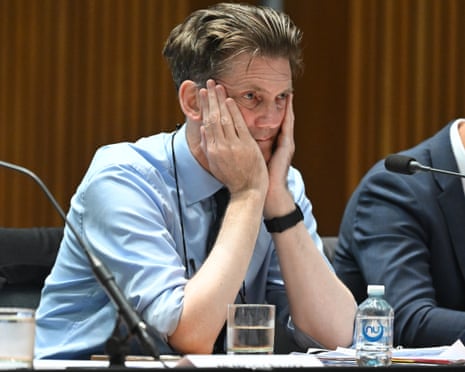
Michael Brennan, the CEO of the e61 Institute, says it would be “brave” to say that the introduction of the 50% capital gains tax discount in 1999 played a major role in the massive boom in house prices since the turn of the century.
Instead, the “locking in of expectations that interest rates would be permanently lower” meant buyers were prepared to pay more for a range of assets, including property. That had a “significant effect” on the housing market, Brennan told a parliamentary committee looking at the CGT.
There was also a big rise in incomes from 2003 as China’s rapid industrialisation sparked a boom in the demand for iron ore. “We had significant population growth at the time; that’s also something that contributed to the run-up in housing prices a bit in that period,” he said.
Brennan doesn’t believe that reforms to the CGT should be viewed through the lenses of housing affordability or intergenerational fairness, despite the fact that much of the talk through the three days of hearings has been on this topic. Instead, it should be about the “twin principles of horizontal and vertical equity”.
Horizontal equity argument is the idea you want to have people with similar incomes taxed similarly. And vertical equity in the sense we have a belief in progressivity: that those on higher incomes make a higher proportionate contribution to revenue than those on lower incomes.
His previous evidence was that the CGT discount in its current form fails on both these counts.
Albanese’s dog Toto ‘on alert’ but ‘all good’ after bomb threat at Canberra home
Toto, Anthony Albanese’s blond cavoodle, is standing guard at the prime minister’s residence in Canberra after the Lodge was evacuated for a few hours on Tuesday night over a bomb threat.
Albanese took to social media to share a photo of his pup, who also served as a ring-bearer during his wedding last year:
“Toto on alert but all good,” the prime minister wrote on Instagram. “Thanks to AFP for your ongoing work and professionalism and to people who sent kind messages of care and support.”
You can read more about yesterday’s events here:
The flat 50% capital gains discount on the sale of assets held for more than a year “undermines progressivity” in the tax system as it favours the very top income earners, the head of the independent e61 Institute says.
Michael Brennan, a former chair of the Productivity Commission, said returning to a pre-1999 approach that adjusted gains for inflation and allowed the profits to be averaged over a number of years (rather than taxed as if the profits all happened in a single year) was a more efficient and equitable approach.
Speaking at a parliamentary committee hearing into the operation of the CGT, Brennan said it wasn’t clear that we should tax wage income less favourably to capital income.
“There are circumstances under which you can effectively substitute what would otherwise be wage income for something that looks like capital income,” he said.
And you’re making a reasonably significant real return out of that because the discount will be pretty kind to you, because you don’t get a discount on your wage income.
He said it was not clear that we should be “artificially encouraging” capital income or business formation through tax breaks.
The broader point is it’s not obvious from an economic point of view that we get more dynamism, innovation, entrepreneurship, etc, by having people buying and selling businesses or going into business.
A lot of that will happen through an employer and employee relationship; there’s a lot of innovation and dynamism to be unlocked within an employment structure as well.
Chris Baghsarian’s family welcomes recent arrests and asks for privacy
The family of Chris Baghsarian released a statement this morning. They said:
We welcome the news of the recent arrests in relation to the kidnapping of our father and grandfather.
As we continue attempting to come to terms with this incident, we ask that media respect our privacy.
We will not be conducting any interviews and we kindly ask media refrain from filming outside our homes.
Disclaimer : This story is auto aggregated by a computer programme and has not been created or edited by DOWNTHENEWS. Publisher: theguardian.com



