Updated ,first published
Australia is weighing its participation in the international agreement to release 400 million barrels of oil to counter the supply shock caused by the Iran war, as distribution bottlenecks and panic buying cause localised fuel shortages and price spikes in regional communities across the country.
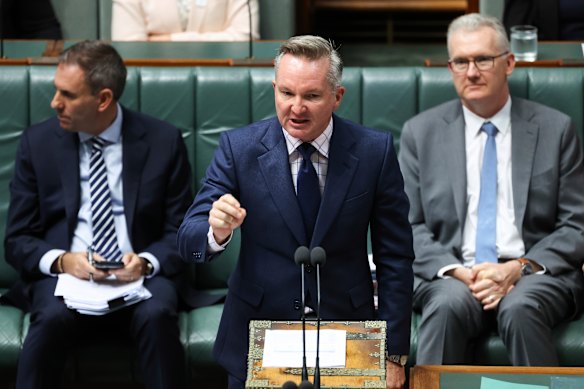
Energy Minister Chris Bowen said this morning that Australia “is finalising its response” to the overnight deal struck between the 32 member countries of the International Energy Agency, of which Australia is one, in a move to reduce the elevated oil prices caused by closure of the key shipping channel at the Strait of Hormuz.
The government also said on Thursday morning that it would crack down on “suspicious” spikes in fuel prices. It has doubled to $100 million the fine for price gouging by service stations and fuel suppliers, which have been accused of raising prices before global market spikes flowed through.
Bowen said the government would consider if it participated in the IEA’s oil release, which is a voluntary program that would have Australia tap its fuel reserves to pump supply into the local market.
“The government’s focus is ensuring our domestic fuel gets to where it needs to go, at an affordable price,” he said.
“If we do join this action, Australia will not be required to send fuel overseas but rather use its existing domestic reserves to take pressure out of the global market.”
Oil tankers are currently halted in the Persian Gulf due to the risk of attack by Iran if they enter the Strait of Hormuz, the narrow channel through which 20 million barrels usually pass each day.
The 400 million-barrel release by the IEA member countries represents four days of average global daily consumption, which is roughly 100 million barrels a day.
The US-Israeli attacks on Iran beginning late last month have sparked retaliatory attacks from Iran on massive oil fields in the Middle East.
Oil prices have fluctuated wildly, reaching almost as high as $US120 per barrel in recent days, but receding to about $92 on Thursday.
Regular unleaded petrol is selling for an average of $217.9 in NSW and $222.3 in Melbourne, about 25 cents per litre higher than last week.
Independent fuel suppliers have reported difficulty in filling orders, as major companies restrict distribution. Social media is awash with reports of regional motorists claiming their local service station is empty, and farmers reporting diesel price spikes and delays to orders from private suppliers.
Bowen has assured Australians there was no shortage of petrol and diesel, in both the two months worth of fuel stocks held in Australia and the volumes coming into the country.
He has said panic buying in regional communities is driving fuel shortages.
“We’ve dramatically increased the surveillance of these suspicious price spikes that people are seeing in communities around Australia. And we’ve also empowered the ACCC to work closely with industry where there are shortages, particularly in regional areas.”
Treasurer Jim Chalmers earlier said “we’re seeing some very suspicious price spikes” to fuel around the country.
“The message to the retailers is … don’t take advantage of what’s happening in the Middle East,” he told Sky News.
“We’re certainly prepared to see the ACCC crack down hard on any behaviour that is unwarranted.”
The government said it was also convening the National Coordination Mechanism to respond to emerging supply chain issues, the Trusted Information Sharing Network, and the National Oil Supplies Emergency Committee.
ACCC commissioner Anna Brakey said on Wednesday the organisation would convene an emergency meeting with industry “to explain their actions during this period of volatility”.
 Mike Foley is the climate and energy correspondent for The Age and The Sydney Morning Herald.Connect via email.
 Brittany Busch is a federal politics reporter for The Age and Sydney Morning Herald.Connect via email.
From our partners
Disclaimer : This story is auto aggregated by a computer programme and has not been created or edited by DOWNTHENEWS. Publisher: www.smh.com.au