

Updated ,first published
An Australian-made hypersonic aircraft successfully completed its first flight from a NASA facility in the US, reaching five times the speed of sound in a test that scientists say will help forge the future of air travel.
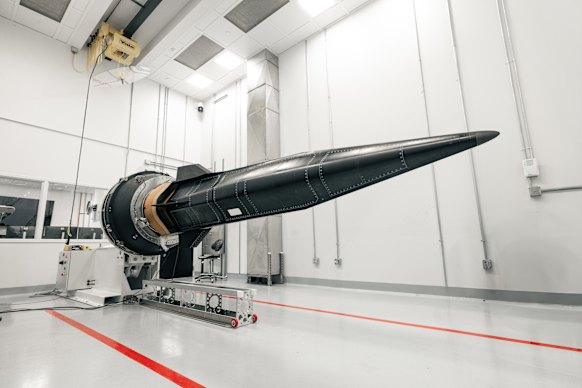
The aircraft, called the DART AE, was developed by Brisbane-based Hypersonix Launch Systems, led by former NASA research scientist Michael Smart and a team of University of Queensland engineers.
The DART was launched by a booster rocket from NASA’s Wallops Flight Facility on Wallops Island, Virginia, on Friday evening (US time). It travelled through the upper atmosphere for about 800 kilometres at a max speed of Mach 5, or five times the speed of sound. That’s more than 6000km/h.
And it’s not just a tube being shot into the air. The 3.5-metre-long vehicle – powered by a 3D-printed, hydrogen-fuelled scramjet engine that compresses incoming air using high-speed shockwaves – can be manoeuvred. It is, for all intents and purposes, an aircraft.
“Most hypersonic craft are rockets. Rockets can’t manoeuvre. You just point and shoot them,” Smart said. “The manoeuvrability is an absolutely critical new characteristic … Anything you think an aircraft does, we can do.”
Organisers were tight-lipped about the flight plan before the launch, other than to say they were aiming to conduct the longest hypersonic flight ever staged by a hydrogen-powered vehicle. They said it could travel up to 800 kilometres, with the aircraft’s metallic skin heating up to 800 degrees.
This was the first launch mission for Hypersonix, founded at the end of 2019 by Smart, who for 15 years was a professor of hypersonic propulsion at UQ. The growing firm was selected as a partner by the US Defence Innovation Unit – part of what is now the Department of War – from a field of more than 60 applicants.
“Just to get in the air is a big deal for this company, and it’s a big deal for Australia,” Smart says.
Testing this kind of technology is vital for the future of hypersonic flight, which, beyond its scientific applications, will eventually transform the way people travel.
Hypersonix chief executive Matt Hill, who is in Virginia with Smart and a team of 10 for the mission, says this type of engine could power an aircraft that will fly from Sydney to London in two hours. It’s not pie-in-the-sky stuff, either – he says it could be technologically possible in 10 or so years, though the logistics of flying people long distances make it challenging.
“When people fly, they expect air and champagne and movies – all those things – and that’s really the more complex thing,” Hill says. “It’s still a way off. But we’re building the core technology that would enable that type of flight.”
The DART separated from the rocket at 45 kilometres above Earth. Space company Rocket Lab, which conducted the launch, broadcast it live on social media and said the mission was “100 per cent” successful. The launch was delayed several times throughout the week due to bad weather and external circumstances.
Hill said the successful launch confirmed an Australian company could design, build and operate technology in what he called one of the most demanding flight regimes on Earth. “It is an important step toward delivering hypersonic systems that are operationally relevant for Australia and its allies.”
Hypersonix has 58 staff in Australia, most aged under 30, while UQ ranks as one of the world’s top universities in hypersonic research. The DART was assembled in Brisbane and transported to the US “with great difficulty”.
The engine used in this flight is the fastest scramjet engine in the world today, Smart says, with the potential to power a vehicle to 12 times the speed of sound.
Where Australia falls down, Smart says, is in the commercialisation of its research and development. “That’s what we’re really trying to do here.”
Get a note directly from our foreign correspondents on what’s making headlines around the world. Sign up for our weekly What in the World newsletter.
 Michael Koziol is the North America correspondent for The Age and Sydney Morning Herald. He is a former Sydney editor, Sun-Herald deputy editor and a federal political reporter in Canberra.Connect via X or email.
From our partners
Disclaimer : This story is auto aggregated by a computer programme and has not been created or edited by DOWNTHENEWS. Publisher: www.smh.com.au






