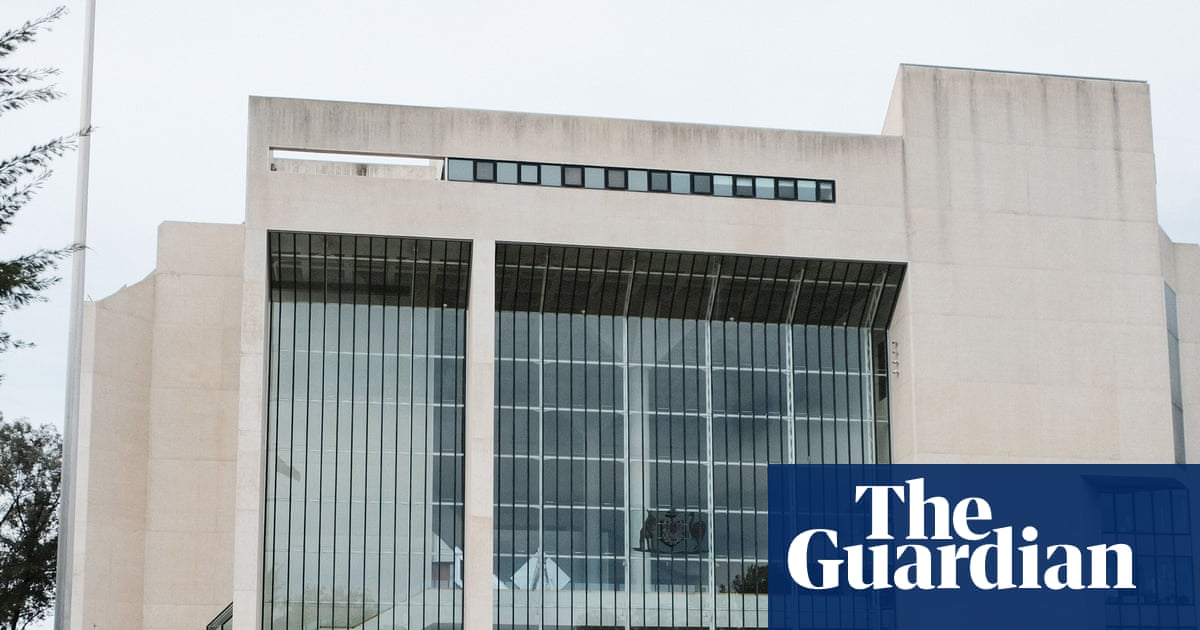
Dozens of former immigration detainees who have already served prison sentences will have ankle bracelets removed and curfews scrapped, with the high court again striking down laws targeting the group.
On Wednesday, the Albanese government’s preventative detention regime suffered another blow as the court ruled the tough laws to deal with the NZYQ cohort were unconstitutional.
The ruling meant those subject to electronic monitoring and curfew conditions would have their bracelets removed and instead have to regularly report to officials. It also meant the government could no longer impose curfews.
Guardian Australia understands the ruling will affect 43 people with ankle bracelets in the community.
The case was brought by a Papua New Guinea citizen, referred to as EGH19 in the courts, who arrived in Australia in 2000 and was convicted of murder in 2006 while still a minor.
The man was offered a protection visa in 2022, but it was cancelled almost two years later after he pleaded guilty to domestic violence offences.
He was released on parole in December 2024 and placed in immigration detention upon his release in April 2025, when he was then required to wear an ankle bracelet and abide by a curfew.
The high court’s chief justice, Stephen Gageler, and a majority of the court’s seven justices, ruled the laws – amended in November 2024 – were not consistent with the constitution and were therefore invalid.
In her reasons, justice Michelle Gordon found that the law’s “purpose of protecting the community from harm is insufficient” and that any justification for ongoing monitoring had to be “exceptional”, such as preventing a terrorist attack.
After the ruling, the home affairs minister, Tony Burke, said he was grateful for the $2.5bn deal struck with Nauru to remove the NZYQ cohort from Australia.
“Fortunately, we now have the agreement with Nauru because the best thing for people who have had their visa cancelled is to not be in this country,” Burke said.
Under the arrangement, the government can apply for 30-year Nauruan visas on behalf of those released into the community on bridging visas, pending removal.
Guardian Australia is aware of at least six men removed from the country and living within a former regional processing centre on Nauru.
The shadow home affairs minister, Jonathon Duniam, said the opposition would work with the government to pass new laws.
“We were assured in 2024 by Tony Burke that they were meticulously working through every eventuality, any risk that was posed by these laws being challenged. We were assured these laws would stand up to tests in the high court,” Duniam said.
“Well, he was wrong. These laws have been struck out, so this government needs to come forward with new laws.”
The Asylum Seeker Resource Centre’s deputy chief executive, Jana Favero, said the ruling showed the government had been “making rushed laws on the run, with no regard for fairness or our country’s constitution”.
“We work with people every day who are affected by these conditions – their lives have been turned upside down by these politicised punishments imposed on them simply because of where they were born,” she said.
Greg Barns SC, spokesperson for the Australians Lawyers Alliance, criticised the government for succumbing to “populist scare mongering by the media and its political opponents”.
“This is an important decision not just for those immediately impacted by these unlawful measures, but it is a broader reminder to governments that it is only the courts that have the constitutional power to impose punishments,” he said.
The government brought in the preventative detention regime in late 2023, after the high court ruled indefinite detention unlawful, resulting in the immediate release of 92 people, including refugees and stateless people, who could not be returned to their country of origin. A larger cohort of more than 300 in long-term detention were ultimately released as well.
In November 2024, the high court found the subsequent monitoring regime, which included ankle bracelets and curfews, to be unconstitutional.
The government then passed amendments, making it so only those that “poses a substantial risk of seriously harming any part of the Australian community by committing a serious offence” could be subject to such conditions.
The judgment said at the end of June 2025 there had been 346 bridging visa removal holders. EGH19 was one of the 46 subject to both an ankle bracelet and a 10pm-6am curfew.
A further 41 were subject to ankle monitoring, while only one was solely required to comply with a curfew.
Disclaimer : This story is auto aggregated by a computer programme and has not been created or edited by DOWNTHENEWS. Publisher: theguardian.com