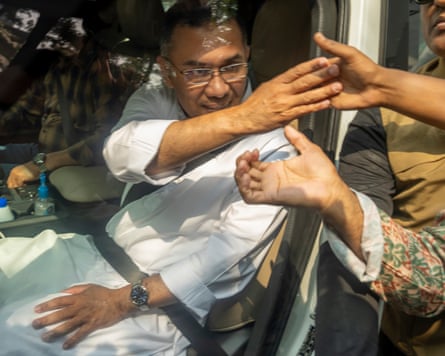
The Bangladesh Nationalist party, led by Tarique Rahman, has won a sweeping victory in the country’s first election since a gen Z uprising toppled the autocratic regime of Sheikh Hasina.
Results from the election commission confirmed the BNP alliance had won 212 seats, returning the party to power after 20 years, while the rival alliance, led by Islamist party Jamaat-e-Islami, won 77 seats.
The vote had been seen as the first free and fair election held in Bangladesh for almost two decades and came after a period of significant political upheaval in the country.
“This victory was expected,” said Salahuddin Ahmed, a leading BNP committee member. “It is not surprising that the people of Bangladesh have placed their trust in a party … capable of realising the dreams that our youth envisioned during the uprising.”
Ahmed acknowledged a difficult task lay ahead for the new BNP government, which has pledged a new era of democracy and zero tolerance towards corruption. “This is not a time for celebration, as we will face mounting challenges in building a country free from discrimination,” he said.
India was among the first countries to congratulate the BNP. Relations between the two neighbours had plummeted since the fall of Hasina and the message from the Indian prime minister, Narendra Modi, congratulating the BNP on its “decisive” win, was seen as extending an olive branch to the new government.
“India will continue to stand in support of a democratic, progressive and inclusive Bangladesh,” said Modi, adding that he was looking forward to working with Rahman.
The US and Pakistan also congratulated the BNP on the election victory.
Rahman, who returned to Bangladesh in December after 17 years of exile in London, is poised to become the country’s next prime minister. He comes from one of Bangladesh’s most powerful political dynasties; the son of the former prime minister Khaleda Zia and the former president Ziaur Rahman, who was assassinated in 1981.
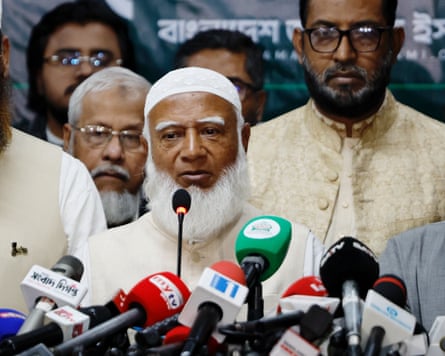
Shafiqur Rahman, the head Jamaat-e-Islami, conceded defeat. Rahman said Jamaat would not engage in the “politics of opposition” for the sake of it. “We will do positive politics,” he told reporters.
In a statement on Friday morning, Jamaat-e-Islami alleged some irregularities in vote counting in constituencies where their candidates suffered narrow losses, which it said “raises serious questions about the integrity of the results process”.
Jamaat-e-Islami’s campaign had attracted controversy, particularly among female voters, over regressive comments made by Shafiqur Rahman on women’s rights and employment. Nonetheless Jamaat-e-Islami’s 68 seats respresent a historic showing for a party that had previously never won more than 12% of the vote. Together with seats won by allied parties, it will likely be a formidable opposition to the BNP.
The election was the first truly competitive vote in the country in years. As documented by human rights groups and the UN, Hasina’s regime routinely suppressed dissent of its critics and political opponents, thousands who were disappeared, tortured and killed in secret jails. Many emerged only after Hasina was toppled. The past three elections under Hasina were marred by widespread allegations of vote-rigging.
Following the bloody uprising that led to her downfall, many viewed the election as a crucial test of Bangladesh’s ability to restore trust in democracy and transition from public protest into tangible political reform and stability. Hasina’s Awami League party was barred from contesting and its supporters said they would boycott the vote.
“More than anything, I’m hoping this BNP government remembers why people risked their lives to vote – we wanted an end to fear, not just a change of faces,” said Sadia Chowdhury, 25, a masters student at Jahangirnagar University. “If they can give us jobs based on merit, reign in political violence and prove that the law applies to everyone, then maybe we’ll finally feel this country belongs to us again.”
The largely peaceful nature of polling day was seen as a huge step forward for the country. Across the capital, police officers stood watch on horses wearing blankets that bore the message: “Police are here, vote without fear.” Voters at polling stations in the capital, Dhaka, expressed their jubilation as being able to cast their vote freely and without fear for the first time in years.
“Last time I voted was in 2008,” said Mohammad Shah Hossain, 46, who said he was supporting the BNP. “After that it got very difficult to come out and vote. Every time I went to the polling station, somebody had already cast my ballot.”
According to the election commission, preliminary figures showed nationwide voter turnout at 59.4%, exceeding the 42% seen in the last elections. This was also the first election that had given the overseas diaspora an opportunity to vote. Postal votes, which also included officials in the country who could not return home to cast their ballot, saw an 80.11% participation rate.
The student-led uprising that toppled Hasina’s 15-year regime in August 2024 had been prompted by mounting anger over widespread corruption, human rights abuses and an economic slump. The uprising, and Hasina’s brutal crackdown on anti-government protesters, left an estimated 1,400 people dead, according to the UN.
For the past 18 months, the country has been run by an interim government under Bangladesh’s only Nobel laureate, Muhammad Yunus, who was tasked with readying the country for free and fair elections. Speaking after casting his vote in Dhaka, Yunus said the country had “ended the nightmare and begun a new dream”.
The newly elected government faces an uphill task of restoring democracy, law and order and economic growth to the country. To some, the return of the BNP – a dynastic party whose previous regime was riddled with rampant corruption – did not represent the spirit of reform and hunger for change that had driven the student-led uprising against Hasina.
Alongside the election, a referendum was held on a set of constitutional reforms championed by Yunus, known as the July Charter, which is designed to prevent any autocratic regimes taking power in the future by strengthening judicial independence and introducing a two-term limit for the prime minister. Early results suggested it had passed with more 65% voting yes.
As the election unfolded, Hasina remained in exile in India after a war crimes tribunal sentenced her to death for crimes against humanity committed during the final throes of her regime. Her escape, and the refusal by India to send her back, has been a key issue in the frayed ties between Dhaka and New Delhi. In a statement sent after polling stations closed, Hasina denounced the election as a “carefully planned farce” and called for the results to be cancelled.
Redwan Ahmed contributed reporting from Dhaka
Disclaimer : This story is auto aggregated by a computer programme and has not been created or edited by DOWNTHENEWS. Publisher: theguardian.com