
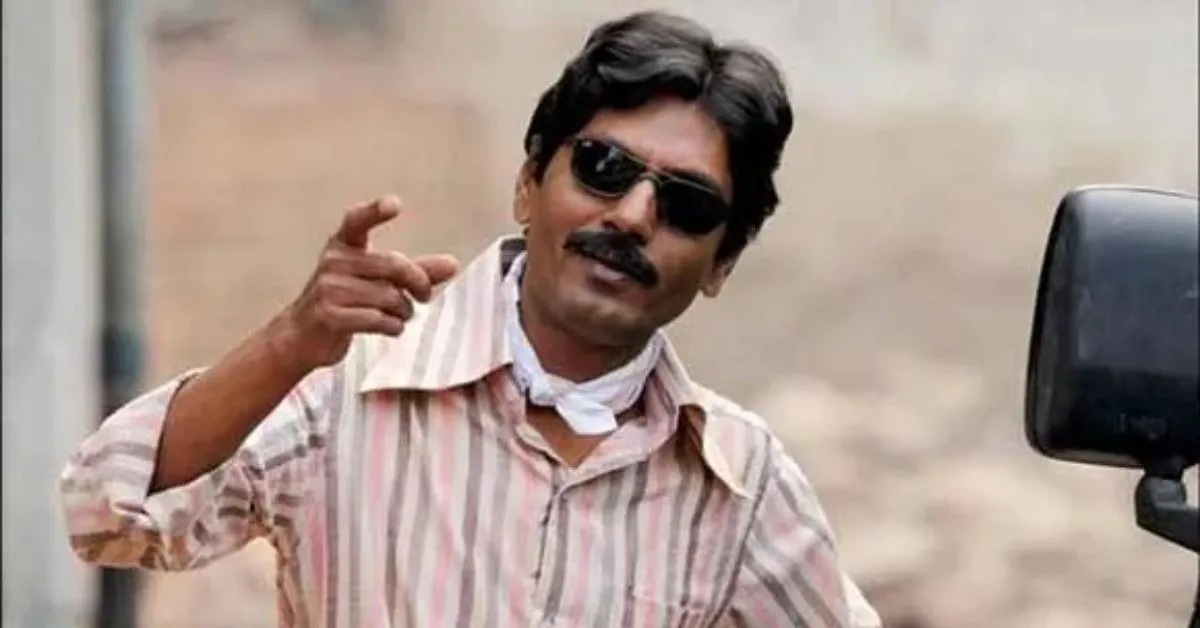
Some actors perform their roles, and then some actors dissolve into them so completely that you forget there was ever a script. Think of the simmering, sharp-edged Faizal Khan in Gangs of Wasseypur, the quietly aching widower in The Lunchbox, or the warm, dependable journalist in Bajrangi Bhaijaan. The faces are different. The energies are different, and even the silences feel distinct.
At the centre of them all is one man — Nawazuddin Siddiqui, an actor whose remarkable range is matched only by the resilience of his journey.
But long before the applause, awards and international red carpets, there was a young man from a small town navigating rejection, invisibility and survival in Mumbai.
Budhana to the big city: The making of a dream
Nawazuddin Siddiqui was born on 19 May 1974 in Budhana, a small town in the Muzaffarnagar district of Uttar Pradesh, into a zamindari Muslim family of Lambardars. The eldest of eight siblings, he grew up in a large household where cinema was not an obvious career path. He spent much of his youth in Uttarakhand, absorbing the quiet rhythms of small-town life that would later lend authenticity to many of his performances.
Academically inclined, he pursued a Bachelor of Science in Chemistry from Gurukul Kangri University in Haridwar. After graduation, he worked as a chemist in Vadodara for nearly a year. The job was stable and predictable — but deeply unfulfilling.
Everything changed when he watched a play.
The experience stirred something profound. Drawn to the stage, he moved to Delhi in search of work and purpose. Determined to gain admission into the prestigious National School of Drama, he discovered that prior theatre experience was mandatory. So he created his own opportunity.
Along with friends, he performed in more than ten plays, including one in Dehradun, simply to meet the eligibility criteria. It was persistence, not privilege, that earned him a seat at NSD.
The years no one saw
Armed with formal training, Nawazuddin arrived in Mumbai believing that craft would speak for itself. It didn’t — at least not immediately.
For years, he remained on the margins of Bollywood. He appeared in brief, often uncredited roles in films like Sarfarosh and Munna Bhai M.B.B.S., blending into scenes that rarely lingered on him. Casting directors told him he did not fit the conventional mould of a Hindi film hero. The rejection was blunt and frequent.
/filters:format(webp)/english-betterindia/media/media_files/2026/02/24/nawazuddin-2026-02-24-17-51-36.jpg)
Money was tight. To survive, he took up odd jobs — including working as a watchman. He has spoken candidly about that phase, saying the struggle was neither romantic nor “beautiful”; it was exhausting and uncertain. During one particularly difficult period, he even helped sell coriander (dhaniya) to earn a living. It was humbling work — far removed from film sets and camera lights — but it kept him afloat.
He shared cramped apartments with fellow aspirants, often juggling rent and auditions, chasing opportunities that rarely translated into meaningful roles. There were moments of doubt, moments when returning home might have seemed easier. But he chose to stay.
His breakthrough began to take shape with Black Friday, directed by Anurag Kashyap. Though the film faced delays, it marked the beginning of a creative collaboration that would later redefine his career. Nearly a decade after arriving in Mumbai, Gangs of Wasseypur finally gave him the space to command the screen and when it did, audiences could not look away.
Redefining the hero
Post-Wasseypur, Nawazuddin Siddiqui did something remarkable — he refused to be predictable. He chose layered characters over loud ones. In The Lunchbox, he conveyed longing through glances and pauses. In Bajrangi Bhaijaan, he proved that even in a superstar-led film, sincerity can leave a lasting impression.
/filters:format(webp)/english-betterindia/media/media_files/2026/02/24/nawazuddin-siddiqui-2026-02-24-17-53-57.jpg)
Photograph: (Shutterstock)
Over the years, he has received multiple accolades, including National Film Awards, and has represented Indian cinema at international festivals such as Cannes. Yet beyond the trophies, his most significant achievement lies elsewhere.
He reshaped the idea of what a leading man in Bollywood could look like.
In an industry often driven by image and formula, Nawazuddin carved a space for raw talent and unconventional presence. His journey from Budhana to selling coriander on the streets and working night shifts as a watchman to walking global red carpets is not a fairy tale. It is a testament to endurance.
If there is one lesson his story offers, it is that you may not fit the mould. But sometimes, staying true to your craft is what eventually reshapes it.
Sources:
‘Watchman to star: A look at Nawazuddin Siddiqui’s journey | Birthday Special’ by Twinkle Gupta for India Tv News, Published on 19 May 2025.
‘Nawazuddin Siddiqui Worked As A Watchman Once, ‘The Struggle Wasn’t Beautiful’ by Nilanjana Basu for NDTV Movies, Published on 14 March 2019.
‘Nawazuddin Siddiqui shares story of his struggle in Humans of Bombay post, says ‘I went from a watchman to watch-me man’ by Hindustan Times, Published on 15 March 2019.
Disclaimer : This story is auto aggregated by a computer programme and has not been created or edited by DOWNTHENEWS. Publisher: thebetterindia.com



