
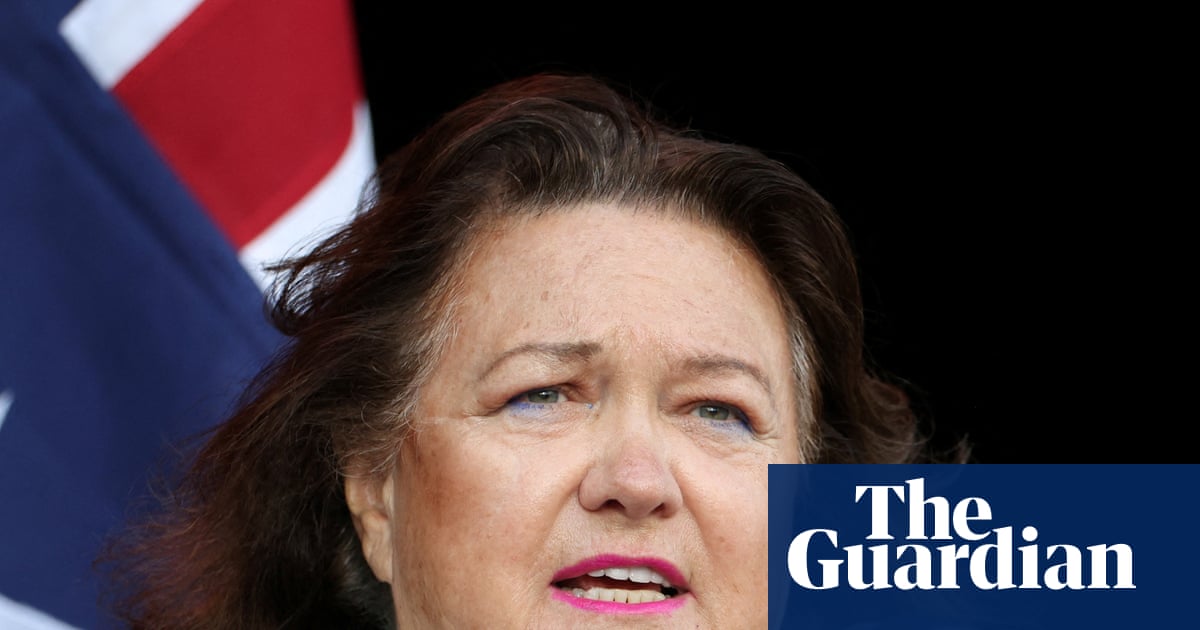
Australia’s richest person, Gina Rinehart, says “I don’t understand” the justification for prosecuting Ben Roberts-Smith for alleged war crimes, as pockets of high-profile support emerge for the Victoria Cross recipient.
Roberts-Smith was arrested in Sydney on Tuesday and charged with five counts of “war crime – murder” in relation to alleged offences in Afghanistan between April 2009 and October 2012. He is yet to enter a plea but is expected to defend the charges.
The arrest sparked a flurry of commentary split along political lines, with conservative and rightwing figures – including a former prime minister – voicing support for Australia’s most decorated living solider. A three-year-old petition asking for a pardon for Roberts-Smith garnered thousands of new signatures on Tuesday and Wednesday.
Rinehart, a mining billionaire, issued her own statement in which she maintained her support for the SAS veteran.
“I don’t understand how it can be justified to spend more than $300 million to try for years to bring SAS veterans, who have served our country, towards criminal proceedings, and most recently the arrest of Ben,” Rinehart said.
“As the recently passed, Brigadier George Mansford succinctly stated, ‘The oath to serve your country did not include a contract for the normal luxuries and comforts enjoyed within our society. On the contrary, it implied hardship, loyalty and devotion to duty’.
“Have we lost sight of the fact that in our inadequately defended country, facing uncertain times, the morale of our defence force has already been brought to its lowest ebb since inception, our defence personnel numbers are inadequate, and recruitment is suffering.
“Like many Australians, I hope that compassion and the Aussie spirit is extended to Ben and his family and his duty to our country in the hardship of war is never forgotten.”
Responding to a post in support of Roberts-Smith on X, the social platform’s owner, billionaire Elon Musk, replied: “This sounds insane.”
The former Australian prime minister Tony Abbott also released a statement that said his “instinctive sympathy” remains with special forces soldiers from the Afghanistan campaign who “fought bravely and well for a just cause”.
“I am very sorry that some of them have been subjected to a form of persecution by the country they served.”
He said they often fought under “highly restrictive rules of engagement”, and that “it’s wrong to judge the actions of men in mortal combat by the standards of ordinary civilian life”.
The opposition leader, Angus Taylor, would not comment directly on Roberts-Smith’s arrest on Tuesday, but emphasised support for defence personnel and veterans.
But some of his Coalition colleagues have gone further. The shadow veterans’ affairs minister, Michael McCormack, suggested the soldier was the victim of a smear campaign.
“For the record, alleged war crimes must be accounted for … but the persecution of one of Australia’s most decorated soldiers – years after his tours of duty in one of the most testing wars against some of the most ruthless enemies our brave Diggers have ever encountered – must be taken for what it is … a campaign to smear someone from people whom would never step up if our country was in peril,” he posted on Facebook.
The shadow defence personnel minister and veteran, Phillip Thompson, said there should be accountability for actions in war but claimed it was wrong to “assess split-second decisions made in combat as though they were made in ordinary civilian life”.
The National party leader, Matt Canavan, on Wednesday said: “I feel very uncomfortable passing any judgment on someone that put their life on the line for our country.”
“Clearly, though, we’re a country of high standards and they must be applied,” Canavan told the ABC’s Radio National.
“I’m not exactly sure about the wisdom of subjecting military personnel to a civilian court process.”
Much of the support for Roberts-Smith has emerged along existing cultural fault lines, particularly among prominent Christian nationalists and other rightwing groups. International commentators, particularly in the US, have also weighed in on the case.
Disclaimer : This story is auto aggregated by a computer programme and has not been created or edited by DOWNTHENEWS. Publisher: theguardian.com





