
If you go into Woolworths to buy a bunch of small “kids’ bananas” you may not realise you’re paying double the price of the larger cavendish bananas right next to them.
At one Woolworths store, kids’ bananas have been sold in bunches of five and priced at $3.70 a bunch. At a glance, that seems more or less the same price as the loose cavendish bananas next to them on the shelf, priced at $3.50/kg.
However, when a Guardian reader weighed a bunch of the “kids’ bananas” – which was 530g – they worked out their per-kilogram price was significantly more expensive at $6.98 – that’s a 99% price increase for smaller pieces of the same fruit.
Guardian Australia has reviewed a range of examples of confusing and seemingly random per unit pricing, a practice the supermarkets are expanding that makes it extremely difficult for shoppers to compare prices.
Confusing pricing conceals wild variations
Under the existing rules, the major supermarkets can price fruit and vegetables per unit or per kilogram, whether they are packaged or loose.
Because supermarkets are not required to display a per-kilogram price, or even the average weight of items, shoppers are unlikely to know whether they are actually getting a good deal when paying a set price for each item.
Sign up: AU Breaking News email
The same Guardian reader who weighed the bananas did another test at their local Woolworths, this time on cucumbers.
Lebanese cucumbers were priced at $4.90/kg, right next to continental cucumbers, priced at $2.50 each. The continental variety might seem cheaper, especially because they are bigger.
But when the reader weighed one continental cucumber – at 340g – they worked out that the cost per kilogram was $7.35. While not exactly the same product, it cost 50% more per kilogram compared to the Lebanese variety.
A Woolworths spokesperson said the pricing they used was “clearly communicated to allow our customers to make informed choices when it comes to their purchases”.
Random nature of unit pricing on display
In stores, Woolworths, Coles and Aldi have all been expanding their use of per-unit pricing, and often do not display per-kilogram pricing.
Coles has said it is trialling an expansion of per-unit pricing. However, when Guardian Australia visited a Coles in Melbourne this week, more than half of the fresh produce was already priced per item, in what seemed like a random fashion.
Cauliflowers were priced at $5 each, next to broccoli which was priced at $8/kg. Silver beet, kale, celery, spring onions, pak choy, leeks, wombok were all sold per-unit, as were kiwifruit, lemons, limes, sweet corn, pineapple, papaya, passion fruit and different melons.
Many of the lettuces were sold in Coles-brand plastic packaging and priced between $2.50 and $4.70. There was no per-kilogram price displayed on the tickets and no weight marked on the packaging.
A spokesperson for Coles said the mix of per-kilogram and per-unit pricing made it easier for consumers.
“Many items are commonly selected as individual pieces, and per-unit pricing makes it easier for customers to quickly choose the number of items they need,” they said.
They said their goal was to “balance transparency with simplicity, so customers can easily understand prices and shop in the way that suits them best”.
It was similar at Aldi: rock melons priced at $4.99 each sat next to watermelons priced at $1.99/kg. You could buy bags of five lemons for $5.99 per bag which the price tag said worked out to $1.20 each, next to a basket of loose lemons for sale for $1.49/each.
There are no scales in Aldi stores, so it’s impossible for a customer to weigh five loose lemons and work out if they are a better deal. Aldi declined to comment.
Even more inconsistencies shopping online
Guardian Australia reported last month that the major supermarkets’ shift to charging customers for fresh produce by the item, rather than by weight, was leading to “wild volatility” in pricing with some items more than 50% more expensive.
When buying groceries online from Coles and Aldi, the supermarkets displayed an approximate per-unit price for some fruits and vegetables online next to each item’s average weight and the price a kilogram.
For these items, Coles and Aldi adjust the final price depending on the actual weight.
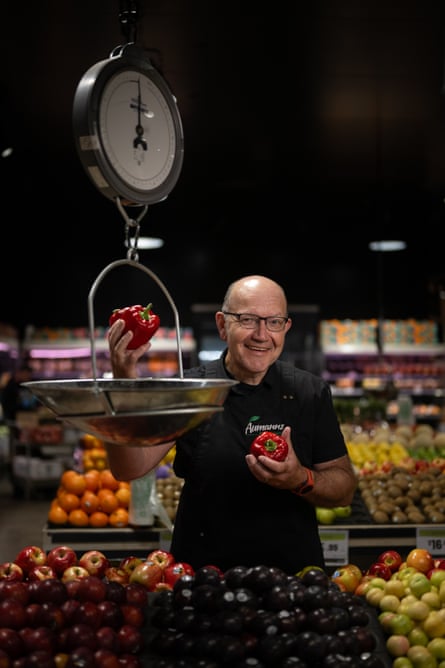
Dario Bulfone, who works in operations at the local greengrocer Aumanns at Warrandyte, said it was “not complicated at all” to take the average weight of products and adjust their final prices based on their actual weight.
When Woolworths sells groceries online it prices fresh produce items individually and the prices are fixed regardless of how much each piece weighs.
Bulfone said presenting fixed per-unit pricing without a “true weight reconciliation” created confusion at best and, at worst, systematically disadvantaged customers.
“The technology already exists. The systems already exist,” he said. “Choosing not to do it is not a technical limitation. It’s a decision.”
A Woolworths spokesperson said it was “investigating additional system capability” for online customers who “might prefer an approach that mirrors how we price in our stores”.
Consumer advocates have called for supermarkets to be required to consistently display and charge fresh produce prices per kilogram, in stores and online, with any displayed per-unit to be estimates only.
The assistant competition minister, Andrew Leigh, did not answer directly when asked by Guardian Australia if he would support this mandate.
Instead, he pointed to the Albanese government’s commitment to strengthening some other pricing rules, which he said was “about clear, accessible information which allows shoppers to compare prices fairly and make informed choices”.
The government has not announced any reforms to per-unit pricing.
Do you know more? Contact catie.mcleod@theguardian.com
Disclaimer : This story is auto aggregated by a computer programme and has not been created or edited by DOWNTHENEWS. Publisher: theguardian.com