Bhubaneswar: The recent decision of the Bharatiya Janata Party government in Odisha to expand reservation in higher education is far more than an administrative correction—it is a politically consequential intervention that could recalibrate the state’s electoral landscape.
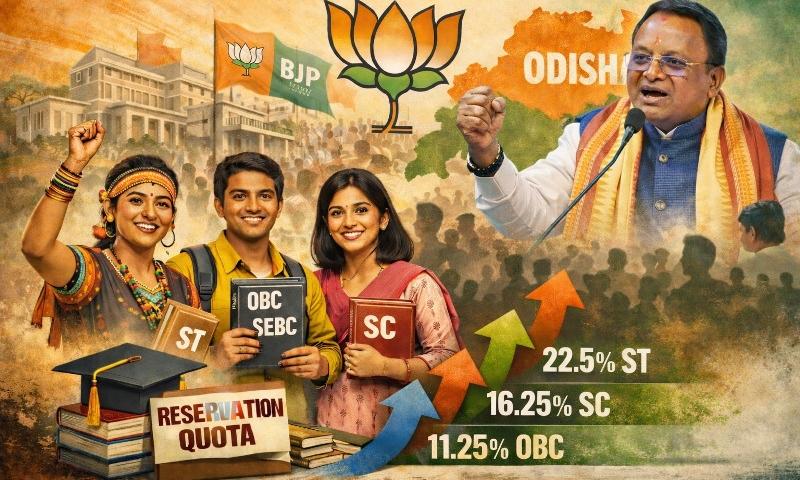
At a structural level, the reform addresses a long-standing mismatch between demographic realities and quota allocation. By raising reservation for Scheduled Tribes to 22.5 per cent and for Scheduled Castes to 16.25 per cent, while introducing 11.25 per cent for Socially and Economically Backward Classes (SEBCs), the government has aligned policy with population proportions. In a state where STs alone constitute over one-fifth of the population, the earlier framework had increasingly appeared inadequate. Chief Minister Mohan Charan Majhi can thus credibly frame the move as a step toward substantive social justice.
Yet, the political subtext is unmistakable. Odisha’s electorate is overwhelmingly composed of SC, ST and OBC communities, together accounting for nearly 90 per cent of the population. By expanding access to professional education—arguably the most aspirational pathway for upward mobility—the BJP is attempting to forge a broad, cross-sectional social coalition that could endure beyond a single electoral cycle.
The inclusion of SEBCs is particularly significant. Unlike SCs and STs, OBC communities in Odisha have historically lacked cohesive political consolidation, often aligning with regional formations such as the Biju Janata Dal. By formally integrating SEBCs into the reservation framework for higher education, the BJP is not merely addressing a policy gap; it is seeking to politically mobilise a fragmented but numerically influential constituency.
This marks a discernible shift in the BJP’s Odisha strategy—from ideological positioning to welfare-driven social engineering. Since assuming office in 2024, the party has sought to distinguish itself from its predecessor by foregrounding governance outcomes. The reservation reform provides a compelling narrative: one that blends inclusion with opportunity in high-value sectors such as medicine, engineering and management.
The timing is equally strategic. With the 2027 panchayat and urban local body elections approaching, the BJP faces the deeply entrenched grassroots machinery of the BJD, which continues to dominate local governance institutions. Dislodging this network requires policies that deliver tangible and aspirational benefits at scale. Expanded reservation, in this sense, serves a dual function—enhancing educational access while fostering a sense of political reciprocity among beneficiaries.
According to political analysts, — for the BJD, the challenge is subtle but significant. Its traditional support base among rural, SC and ST voters may not erode immediately, but sustained policy-driven outreach by the BJP could gradually reshape voter alignments. The contest is thus evolving—from one defined by legacy and organisational depth to one centred on who better articulates and delivers on the aspirations of Odisha’s marginalised majority.
Disclaimer : This story is auto aggregated by a computer programme and has not been created or edited by DOWNTHENEWS. Publisher: deccanchronicle.com