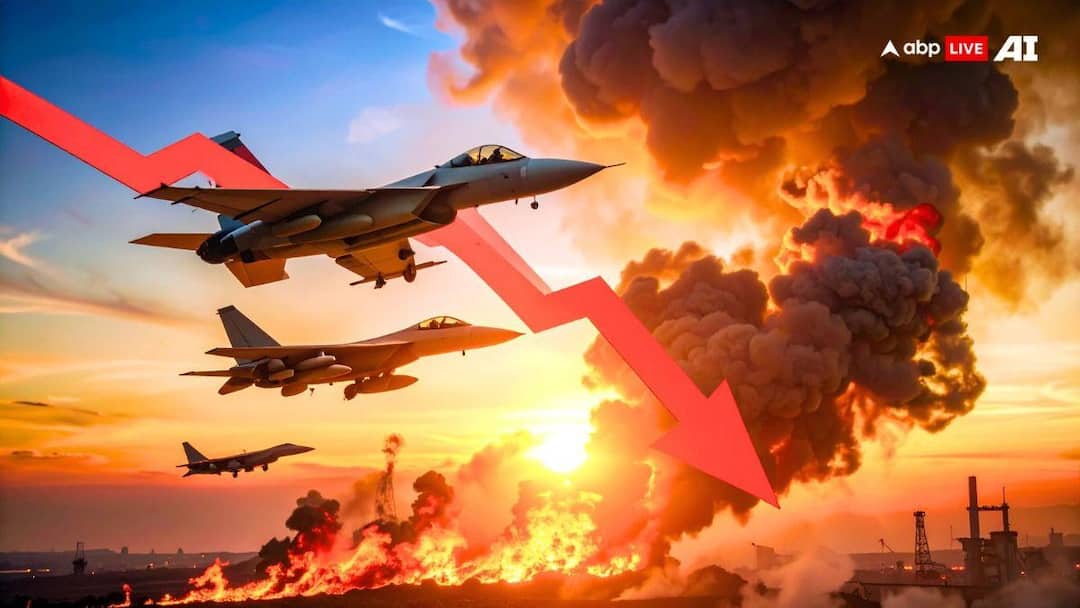
Indian equity markets are staring at a sharply negative start on Monday, with benchmark indices plunging in the pre-open session amid escalating geopolitical tensions in the Middle East and a steep selloff across global equities.
The BSE Sensex rang the opening bell near 80,300, crashing more than 1 per cent and nearly 1,000 points, while the NSE Nifty50 started trading at 24,850, plummeting 1.31 per cent and over 300 points, around 9:15 AM.
On the 30-share Sensex, BEL emerged as the sole gainer in the morning. On the other hand, the laggards included IndiGo, L&T, Eternal, Adani Ports, and Asian Paints. IndiGo shares tanked more than 4 per cent in the opening hour.
In the broader markets, the Nifty Microcap250 led the bleeding across the board and nosedived 2.06 per cent. Sectorally, the Realty index plunged 2.39 per cent, followed by the Media and Midsmall IT & Telecom indices which tanked 1.89 per cent and 1.62 per cent respectively.
At around 9:06 AM in the pre-open session, the Sensex was at 78,222.53, down 3,064.66 points or 3.77 per cent. The Nifty stood at 24,630.80, lower by 547.85 points or 2.18 per cent, signalling a significant gap-down opening.
The sharp weakness comes after a volatile weekend marked by heightened conflict between the United States, Israel and Iran, rattling global financial markets and pushing crude oil prices higher.
Geopolitical Shock Triggers Global Risk-Off Mood
Over the weekend, tensions escalated dramatically after the United States and Israel launched strikes on Iran. Iranian state media confirmed that Iran’s Supreme Leader Ayatollah Ali Khamenei was killed in the attack. US President Donald Trump has vowed retaliation following the death of US servicemen in Iran’s counterstrike, raising fears of a prolonged conflict.
Market participants expect the geopolitical overhang to dominate sentiment in the near term, with risk appetite turning fragile across asset classes.
Asian markets plunged in early Monday trade. Japan’s Nikkei 225 dropped as much as 2.7 per cent, while South Korea’s Kospi fell 2.43 per cent. US futures also signalled weakness, with both the S&P 500 and Dow Jones Industrial Average futures falling over 1 per cent on Sunday. In the Asia session, Dow futures and S&P 500 futures were trading about 0.6 per cent and 0.54 per cent lower, respectively.
Oil Price Spike Adds To Inflation Worries
Brent crude, the global oil benchmark, jumped 2.87 per cent to $72.87 per barrel as fears of supply disruptions intensified. For India, which imports around 85 per cent of its crude oil requirements, sustained elevated oil prices pose significant macroeconomic risks.
“The near-term impact will be negative. Crude has spiked, and if the crude price remains high for an extended period of time, our balance of trade and balance of payments will be impacted since we import around 85 per cent of our oil requirements,” said VK Vijayakumar, Chief Investment Strategist at Geojit Investments Limited.
Manoranjan Sharma, Chief Economist at Infomerics Ratings, said benchmark indices are expected to open lower with heightened volatility as investors reassess geopolitical and commodity-related risks.
Santosh Meena, Head of Research at Swastika Investmart Ltd, noted that for an oil-importing economy like India, sustained high crude prices could fuel inflationary pressures, widen the fiscal deficit and complicate rate-cut expectations. He added that this external shock comes at a technically vulnerable phase for the market.
Analysts Expect Volatility In Holiday-Shortened Week
Markets will remain closed on Tuesday for Holi, making the week shorter and potentially more volatile. Analysts expect investors to respond not only to geopolitical developments but also to domestic macroeconomic data.
Investors will also react to Q3 GDP data and monthly auto sales numbers, while upcoming IIP and PMI readings are expected to shape domestic macro expectations. Globally, key economic releases from the US and China, along with crude price trends, will influence overall risk sentiment. The trajectory of foreign institutional investor (FII) flows will remain a critical driver for index movement in the near term.
Last Week’s Weak Close Adds To Pressure
Domestic equities had already ended last week under pressure. The BSE Sensex declined 1,527.52 points, or 1.84 per cent, over the week, while the NSE Nifty fell 392.6 points, or 1.53 per cent.
Ajit Mishra, SVP – Research at Religare Broking Ltd, said persistent geopolitical tensions and weakness in technology stocks had weighed on sentiment heading into the weekend.
If geopolitical tensions persist or oil prices continue to climb, volatility may remain elevated.
Related Video
Breaking News: India Budget 2026-27 Sparks Market Volatility, Long-Term Reforms Highlighted
Disclaimer : This story is auto aggregated by a computer programme and has not been created or edited by DOWNTHENEWS. Publisher: abplive.com