The Mahabharata can be described as a foundational ancient Indian epic, authored by sage Vyasa, detailing a catastrophic 18-day dynastic war between two groups of cousins — the five virtuous Pandavas and the one hundred Kauravas — over the throne of Hastinapura, culminating in the Kurukshetra War. Comprising over 100,000 verses, it is the world’s longest poem and a key text of Hindu dharma, philosophy and history. Dharma encompasses righteousness, duty, law and the natural way of living. Divided into 18 parvas (books), it contains not only the war narrative but also extensive ethical teachings, myths, and legends. It is considered one of the two major itihasas (historical accounts) of Hinduism, alongside the Ramayana. Itihasa refers to the ancient tradition of retelling events as they happened, along with informative elements to draw relevant lessons.
This intellectual freedom evident throughout the Mahabharata, rarely prescribes the only way to do the right thing. The Mahabharata follows a descriptive rather than a prescriptive style of writing. It operates within the environment of human weakness, frailties, misgivings, doubt and differences on one hand and perseverance, righteousness, honour, truth and adherence to duty on the other. These apparent contradictions at the level of an individual are accompanied by a similar competitive and cooperative approach amongst states and rulers. This leads to actions and resultant consequences that are more often than not the result of a decision dilemma, making the decision-making cycle and the eventual action worthy of objective evaluation.
The Mahabharata is highly relevant to modern warfare, offering timeless strategic, ethical, and diplomatic lessons that transcend its ancient setting. It provides insights into “dharma yuddha” (just war), the limits of power, the necessity of alliance-building, and the psychological impact of conflict. Key lessons include the importance of preventing war through negotiation, as seen in the Udyoga Parva, and managing the “rules of engagement” to achieve ultimate victory.
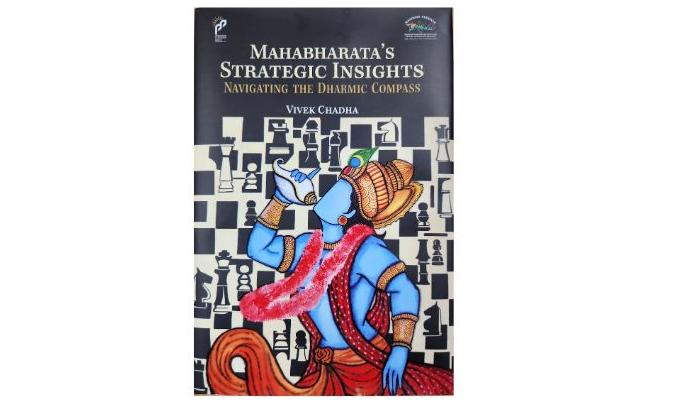
Col Vivek Chadha (retd), a senior fellow at the Manohar Parrikar IDSA, has presented the book as a timely exploration of the theme when the subject has gained renewed interest. He analyses the Mahabharata from a strategic perspective instead of getting into more tactical details on the battlefield. This helps derive strategic insights that include Krishna’s decision-making ability that includes a derived decision-making cycle that could be equally relevant for contemporary policy makers. The book also suggests a strategic framework based on the reading of the epic. This framework contextualises the idea of war, diplomacy, deterrence, use of force, stratagem, and the relevance of capacity building over time. These aspects are often the subject of discussion and debate, and it is interesting to note that they were equally relevant in ancient times.
The Mahabharata is often described as the book of war. The author argues that it is as much a book of war as it is a book that reinforces the importance of maintaining peace, especially given the high costs of war. Yet he underlines that the desirability of peace does not guarantee the absence of war. Therefore, peace comes from a position of strength and capability rather than by appealing to its virtues.
Not only does this book deserve to be read by academics, soldiers, strategists security planners, diplomats and most important, politicians, who should read it and strive to imbibe statecraft, it deserves to be written about and celebrated by more readers.
Col Anil Bhat (retd), a strategic affairs analyst and former spokesperson, defence ministry and Indian Army, can be contacted at wordsword02@gmail.com
Mahabharata’s Strategic Insights
By Vivek Chadha
Manohar Parrikar IDSA & Pentagon Press LLP
pp. 255; Rs. 995/-
Disclaimer : This story is auto aggregated by a computer programme and has not been created or edited by DOWNTHENEWS. Publisher: deccanchronicle.com