
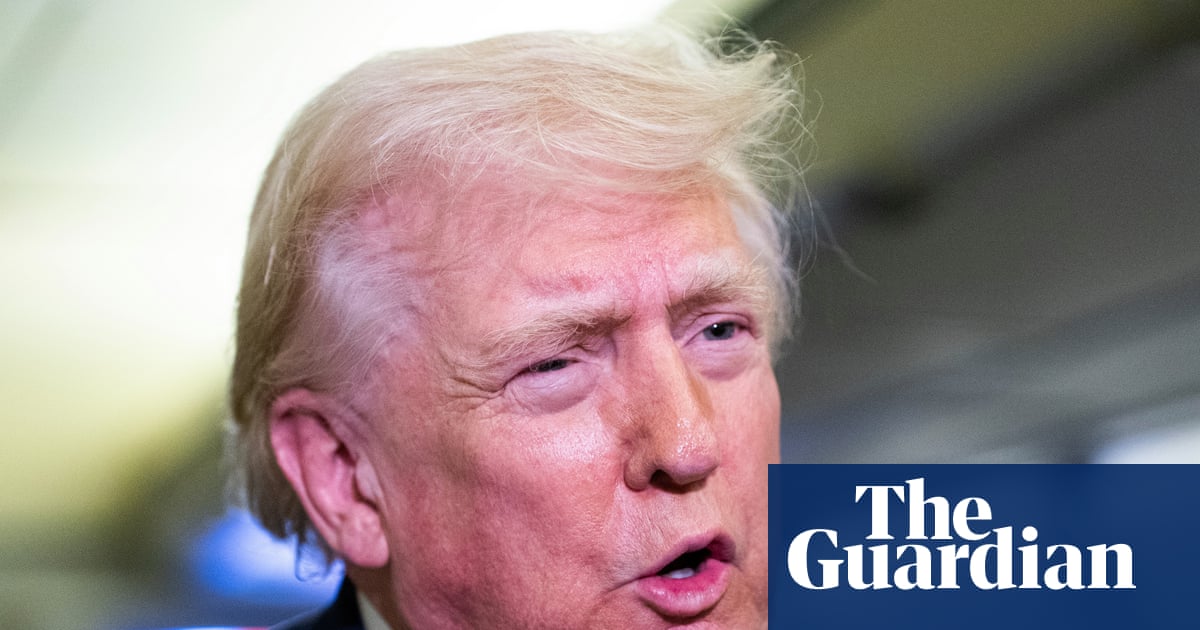
The price of oil hit nearly $117 (£89) a barrel on Monday as Donald Trump threatened to “blow up” and “completely obliterate” Iranian electricity plants, oil wells and its export hub Kharg Island if it did not agree to a deal.
Brent crude rose after Trump wrote on his social media platform Truth Social that if a deal was not agreed and the strait of Hormuz was not reopened, the US would take further action.
He wrote: “We will conclude our lovely ‘stay’ in Iran by blowing up and completely obliterating all of their Electric Generating Plants, Oil Wells and Kharg Island (and possibly all desalinization plants!), which we have purposefully not yet ‘touched’ …
“This will be in retribution for our many soldiers, and others, that Iran has butchered and killed over the old Regime’s 47 year ‘Reign of Terror’.”
The US president threatened to seize the Iranian export hub of Kharg Island in an interview with the Financial Times on Sunday.
Trump said: “To be honest with you, my favourite thing is to take the oil in Iran, but some stupid people back in the US say: ‘Why are you doing that?’ But they’re stupid people.”
“Maybe we take Kharg Island, maybe we don’t. We have a lot of options,” he said.
The oil price rose by 2% to $116.89 a barrel in early trading on Monday – not far off the $119.50 highest level since the US-Israel war with Iran started on 28 February – before later dipping to $112 a barrel. In Europe, stock markets rose slightly, with the European Stoxx 600 index rising by 0.9%. The UK’s blue-chip FTSE 100 share index rose 1.6%.
In the US, the S&P 500 and Dow Jones were up slightly in early afternoon trading on Wall Street. The tech-heavy Nasdaq was roughly flat.
Natural gas prices rose slightly in Europe on Monday. Dutch month-ahead futures rose 1% to €54.70 a megawatt-hour.
In Asia, where economies are highly exposed to the shortage in oil and gas coming out of the Gulf, stock markets dropped sharply before Trump’s latest post. Japan’s Nikkei fell by 2.8%, while the South Korean Kospi dropped 3%. Hong Kong’s Hang Seng index shed about 0.8%.
Investors have grown increasingly nervous as the conflict in the Middle East has escalated in recent days as a further 3,500 US troops have arrived in the Middle East. Houthi rebels in Yemen have now also entered the conflict, firing ballistic missiles at Israeli sites in a dangerous spread of the war that could also worsen the global energy crisis.
“There’s still no sign of a clear end to the conflict, and given the various headlines, investors remain fearful about a fresh escalation,” analysts at Deutsche Bank said.
The war in the Middle East has ramped up oil prices to historic levels, with Brent crude now poised for its biggest monthly gain ever in March – up by 54% – beating the previous record of 46% in September 1990 after Saddam Hussein invaded Kuwait.
The disruption has fed through to prices at the petrol pump. The breakdown company RAC found that average petrol prices in the UK are now at 152p a litre, the highest level in 28 months. Diesel has reached 181.2p a litre, its highest level since December 2022, the RAC said. Industry figures have warned that there could be “temporary shortages” at petrol pumps in the UK.
Keir Starmer was expected to hold talks on Monday afternoon with bosses from Shell, BP and the Norwegian energy company Equinor, as well as executives from the finance, insurance and shipping industries, about the crisis in the Middle East. The UK prime minister was expected to discuss what emergency measures might be needed to contain the crisis from the blockade in the strait of Hormuz.
Brent traded as high as $119.50 a barrel during March, its highest level since June 2022, after Iran all but closed the strait, through which a fifth of global oil and gas would normally pass.
Ipek Ozkardeskaya, a senior analyst at Swissquote, said: “There are bets that crude could rise to $150 and even to the $200 per barrel level if the war doesn’t end quickly. I believe that demand would be heavily hit if prices go that high. Above $120-130 per barrel, global recession odds would take the upper hand and tame upside pressure.”
Aluminium prices jumped more than 5% in Asia after Iran struck aluminium producers in Bahrain and the UAE over the weekend, she added.
Meanwhile, the chancellor, Rachel Reeves, is expected to tell G7 nations that they must move faster on clean energy to insulate economies against global price shocks from oil and gas, as she and the energy secretary, Ed Miliband, virtually meet G7 finance and energy ministers on Monday.
Disclaimer : This story is auto aggregated by a computer programme and has not been created or edited by DOWNTHENEWS. Publisher: theguardian.com







