
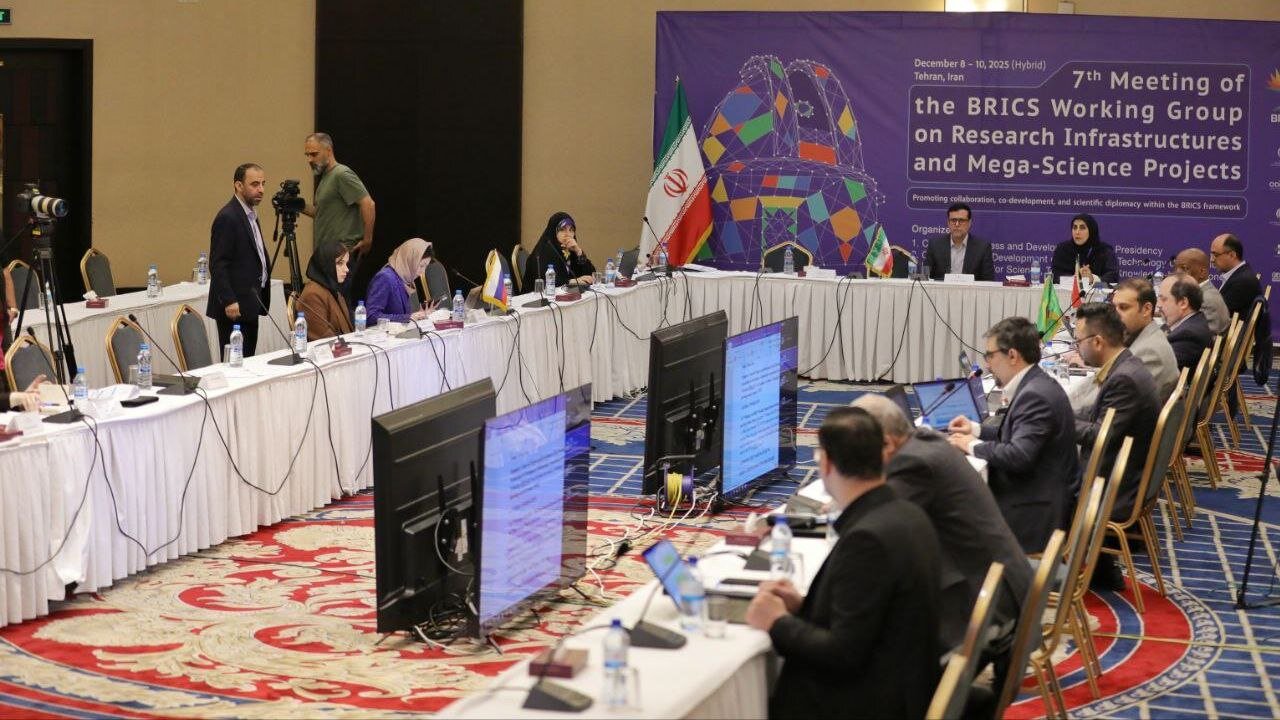
TEHRAN – Hosting the 7th meeting of BRICS working groups on research infrastructures and mega-science projects, Iran has proposed the development of joint scientific infrastructures.
The three-day event was held from December 8 to 10 at the Azadi Hotel in Tehran.
The first proposal was focused on boosting collaborative efforts in large-scale research projects. The country announced its readiness to cooperate with member states in large projects such as developing synchrotrons (particle accelerators) and expanding the Iranian National Observatory, IRNA reported.
The country’s second proposal was to join and connect Iran’s laboratory network to the BRICS laboratory networks to facilitate mutual access to advanced equipment and expertise.
Organized by the Center for Progress and Development Cooperation of the Presidency, serving as the national BRICS focal point for technology and innovation, in collaboration with the Organization for the Development of International Cooperation in Science and Technology, Tehran meeting brought together scientific delegations of BRICS member states including Brazil, China, Egypt, Ethiopia, Indonesia, Russia, India and the UAE, IRNA reported.
The key focus areas of the Tehran meeting included advancing joint research cooperation among BRICS member states, supporting the development of mechanisms for defining and financing mega-science projects, and strengthening the role of research infrastructures as drivers of innovation, sustainable development, and science diplomacy.
The opening ceremony kicked off on Monday with Iranian representatives delivering lectures and expounding on the country’s capacities in research infrastructures and knowledge-based economy. Delegates of other countries presented talks, as well.
The Russian representative provided an account of the previous meeting, held in Russia, detailing discussions, decisions, and approvals.
Next, participating states elaborated their policies, accomplishments, and national plans related to research infrastructures and mega-science projects.
The three-day event proceeded with specialized meetings, exploring opportunities for joint projects and future cooperation.
On the second day, participants made proposals for collaborative programs, strategies, and plans in research infrastructure and scientific mega-projects, and then the cooperation framework document was reviewed and summarized.
To showcase Iran’s scientific and research capabilities and strengthen international collaborations, foreign delegations were planned to pay visits to the country’s advanced scientific centers, including the National Brain Laboratory and the Institute for Basic Sciences.
According to the head of the Organization for the Development of International Cooperation in Science and Technology, Hossein Roozbeh, BRICS is turning into an influential player in the future scientific and technological order, and Iran, relying on its powerful science and technology ecosystem, is expanding its role in infrastructures and mega-science projects of member states.
Iran has a vast capacity for fostering international interactions, sharing knowledge and technology, cooperating in scientific institution-building, and participating in major research projects, the official added.
“Tehran meeting is expected to promote collaborative projects and cooperation in different scientific and technological sectors between the country and BRICS member states.
We aim to take full advantage of this international opportunity, establishing maximum impact on our future scientific cooperation,” Roozbeh further noted.
The BRICS Working Group on Research Infrastructures and Mega-Science Projects provides opportunities for fundamental and applied research that can lead to solutions for shared challenges faced by BRICS and the global community.
The Working Group is also responsible for developing the digital platform “BRICS Global Research Advanced Infrastructure Network (BRICS GRAIN)”, which provides information on more than 30 research infrastructures across BRICS member states in five key fields: energy, nanotechnology, biology, fundamental physics, and astronomy. Overall, facilitating data sharing, enabling access to laboratories, and making this process a core component of BRICS’ collaborative efforts is the main objective of this platform.
MT/MG
Disclaimer : This story is auto aggregated by a computer programme and has not been created or edited by DOWNTHENEWS. Publisher: tehrantimes.com




