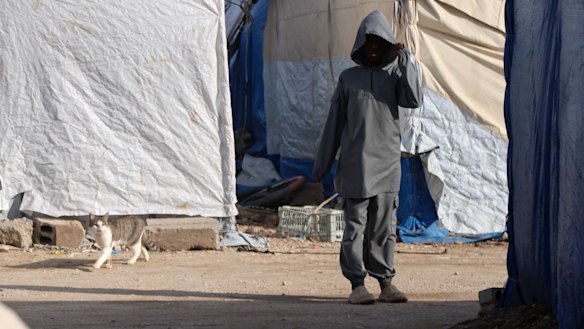
The limbo facing 34 Australian women and children this week as they left the hellhole of Al Roj camp in north-east Syria is deeply disturbing. In recent weeks, we saw the collapse of a system of arbitrary detention enforced for almost seven years by the Syrian Democratic Forces in Northeast Syria, supported by the US-led Global Coalition Against Daesh.
The nearby Al Hol camp, which held at its height more than 40,000 women and children, essentially disappeared overnight. All the arguments made for almost a decade to justify indefinite detention without trial, in conditions that met the standard for torture under international law, were revealed as paper-thin. In Al Roj camp, still under the control of the SDF, conditions are grim, and the future is bleak.
Australian women and kids have been subsisting in flimsy tents, in freezing cold winter conditions, deprived of the most basic necessities for a dignified life. Since the SDF’s broader retreat and a ceasefire agreement with the interim Syrian government, conditions in Al Roj have reportedly worsened. Violence, coercion, theft and extreme mental distress pervade the lives of those who remain detained there. The region remains volatile and insecure.
Al Roj, which Fionnuala visited several years ago, is a place where even the camp authorities acknowledged that the women and children were low security risks, and many of them should never have been detained at all. At the mercy of an armed group in a civil war, there was no legal process for detaining them and no courts to protect them. UN Women issued a report a few months ago, which confirmed what many of us already knew.
Many women, including some Australians, ended up in Syria through complex and often coercive means. Some were the victims of grooming and trafficking. Others were caught under the control of men and families determined to go, and they lacked the power or economic capacity to say no. Those who went voluntarily, played a role in Islamic State, and placed their children at risk, should be met with the full force of the law.
For the Australian kids in the camps, life is cruel and unforgiving. In the group trying to return, 23 of them, or two-thirds, are children. They did not choose to be there. They did not make their bed and lie in it, as Prime Minister Anthony Albanese falsely claimed this week.
Now they are being treated as accomplices to terrorism, simply because of who fathered or birthed them and where they were born. We don’t condemn children to arbitrary detention and torture in Australia just because of the crimes their parents have allegedly committed. No Australian child in Syria should be treated differently. No child deserves this fate. They are victims of terrorism, violence and abuse. Every Australian child deserves the full protection of the Australian authorities.
The Syrian, Iraqi and American governments, which are Australia’s partners in countering terrorism, have consistently asked countries like Australia to live up to their obligations and bring their women and children home. If Australia wants to support the political transition in Syria after the notorious Assad regime, it should bring its nationals home. If Australia wants to live up to its obligations as a good security partner, it should bring its nationals home. If Australia wants to be an advocate for the rights of the child, and be a partner in global efforts to stem trafficking and coercion against women, it should bring its nationals home.
Making these most vulnerable women and children the further victims of violence does not make Australia safer or more secure. It demonstrates a lack of compassion, responsibility and obligation to both security and human rights.
Under Australian and international law, Australian citizens have a right to return home. It is not Syria’s responsibility to indefinitely manage Australians stranded without legal immigration status in Syria. The group already has Australian passports and is ready to travel.
Any security risks posed by individuals can be effectively addressed by Australia’s extensive counter-terrorism laws, including through criminal prosecution, control orders, restrictions following their return under temporary exclusion orders, and surveillance.
Australian authorities have known about the detained Australians for many years and have undoubtedly conducted extensive investigations. There is no genuine reason to continue to exclude them from Australia for further checks. They are not trying to sneak undetected into Australia. While temporary exclusion orders are available to the government, they merely prolong – and do not solve – the problem. No other country is obliged to take Australian citizens with no other nationality. The time to resolve this saga is now.
The experience of the many countries who have repatriated their citizens, including men, is that rehabilitation and reintegration can be done successfully, so that returnees can thrive and become full members of the community. This is true of the Australians who have already returned under previous Coalition and Labor governments. The children will need counselling to address the trauma they have experienced, intensive education to make up for missed schooling, and other support to address their lost childhoods and barriers to their development.
Australia can now show human rights and security leadership by making the humanitarian decision to allow their return. The administrative hurdles of this week on the Syrian side can be easily resolved. We urge Australia to urgently bring these Australian women and children home, not only to protect the human rights of its children and its citizens but also to be a responsible international security partner.
Fionnuala Ni Aolain is a commissioner on the UN Independent Commission of Inquiry on the Syrian Arab Republic. Ben Saul is UN special rapporteur on the promotion and protection of human rights and fundamental freedoms while countering terrorism.
 Fionnuala Ni Aolain is a commissioner on the UN Independent Commission of Inquiry on the Syrian Arab Republic.
 Ben Saul is Challis Chair of International Law at the University of Sydney.
From our partners
Disclaimer : This story is auto aggregated by a computer programme and has not been created or edited by DOWNTHENEWS. Publisher: www.smh.com.au