Updated ,first published
One of the 34 women and children seeking to return to Australia from an internment camp in Syria has been prevented from doing so under an order designed to protect Australians from national security risks.
The orders can apply to any citizen aged from 14, and Home Affairs Minister Tony Burke did not specify whether the individual excluded was one of the 11 women, or a child.
Burke and Prime Minister Anthony Albanese have been under challenge from the Opposition to use these orders to prevent the repatriation of the women who had originally travelled to Syria and lived under the so-called caliphate of Islamic State.
Burke said in a brief statement the order was made on advice from security agencies.
“At this stage security agencies have not provided advice that other members of the cohort meet the required legal thresholds for temporary exclusion orders.”
The regime, put in place under the Morrison government in 2019, can prevent people re-entering Australia for up to two years. The Law Council of Australia says they are to prevent Australians suspected of involvement in terrorism-related activities from returning, allowing for a controlled return or further investigation.
Burke’s brief statement did not say whether this order would apply for the full two years.
The government has adopted a hard line against the proposed family repatration plan, maintaining his insistence that his government is not helping Islamic State-linked families return home, even though Syrian officials confirmed overnight that the women and children have passports issued by Australia.
This masthead revealed on Wednesday that the head of the camp detaining the 34 women and children confirmed the families had presented valid passports. Sources with knowledge of the situation, but who are not authorised to speak publicly, referred to the passports presented at the al-Roj camp as “single-use-only” documents.
In an exclusive interview in Arabic with this masthead, camp boss Hakamia Ibrahim said: “We photographed the families’ passports and made copies. I personally saw the passports and obtained copies of them – this is a security measure.” Authorities in the north-east of Syria have always required valid travel documents before families can be released from the camp.
Requests by this masthead to see the documents were declined.
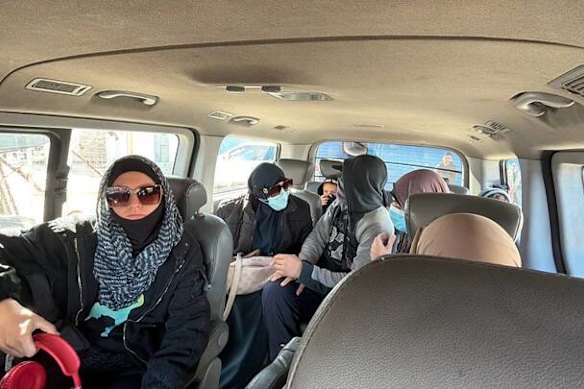
The 11 women and 23 children – all Australian citizens – are trying to get home after their IS-fighter husbands and fathers were imprisoned or killed. They have lived in tents for seven years since the fall of the so-called caliphate in March 2019.
Albanese has for months denied the government has been aiding any Australians to leave Syria, but the issuing of passports to them challenges that narrative.
He insists that issuing a passport, and supporting a family-organised repatriation, does not constitute “assistance”.
“An implementation of Australian law is what is happening,” Albanese told journalists in Tasmania on Wednesday. “We are providing no assistance to these people, and won’t provide any assistance to these people. But we won’t breach Australian law.”
UN special rapporteur on human rights and counterterrorism, Professor Ben Saul, said the prime minister was being “utterly disingenuous” in claiming the government was not helping the women and children, even if it hadn’t been proactively facilitating their return.
“It’s entirely misleading in the sense that, of course, giving somebody a passport is assisting them,” the international law expert said.
“They’re obviously dodging political bullets here because there’s a pretty toxic climate around terrorism post-Bondi.”
The “family repatriation” has been organised by western Sydney doctor Jamal Rifi, a community supporter of Home Affairs Minister Tony Burke in his western Sydney electorate.
Rifi, who is in the Middle East helping facilitate the transfer, has not responded to requests for comment. Burke said in his statement that Rifi had not discussed his plans with the home affairs minister.
“I have no information other than what I’ve seen in the media about whether Dr Jamal Rifi is in Australia or overseas. He has not discussed any plans with me, nor would he have any reason to.”
The Passports Act says passports must be issued to “any Australian who meets eligibility requirements” – requirements that “go to citizenship and identity”, according to senior DFAT officials in answer to parliamentary questions earlier this month.
However, multiple previous requests by the families for their passports have been rebuffed. Albanese has not answered questions about what has changed recently to make it possible.
In north-east Syria, where the group must travel to get home, Albanese’s comments are being reported as the Australian government refusing to repatriate the cohort. Ibrahim also said that, since the women were turned around on the highway and returned to the camp on Monday, it was unclear if they would obtain permission to travel at all.
Opposition defence spokesman James Paterson said temporary exclusion orders should be considered.
“It can keep an Australian citizen offshore for up to two years while a case is built against them so that they can be charged if they ever do choose to return subsequently,” Paterson told Sky News.
“Now it is possible, depending on the individual circumstances of each of these people, that they have committed offences while overseas. It appears that they’re associated with a listed terrorist organisation, ISIS, which is a crime.”
Albanese said the government was taking national security advice about using exclusion orders, a measure to stop citizens deemed to be a security threat from re-entering the country for up to two years.
“We will do what we can to keep Australians safe within the law,” Albanese said. Concerns have been raised about whether the orders are constitutional, though the question has never been tested in the High Court.
Saul said it was unlikely the women’s conduct would reach the legal threshold for the orders to be used.
“Just pointing to past historical ties to ISIS would certainly not be enough,” the challis chair of international law at the University of Sydney said.
“You’ve got to show that the minister suspects, on reasonable grounds, that making the order would substantially assist in preventing a terrorist attack or terrorist training, or support for a terrorist act.”
Opposition home affairs spokesman Jonno Duniam said if the threshold to use the exclusion orders was too high, the law should be changed.
“Why not pick up the phone to the opposition? We need to alter the laws to protect our country, and if that means altering the laws to lower the threshold, then let us know because we need to keep Australia safe. Don’t pretend it’s all out of your control,” Duniam told Sky News.
Ibrahim, the camp director, said the families were devastated that the attempt to bring them home from the camp had, at least temporarily, stalled. “The hopes of the women and children have been shattered.”
Family advocates say the Australian government has known of the identities, status and activities of this cohort for more than a decade in some cases, and they have been extensively investigated by the Australian Federal Police and ASIO since their capture and internment in 2019.
Those who have been returned in 2019 and 2022 have faced minor criminal charges. No convictions have been recorded.
Start the day with a summary of the day’s most important and interesting stories, analysis and insights. Sign up for our Morning Edition newsletter.
 Michael Bachelard is a senior writer and former deputy editor and investigations editor of The Age. He has worked in Canberra, Melbourne and Jakarta, has written two books and won multiple awards for journalism, including the Gold Walkley.Connect via X or email.
 Brittany Busch is a federal politics reporter for The Age and Sydney Morning Herald.Connect via email.
From our partners
Disclaimer : This story is auto aggregated by a computer programme and has not been created or edited by DOWNTHENEWS. Publisher: www.smh.com.au